

A panoramic illustration of Gwalior Fort in Madhya Pradesh, showcasing the magnificent Man Mandir Palace, its colourful decorative tilework and imposing sandstone fortifications overlooking Gwalior city.
Gwalior Fort: History, Architecture, Temples and Visitor Guide
Gwalior Fort, one of India’s most remarkable historic fortresses, stands on a massive sandstone hill overlooking the city of Gwalior in Madhya Pradesh. Known for its imposing defensive walls, magnificent palaces, ancient temples and beautifully carved sculptures, the fort offers an extraordinary journey through centuries of Indian history.
Often described as the “pearl amongst the fortresses of Hind,” a phrase attributed to Mughal Emperor Babur, Gwalior Fort has witnessed the rise and fall of several powerful dynasties.
Its monuments reflect the cultural and architectural influences of the Rajputs, Delhi Sultanate, Mughals, Marathas and other rulers who controlled this strategically important stronghold.
Today, visitors can explore the colourful Man Mandir Palace, the historic Gujari Mahal, impressive Hindu temples, monumental Jain sculptures and Gurudwara Data Bandi Chhor Sahib.
This guide explores the history of Gwalior Fort, its major attractions, architecture, visiting arrangements and practical information for planning a memorable trip.
Where Is Gwalior Fort Located?
Gwalior Fort stands on an isolated sandstone plateau above Gwalior city in northern Madhya Pradesh, India.
The fortress rises approximately 100 metres above the surrounding urban landscape, making it one of the city’s most prominent landmarks.
Its extensive defensive walls follow the natural contours of the hill, creating a formidable fortified complex with sweeping views across Gwalior.
Historically, the hill has been associated with names such as Gopagiri and Gopachal.
The fort’s elevated position helped successive rulers monitor surrounding territory and protect the approaches to the city.
Unlike a conventional palace complex, Gwalior Fort contains several distinct historic structures constructed during different periods.
These include royal residences, temples, gateways, water reservoirs, religious monuments and defensive fortifications.
History of Gwalior Fort
The history of Gwalior Fort stretches back more than a thousand years, although its precise foundation date remains uncertain.
Historical records indicate that the hill was an important fortified and religious site by the early medieval period.
The fortress developed gradually under different rulers, who constructed palaces, temples, gateways and defensive structures over several centuries.
Early History and the Legend of Suraj Sen
One of Gwalior’s best-known legends concerns a local ruler named Suraj Sen and a sage known as Gwalipa.
According to the traditional story, Suraj Sen suffered from a serious illness. During his travels, he encountered the sage, who directed him to drink from and bathe in a nearby water source.
The ruler reportedly recovered and, in gratitude, established a fortified settlement associated with the sage’s name.
The tradition also connects the story with Suraj Kund, a historic water reservoir within the fort complex.
Although this legend remains an important part of Gwalior’s cultural identity, it should not be treated as a verified account of the fort’s construction.
Archaeological and inscriptional evidence points to a much longer history.
A sixth-century inscription associated with the region refers to the rule of Mihirakula, while later inscriptions provide evidence of early medieval religious activity.
The present fortress therefore represents several phases of construction rather than one building project completed during a single reign.
The Rajput Dynasties and the Tomar Period
Gwalior became an important regional stronghold under successive Hindu ruling dynasties.
Among them, the Tomars played a particularly significant role in shaping the fort’s surviving architecture.
The Tomar rulers controlled Gwalior during the late medieval period, with Raja Man Singh Tomar emerging as one of the most influential figures.
Man Singh Tomar ruled from 1486 to 1516 and commissioned major architectural projects, including the celebrated Man Mandir Palace.
His reign is also associated with the development of music, literature and courtly culture.
The Tomar period left an enduring architectural legacy, particularly through elaborate stone carvings, colourful glazed tiles and monumental palace construction.
The Delhi Sultanate and Mughal Period
The fort’s strategic location attracted repeated military campaigns.
Gwalior came under the influence or control of several rulers associated with the Delhi Sultanate, including Qutb-ud-din Aibak and Iltutmish.
Following the decline of Tomar power, the Lodis gained control of the fortress during the early 16th century.
The establishment of Mughal power in northern India brought further political changes.
Babur recognised the fort’s remarkable position and architecture, while later Mughal rulers used it for military and administrative purposes.
During parts of the Mughal period, the fortress also served as a prison for important political figures.
Several of its older palace chambers became associated with royal imprisonment.
The Mughal period forms an important chapter in the fort’s history, although many of the surviving buildings predate Mughal rule.
Maratha, Scindia and British Influence
As Mughal authority declined during the 18th century, Gwalior became an important centre of Maratha power.
The Scindia dynasty, also known as the Shinde family, emerged as a major political force in central India.
Control of Gwalior Fort changed during conflicts involving the Scindias, the Jat rulers of Gohad and British forces.
The fortress also played a role in the upheavals of 1857–1858.
Rani Lakshmibai of Jhansi fought British forces near Gwalior and died in June 1858, becoming one of the most celebrated figures associated with India’s uprising against colonial rule.
During the later colonial period, the fort’s political and military importance continued, while the Scindia family retained its association with the princely state of Gwalior.
After Indian independence, Gwalior became part of the Indian Union.
Today, the fort’s historic monuments are protected and managed through archaeological and heritage authorities.
Architecture and Structure of Gwalior Fort
Gwalior Fort is particularly notable for the relationship between its natural setting and monumental architecture.
Its builders used the steep sandstone hill as a defensive advantage, positioning walls and gateways along the elevated plateau.
The fortress contains massive stone ramparts, bastions, courtyards, palaces and temple complexes.
The exterior walls rise dramatically above the surrounding city, while the interior contains buildings representing different periods and architectural traditions.
Several structures display intricate stone latticework, carved pillars, ornamental brackets and decorative tilework.
The most famous example is Man Mandir Palace, whose colourful exterior contrasts with the otherwise imposing sandstone walls.
Gwalior Fort also preserves examples of Hindu temple architecture, Jain religious sculpture, Indo-Islamic architectural influences and Sikh heritage.
This diversity makes the fort particularly rewarding for travellers interested in architecture and cultural history.
Major Attractions Inside Gwalior Fort
1. Man Mandir Palace – The Architectural Highlight
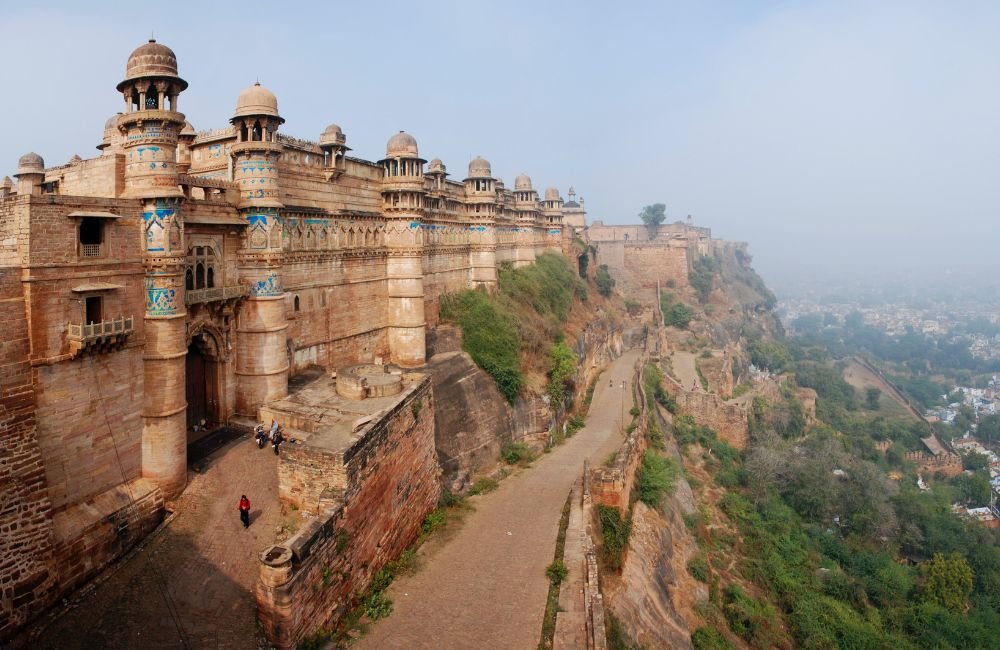
The magnificent Gwalior Fort and Man Mandir Palace stand above the city, showcasing historic sandstone architecture and distinctive blue tile decorations.
Man Mandir Palace, also known as Man Singh Palace, is among the most recognisable monuments within Gwalior Fort.
Constructed during the reign of Raja Man Singh Tomar between 1486 and 1516, the palace represents an important achievement of late medieval Rajput architecture.
Its exterior walls feature distinctive blue, yellow and green glazed tiles arranged in decorative patterns.
The ornamentation includes geometric designs, floral motifs and representations of animals.
Elaborate stone balconies, lattice screens and projecting architectural details add to the palace’s appearance.
Inside, visitors can explore courtyards, chambers and surviving architectural features that offer a glimpse into royal life during the Tomar period.
The palace also contains underground chambers that became associated with imprisonment during later centuries.
For travellers interested in photography, the decorated exterior is one of the fort’s most memorable sights.
2. Gujari Mahal – Palace of Queen Mrignayani

Gujari Mahal, built by Raja Man Singh Tomar for Queen Mrignayani, now houses an archaeological museum showcasing historic sculptures and artefacts in Gwalior, Madhya Pradesh.
Gujari Mahal was built by Raja Man Singh Tomar for his queen, Mrignayani.
According to local tradition, the queen came from a Gujar background and wanted a separate residence that suited her preferences.
The resulting palace became one of the distinctive architectural achievements of the Tomar period.
Gujari Mahal stands on the lower eastern side of the fort complex.
Its sturdy sandstone construction reflects both royal accommodation requirements and the defensive character of the surrounding fortress.
Today, Gujari Mahal houses an archaeological museum.
The museum’s collections include historic sculptures, coins, pottery and other objects associated with the region’s cultural heritage.
Among its celebrated antiquities is the Shalabhanjika sculpture from Gyaraspur, although access to individual objects may depend on museum arrangements.
The museum is particularly worthwhile for visitors interested in understanding the artistic traditions of central India.
3. Teli Ka Mandir – An Ancient Temple
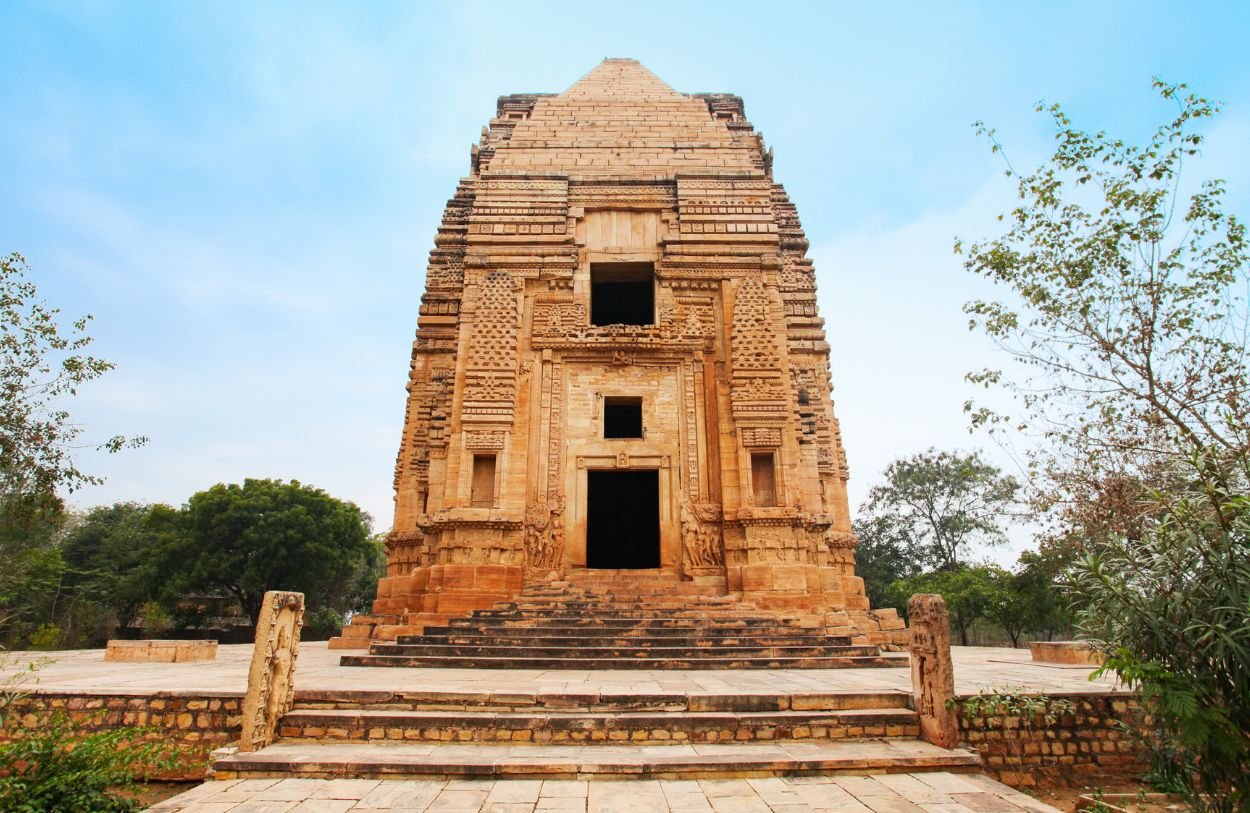
Teli Ka Mandir, also known as Teli Ka Temple, is a historic architectural landmark within Gwalior Fort, renowned for its towering structure and intricate sandstone carvings.
Teli Ka Mandir is one of the oldest surviving architectural monuments within Gwalior Fort.
Generally dated to around the ninth century, the temple rises approximately 30 metres above its surroundings.
Its unusual design combines architectural features associated with different Indian temple-building traditions.
The tall temple structure, decorative entrance and sculptural details distinguish it from many other monuments within the fortress.
The temple has historical associations with Hindu worship, although accounts differ regarding its original dedication.
Its name is commonly translated as the Oilman’s Temple, but several traditions attempt to explain the origin of this designation.
Visitors can admire its monumental proportions, carved architectural elements and distinctive roof profile.
For architecture enthusiasts, Teli Ka Mandir provides an important example of early medieval temple construction.
4. Sas Bahu Temples – Intricate Stone Carvings

The historic Sas Bahu Temples within Gwalior Fort showcase exquisite sandstone carvings and medieval Indian temple architecture in Madhya Pradesh.
The Sas Bahu Temples are another major attraction within Gwalior Fort.
Despite their popular name, which translates literally as mother-in-law and daughter-in-law, the temples are traditionally associated with the name Sahasrabahu, an epithet of Lord Vishnu.
The two temple structures date to the medieval period, principally the 11th century.
The larger temple is associated with Vishnu, while the smaller temple has associations with Shiva.
Both feature elaborate sandstone carvings, sculpted pillars and decorative architectural details.
Visitors can examine the surviving ornamentation, including floral patterns, figures and geometric designs.
Their elevated position also provides impressive views of the surrounding city.
The Sas Bahu Temples are especially appealing to visitors interested in medieval Indian sculpture and temple architecture.
5. Chaturbhuj Temple – A Historic Inscription of Zero
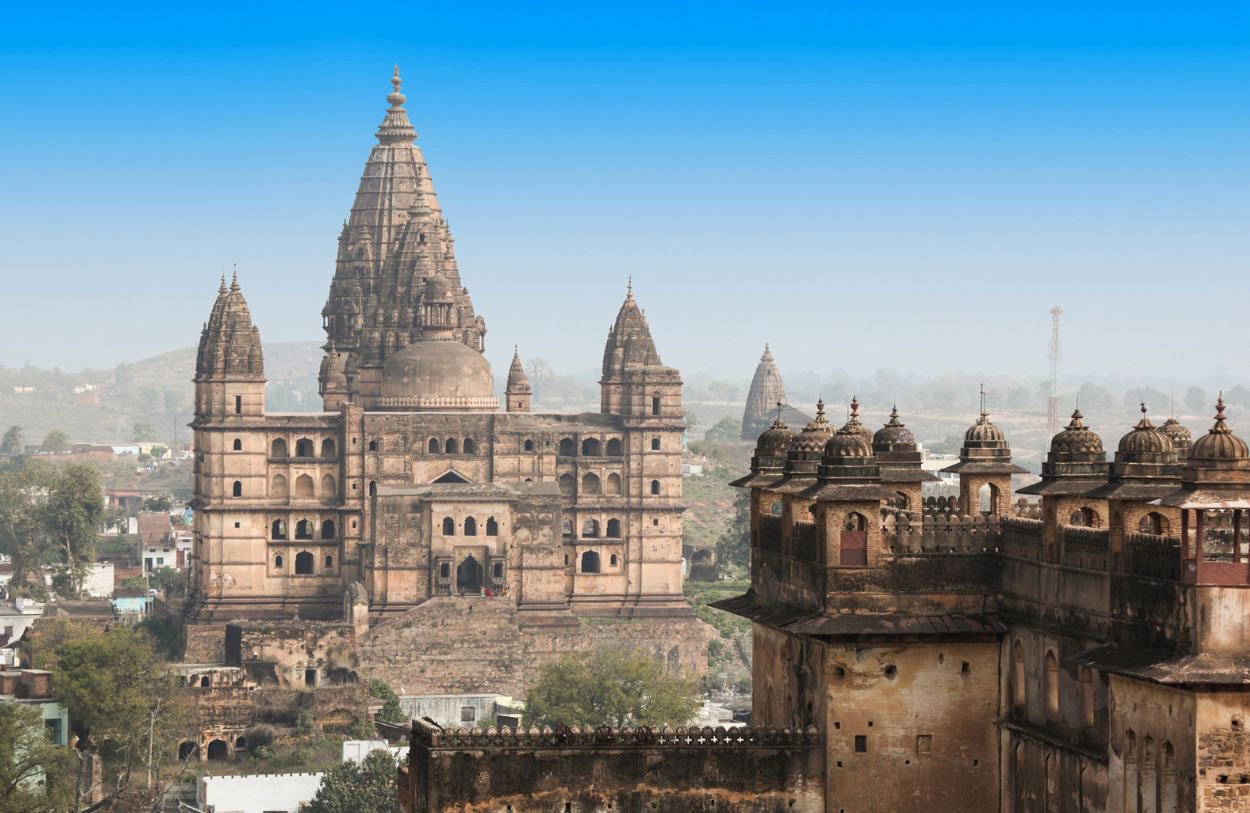
The magnificent Chaturbhuj Temple in Orchha, Madhya Pradesh, renowned for its towering spires, monumental stone architecture and Bundela heritage.
The Chaturbhuj Temple occupies an important place in the history of mathematics as well as Indian religious architecture.
Situated along the eastern approach to Gwalior Fort, the temple is dedicated to Lord Vishnu.
Its inscriptions date to the ninth century, including records from around 875–876 CE.
The temple is famous for an early recorded use of the numeral zero in a mathematical context.
This inscription provides significant evidence of the historical development and use of numerical notation in India.
However, it is more accurate to describe it as one of the earliest surviving recorded examples of zero rather than claiming that the concept originated at this specific temple.
Visitors interested in mathematics, archaeology and ancient Indian learning may find the temple particularly fascinating.
Because it lies along a steep approach to the fortress, access may require additional walking.
6. Jain Rock-Cut Sculptures – Monumental Religious Art

Beautiful rock-cut Jain Tirthankara sculptures at Gopachal Hills, Gwalior, showcasing the city’s remarkable Jain heritage and ancient stone-carving traditions.
The steep rock faces surrounding Gwalior Fort contain impressive Jain sculptures carved directly into the hillside.
Many of these figures were created during the 15th century under Tomar patronage.
The carvings represent Jain Tirthankaras in standing and seated positions.
Some figures are monumental in scale, forming striking compositions against the sandstone cliffs.
Important groups are found near the Urwahi approach and around Gopachal Parvat.
The sculptures demonstrate the craftsmanship of medieval stoneworkers and the importance of Jain religious traditions in the region.
Visitors approaching the fort through the Urwahi route may encounter some of these remarkable carvings along the ascent.
The area is both a heritage attraction and a place of religious significance.
7. Gurudwara Data Bandi Chhor Sahib
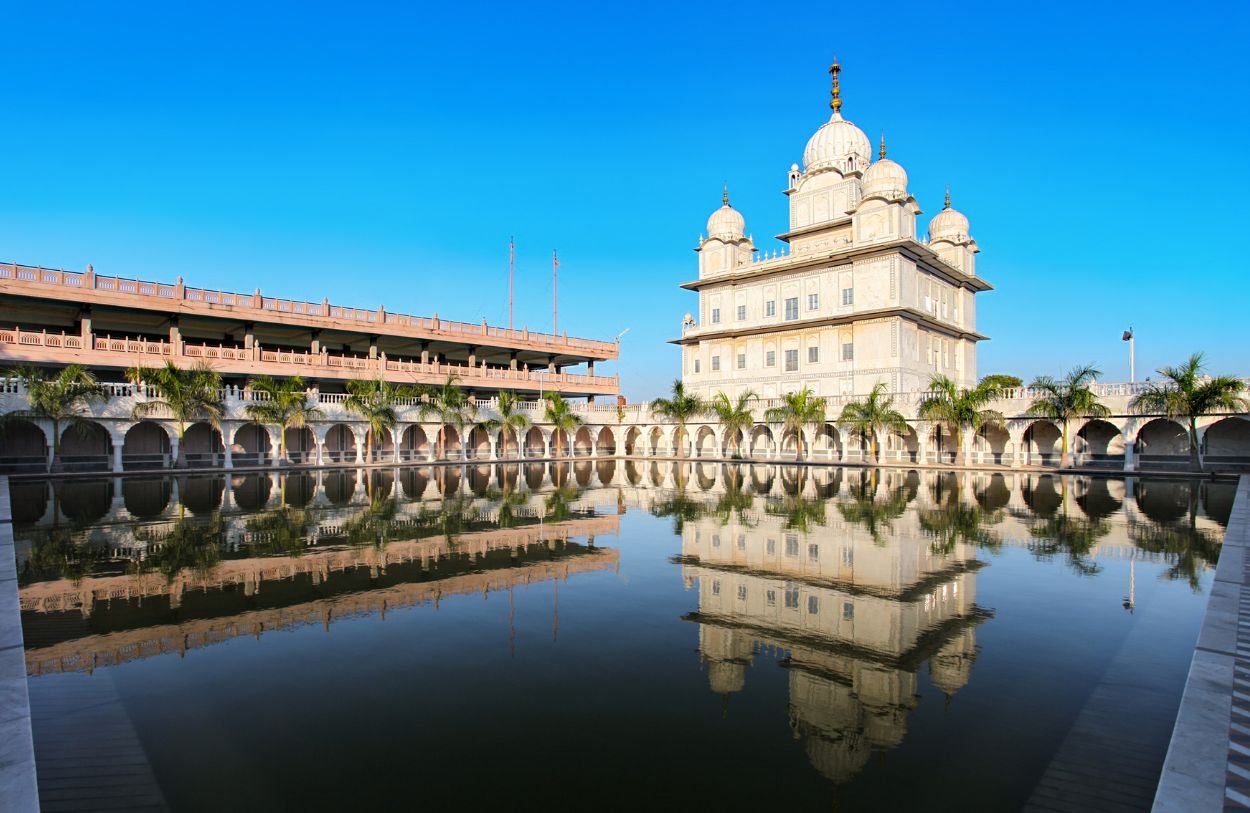
A beautiful view of Gurudwara Data Bandi Chhod Sahib within Gwalior Fort, featuring its magnificent white domes, peaceful water reflections and traditional Sikh religious architecture.
Gurudwara Data Bandi Chhor Sahib is an important Sikh pilgrimage site within the Gwalior Fort complex.
The shrine commemorates Guru Hargobind Sahib, the sixth Sikh Guru, who was imprisoned at Gwalior Fort during the reign of Mughal Emperor Jahangir.
According to Sikh tradition, Guru Hargobind secured his release along with 52 imprisoned princes.
This event gave rise to the title Bandi Chhor, meaning liberator of prisoners.
The episode is commemorated through Bandi Chhor Divas, an important observance in Sikh tradition.
The gurudwara is a place of worship and remembrance, welcoming devotees and visitors.
Those entering should dress respectfully, cover their heads and observe the religious customs of the premises.
8. Other Historic Palaces and Structures
Gwalior Fort contains several additional monuments that reflect its long political history.
These include:
- Karan Mahal: Associated with the Tomar ruler Kirti Singh and the development of the royal palace complex.
- Vikram Mahal: Connected with Vikramaditya Tomar, a successor of Raja Man Singh Tomar.
- Jahangir Mahal: A palace associated with later Sultanate and Mughal-period developments.
- Shah Jahan Mahal: A Mughal-era structure reflecting later architectural influences.
- Historic reservoirs: Water-storage structures that supported the fortress during periods of occupation and conflict.
- Suraj Kund: A reservoir associated with the traditional story of Suraj Sen and the origins of Gwalior.
Visitors with a particular interest in history should allow additional time to explore these less prominent structures.
Is Gwalior Fort a UNESCO World Heritage Site?
Gwalior Fort is included on India’s UNESCO World Heritage Tentative List, but it is not currently an inscribed UNESCO World Heritage Site.
Its Tentative List entry recognises the fort’s architectural diversity, defensive setting and long association with different political and religious traditions.
The proposed heritage value includes its palaces, Hindu temples, Jain sculptures, gateways and historical significance.
A Tentative List entry indicates that a country may consider a property for future nomination. It does not mean that UNESCO has already granted World Heritage status.
Gwalior Fort Sound and Light Show
Visitors interested in learning about the fortress’s history through an evening presentation may consider the Gwalior Fort sound-and-light show.
The programme uses narration, lighting and historic storytelling to introduce the fort’s past.
It is staged within the fort complex and focuses on important episodes associated with Gwalior’s rulers and cultural heritage.
Hindi and English presentations are generally offered, with schedules changing by season.
The evening show requires separate planning from ordinary daytime sightseeing.
Check Madhya Pradesh Tourism’s official information for the current schedule, tickets and operating arrangements before visiting.
Gwalior Fort Entry Fee and Visiting Hours
Planning ahead helps visitors explore the fort comfortably.
Visiting Hours
Incredible India lists the general fort visiting hours as:
6:00 AM to 5:30 PM
However, opening arrangements can vary between individual monuments, museums and religious sites.
Visitors should confirm current access conditions before their journey.
The evening sound-and-light show operates separately from regular monument visiting hours.
Entry Fees
Some monuments within Gwalior Fort require admission tickets.
Different parts of the fort fall under the Archaeological Survey of India and Madhya Pradesh’s state archaeological administration, so more than one ticket arrangement may apply.
Museum admission and evening show tickets may also be separate.
Check official ticketing information at the entrance or through the relevant heritage authority before visiting.
Do not assume that a single ticket includes every palace, museum and event.
How Much Time Do You Need?
For most visitors, allowing at least three to four hours is a sensible starting point for exploring the fort’s principal attractions.
A longer visit may be appropriate if you want to examine the temples, archaeological museum, Jain sculptures and additional palace structures.
The complex is extensive, and some attractions are separated by considerable walking distances.
Best Time to Visit Gwalior Fort
The most comfortable time to explore Gwalior Fort is generally between October and March.
During these months, temperatures are usually more suitable for walking around the exposed stone structures and elevated pathways.
October to March
The cooler season is particularly suitable for architecture photography, historical sightseeing and exploring the larger fort complex.
Morning visits often provide pleasant light for photographing Man Mandir Palace and the surrounding landscape.
April to June
Summer temperatures in Gwalior can become extremely high.
Visitors should avoid prolonged exposure during the hottest part of the day.
Carry sufficient drinking water and plan outdoor sightseeing carefully.
July to September
The monsoon season can bring greener surroundings and occasional rainfall.
However, stone steps and historic pathways may become slippery.
Wear footwear with suitable grip and avoid restricted or hazardous areas during wet conditions.
How to Reach Gwalior Fort
By Air
Gwalior is served by Rajmata Vijayaraje Scindia Airport.
Flight availability and routes vary, so check current airline schedules before planning your journey.
From the airport, visitors can arrange road transport towards the city and fort.
By Train
Gwalior Junction is an important railway station with connections to several major Indian cities.
Rail travel is a practical option for visitors arriving from Delhi, Agra, Jhansi and other destinations.
Check train schedules and availability through Indian Railways’ official booking and enquiry services.
By Road
Gwalior is connected to surrounding cities through the regional road network.
Travellers can reach the city by private vehicle, taxi or available intercity transport.
The fort has two principal visitor approaches:
- Qila Gate: An eastern approach commonly used by pedestrians.
- Urwahi Gate: A western approach accessible by vehicle through a winding road.
The eastern route involves a steeper climb, while the Urwahi approach is generally more convenient for visitors arriving by car.
Confirm current vehicle restrictions and parking arrangements locally.
Suggested One-Day Gwalior Fort Itinerary
Visitors who have one full day in Gwalior can combine the fort’s major monuments with nearby city attractions.
Morning: Explore the Fort’s Main Monuments
Begin early to avoid the strongest midday heat.
Start with Man Mandir Palace and admire its distinctive colourful exterior.
Continue to the Sas Bahu Temples and Teli Ka Mandir.
Allow time to explore their sculptures and architectural details.
Late Morning: Discover Religious and Historic Sites
Visit Gurudwara Data Bandi Chhor Sahib and discover its connection with Guru Hargobind.
If your route permits, explore the Jain rock-cut sculptures or the Chaturbhuj Temple.
Remember that the fort covers a large area, so plan your movement according to the entrance you use.
Afternoon: Visit Gujari Mahal
Explore the Gujari Mahal Archaeological Museum, subject to its visiting arrangements.
The museum provides additional historical context through sculptures and archaeological collections.
Afterwards, consider visiting Jai Vilas Palace Museum elsewhere in Gwalior if time allows.
Evening: Experience the Sound and Light Show
If the show is operating, return to the fort for the evening presentation.
Reserve or purchase the appropriate ticket and confirm the showtime beforehand.
Other Places to Visit Near Gwalior Fort
Gwalior has several important attractions beyond the fortress itself.
Jai Vilas Palace Museum
Jai Vilas Palace is associated with the Scindia royal family and is known for its grand European-influenced architecture.
Parts of the palace house the Jiwajirao Scindia Museum, which displays historic objects, royal furnishings and other collections.
Tomb of Tansen
The tomb of Tansen commemorates one of the most celebrated musicians of the Mughal court.
Gwalior’s rich classical music traditions make this an important cultural destination.
Tomb of Muhammad Ghaus
The tomb of the Sufi saint Muhammad Ghaus is known for its architectural design and delicate stone latticework.
It stands near the Tomb of Tansen.
Rani Lakshmibai Memorial
The memorial commemorates Rani Lakshmibai of Jhansi, who died fighting British forces during the 1858 campaign near Gwalior.
It is an important historic site associated with the struggle against colonial rule.
Sun Temple
Gwalior’s modern Sun Temple, also known as Surya Mandir, draws architectural inspiration from the famous Konark Sun Temple in Odisha.
It offers another cultural and religious stop for visitors exploring the city.
Practical Tips for Visiting Gwalior Fort
A few precautions can make your visit more comfortable.
- Wear comfortable footwear. Stone pathways, uneven surfaces and steps are common throughout the complex.
- Carry drinking water. Some parts of the fort provide limited shade.
- Start early. Morning sightseeing is generally more comfortable during warmer months.
- Respect protected monuments. Avoid touching delicate carvings, damaging surfaces or entering restricted chambers.
- Check photography rules. Ordinary photography is generally permitted at protected monuments, but tripods, professional lighting and commercial filming may require authorisation.
- Consider a knowledgeable guide. Historical interpretation can help distinguish documented events from local legends.
- Plan your route. Some major attractions are located on different sides of the fort and hillside.
- Respect religious customs. Follow dress, footwear and head-covering requirements at places of worship.
Travellers with limited mobility should check accessibility carefully because the historic hilltop setting includes steep approaches, stairs and uneven ground.
Frequently Asked Questions About Gwalior Fort
Who built Gwalior Fort?
Gwalior Fort developed over several centuries under different rulers. Its early origins are associated with the legend of Suraj Sen, while the surviving structures reflect construction during multiple historical periods. Raja Man Singh Tomar commissioned major palace buildings in the late 15th and early 16th centuries.
How old is Gwalior Fort?
The fortified hill has a history extending back more than a thousand years. Early historical evidence dates to around the sixth century, although the present fort includes structures built much later.
What is Gwalior Fort famous for?
Gwalior Fort is famous for its imposing sandstone fortifications, the colourful Man Mandir Palace, Gujari Mahal, ancient temples, monumental Jain sculptures and its association with important historical dynasties.
Where is Gwalior Fort located?
Gwalior Fort is located on a sandstone hill overlooking Gwalior city in Madhya Pradesh, India.
What is the best time to visit Gwalior Fort?
October to March is generally the most comfortable period for sightseeing. The cooler weather makes walking around the extensive fort complex more enjoyable.
Is Gwalior Fort a UNESCO World Heritage Site?
No. Gwalior Fort is currently included on India’s UNESCO World Heritage Tentative List, not the official World Heritage List.
Why is Chaturbhuj Temple famous?
Chaturbhuj Temple is famous for its ninth-century inscription containing an early recorded example of the numeral zero, making it an important site in the history of mathematics.
Can tourists visit Gwalior Fort in one day?
Yes. Visitors can explore the principal palaces, temples and other important attractions in one day. However, a longer visit allows more time for museums, sculptures and nearby historic sites.
Final Thoughts
Gwalior Fort is more than an imposing hilltop fortress. It is a remarkable collection of palaces, temples, religious monuments and historical structures that reveal the cultural development of central India over many centuries.
From the colourful architecture of Man Mandir Palace to the ancient sculptures of the Jain rock-cut complexes, every major attraction offers a different perspective on the region’s history.
For travellers interested in Indian heritage, architecture, religion and history, Gwalior Fort remains one of Madhya Pradesh’s most rewarding destinations.
