
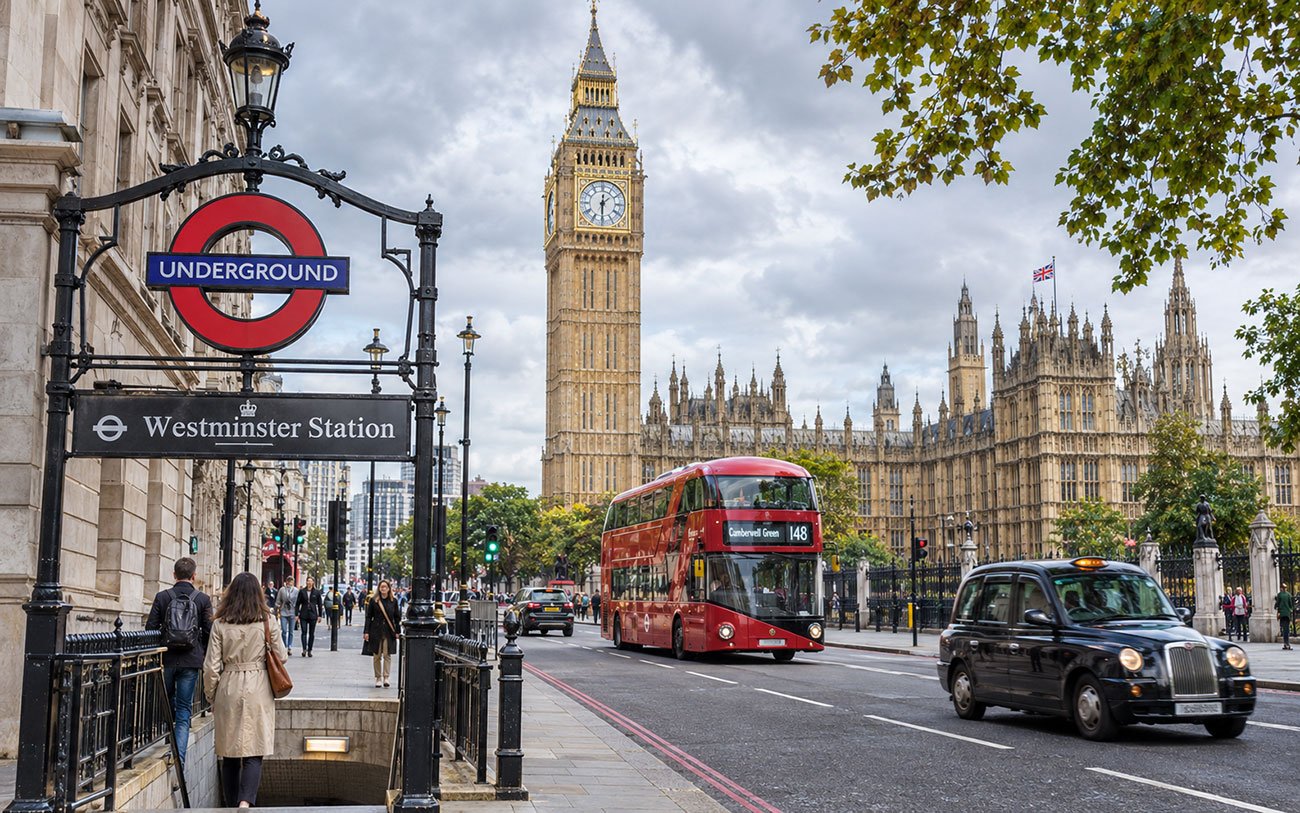
London’s Underground, iconic red buses and black cabs offer convenient ways to explore the city for the first time.
Getting Around London for the First Time: Transport, Maps and Local Tips
London can feel overwhelming when you first arrive. Its historic streets, busy railway stations and extensive transport network may seem complicated. Fortunately, getting around London is easier than many first-time visitors expect.
The simplest approach is to combine public transport with walking. Use the London Underground, Elizabeth line or other trains for longer journeys, take buses when you want to see the streets, and explore nearby attractions on foot.
You can pay for most journeys with a contactless bank card, mobile payment device or Oyster card. There is usually no need to buy a separate ticket for every journey.
This guide explains how to navigate London, choose the right transport, understand fares and avoid common mistakes during your first visit.
Understanding London’s Layout Before You Travel
London is a large city made up of distinctive neighbourhoods. Knowing where its main attractions are located will make your journey planning much easier.
Many popular sights are concentrated in central London, particularly around Westminster, the West End, South Bank and the historic City of London.
Some useful areas to recognise include:
- Westminster: Home to Big Ben, the Houses of Parliament, Westminster Abbey and Buckingham Palace.
- West End: Includes Covent Garden, Soho, Leicester Square, Piccadilly Circus and major shopping streets.
- South Bank and Bankside: Known for the London Eye, riverside walks, Tate Modern and Shakespeare’s Globe.
- City of London: The historic financial district, with St Paul’s Cathedral and several important historic landmarks.
- Tower Hill: A convenient area for visiting the Tower of London and Tower Bridge.
- Camden: Popular for its markets, independent shops and music scene.
- Greenwich: Known for maritime history, Greenwich Park and the Royal Observatory.
The City of London is only one part of the wider capital. When planning a holiday, you will probably spend time in several London boroughs.
Most importantly, do not assume that every journey requires a train. Many central attractions are close enough to explore on foot.
How to Find Your Way Around London
Before setting out, identify your destination, the nearest station and the best route from your accommodation.
London has an extensive network of public transport, but a little advance planning can save considerable time.
Use the Official TfL Go App
Transport for London (TfL) operates an official journey-planning app called TfL Go.
It helps visitors navigate the capital using the Underground, buses, Elizabeth line, Docklands Light Railway (DLR) and London Overground.
You can use it to:
- Plan journeys between stations, attractions and addresses.
- Compare travel routes and connections.
- Find nearby stations and bus stops.
- Check live arrival information.
- View service disruptions and planned closures.
- Identify routes with step-free access.
The app is particularly useful when engineering work affects your usual route.
You can also use the journey planner on the Transport for London website.
Download a London Transport Map
A London Underground map is an essential reference for first-time visitors.
The familiar Tube map uses different colours to identify railway lines. It also shows stations where passengers can change between services.
However, the Tube map is a diagram rather than a geographically accurate street map. Two stations that appear far apart may be within easy walking distance.
Download a transport map before travelling and keep an offline street map available on your phone.
Look for Street Maps and Direction Signs
You do not need to rely entirely on your phone.
Many parts of London have pedestrian information signs known as Legible London. These provide local maps, walking routes and estimated walking times.
You will also find maps at stations and other transport locations.
If you become confused, stop somewhere safe, check your route or ask a member of station staff for assistance.
Getting Around London by Underground
The London Underground, commonly called the Tube, is one of the most useful ways to travel around the capital.
Its network connects central London with residential neighbourhoods, shopping districts, railway terminals and major attractions.
For visitors moving between different parts of the city, it is often a convenient choice.
How to Use the London Underground
Using the Tube is straightforward once you understand the basics.
- Find your nearest Underground station.
- Check which line serves your destination.
- Identify the direction of travel using the destination shown on platform signs.
- Touch your payment card or Oyster card on the yellow reader when entering.
- Follow signs to the correct platform.
- Change lines at an interchange station if necessary.
- Touch out with the same card or device when leaving the station.
Always check the train’s destination before boarding. Some lines have branches, and not every train serves every station shown on the line.
Large interchange stations can involve lengthy walks between platforms. Allow extra time if you have luggage or mobility requirements.
Other Rail Services You Should Know
The Underground is not London’s only urban railway.
Elizabeth line
The Elizabeth line provides east-west connections across London, including Heathrow Airport, Paddington, Bond Street, Tottenham Court Road, Farringdon, Liverpool Street and Canary Wharf.
It is particularly useful when travelling between the airport, central London and destinations further east.
London Overground
London Overground connects many neighbourhoods beyond the central Underground network. It can be useful when visiting areas outside the usual tourist districts.
Docklands Light Railway (DLR)
The DLR serves parts of east and southeast London, including Canary Wharf, Greenwich connections and London City Airport.
National Rail
Mainline and suburban trains connect London with surrounding towns, airports and destinations elsewhere in Britain.
Many London rail journeys accept contactless payment, although coverage and ticketing rules vary by route.
Underground Etiquette for First-Time Visitors
London’s transport network can become crowded, particularly during commuting periods.
A few simple habits make journeys easier:
- Stand on the right side of escalators and leave the left side clear for people walking past.
- Allow passengers to leave the train before boarding.
- Move away from train doors when space is available.
- Keep large bags out of walkways.
- Follow staff instructions and platform announcements.
- Avoid blocking ticket gates while checking your phone.
If you have heavy luggage, consider travelling outside the busiest commuting periods.
How to Pay for Public Transport in London
Understanding London’s payment system is one of the most important parts of planning your first visit.
For most adult visitors, pay-as-you-go travel using contactless or Oyster is the easiest option.
Contactless Cards, Oyster Cards and Travelcards
| Payment method | How it works | Best suited for |
|---|---|---|
| Contactless card or device | Touch in and out using a compatible debit card, credit card, phone or watch | Most adult visitors |
| Oyster card | Add travel credit to a reusable TfL smartcard | Visitors without a compatible contactless card or those needing certain discounts |
| Visitor Oyster card | A prepaid Oyster card available before travelling | Visitors who prefer to arrange a travel card in advance |
| Travelcard | Provides travel within specified zones and validity periods | Travellers whose circumstances make a fixed-period ticket worthwhile |
Contactless payments and Oyster cards benefit from automatic fare capping on eligible journeys.
This means you do not necessarily need to purchase a Day Travelcard before exploring London.
How Daily and Weekly Fare Caps Work
Fare capping automatically limits the amount you pay for eligible journeys.
A daily cap applies to journeys made within TfL’s travel day, which runs from 4:30 am to 4:29 am the following morning.
Weekly capping operates from Monday to Sunday.
The amount depends on the zones and services used.
For example, if you make several Underground journeys within central London, your eligible fares will count towards the applicable daily cap.
Once the cap is reached, additional eligible journeys within the covered zones will not increase your fare.
Important: Always use the same card or payment device throughout your journeys.
A physical bank card, the same card stored on your phone and a payment watch can be treated as different payment methods. Mixing them may prevent your journeys from counting towards the same cap.
Airport express trains, river services and certain other journeys may have separate fares or may not count towards normal caps.
Understanding London’s Travel Zones
London’s rail fare system uses geographical zones.
Zones 1 and 2 cover many of the areas tourists visit most frequently.
Attractions and accommodation further away may fall within higher-numbered zones.
Heathrow Airport, for example, is in Zone 6 on the Underground network.
The zones you travel through can affect your fare. Use TfL’s Single Fare Finder to check a particular journey rather than assuming that every train trip costs the same.
Can International Visitors Use Contactless Cards?
Many contactless bank cards issued outside the United Kingdom work on London’s transport network.
However, not every overseas card is accepted. Your bank may also charge international transaction fees.
Before travelling, check that your card supports overseas contactless payments.
If your card is unsuitable, an Oyster card is a practical alternative.
Travelling with Children
London offers several child travel concessions.
Children under 11 can generally travel free on London buses. They can also travel free on several rail services when accompanied by a fare-paying adult, subject to TfL’s conditions.
Children aged 11–15 may qualify for discounted travel through the Young Visitor discount or an eligible Oyster photocard.
Families should check the relevant conditions before arriving, particularly when travelling by National Rail or airport services.
Each fare-paying passenger normally needs a separate payment card or ticket.
Getting Around London by Bus
London’s red double-decker buses are both a practical transport option and an enjoyable way to see the city.
Unlike the Underground, buses travel through London’s streets, allowing passengers to observe neighbourhoods, historic buildings and everyday city life.
Buses can be useful for short journeys, particularly when your destination is not close to an Underground station.
How to Use London Buses
Using a London bus is simple.
Check the route number and destination displayed on the front of the vehicle.
At the bus stop, confirm that your chosen service travels in the correct direction.
When boarding, touch your Oyster card or contactless payment method on the yellow reader.
You only need to touch in when boarding a London bus. You do not touch out when leaving.
Cash is not accepted for fares on London buses.
Save Money with the Hopper Fare
TfL’s Hopper fare allows passengers using eligible pay-as-you-go payments to make multiple bus and tram journeys within one hour of their first touch-in for one fare.
You must touch in correctly on each journey.
This can be useful if you need to change buses or make several short trips.
For sightseeing, consider sitting on the upper deck of a double-decker bus when seats are available. It provides a different perspective of the city without booking a dedicated sightseeing tour.
Remember that buses may be slower than trains during heavy traffic.
Exploring Central London on Foot
Walking is one of the most rewarding ways to discover London.
Historic streets, public squares, markets and riverside paths often connect attractions more closely than the Underground map suggests.
You can also discover places that are easy to miss when travelling entirely by train.
A Simple Walking Route for First-Time Visitors
One enjoyable route begins at Westminster Underground station.
From there, you can explore the area around Big Ben, the Houses of Parliament and Westminster Abbey.
Cross Westminster Bridge towards the London Eye, then follow the South Bank eastwards.
Depending on how much time you have, continue towards Tate Modern, Shakespeare’s Globe and Borough Market.
This route offers a mix of famous landmarks, river views, cultural attractions and places to eat.
You can divide the walk into shorter sections or use public transport for part of the journey.
More Walkable London Neighbourhoods
Other areas suited to exploring on foot include:
- Covent Garden and Seven Dials: Shops, restaurants, street performers and historic lanes.
- Soho and Chinatown: Food, entertainment and lively streets.
- St James’s and Westminster: Royal landmarks, parks and ceremonial spaces.
- Bankside and South Bank: Riverside scenery, galleries and theatres.
- The City of London: Historic streets, churches and architectural landmarks.
Comfortable walking shoes are worthwhile. London’s pavements can be busy, and some older streets have uneven surfaces.
Carry a compact umbrella or waterproof jacket when the forecast suggests rain.
Getting Around London by Taxi or Private Hire Car
Sometimes public transport is not the most convenient choice.
You might prefer a taxi when carrying luggage, travelling with several people or returning to your accommodation late at night.
London has two important categories of licensed passenger vehicles.
London’s Black Cabs
Traditional London taxis, often called black cabs, can be hailed on the street when available.
You can also find them at taxi ranks or book them through approved services.
These licensed taxis use regulated fares, making them a convenient option when you prefer not to arrange a journey in advance.
However, road traffic can affect journey times and costs.
Minicabs and App-Based Private Hire
Private hire vehicles, commonly called minicabs, operate differently.
They must be booked through a licensed private hire operator before the journey begins.
Booking may be available through an app, website, telephone or operator’s office.
Never accept an unsolicited minicab journey from someone approaching you on the street.
Private hire is not automatically cheaper than a black cab. Compare the quoted fare, journey time and convenience before choosing.
TfL provides a licence checker for verifying operators, drivers and vehicles.
Travelling Around London by River Bus
The River Thames offers another way to move between parts of the capital.
River Bus services operated by Uber Boat by Thames Clippers connect several piers along the river.
They can be useful for travelling between riverside destinations while enjoying views of the city.
Popular riverside areas include Westminster, Bankside, Tower Bridge, Canary Wharf and Greenwich.
You can use compatible contactless cards or Oyster cards for River Bus journeys.
However, River Bus fares are separate from normal Tube and bus fare capping.
Do not confuse regular River Bus services with sightseeing cruises. Tours have their own ticket arrangements.
Cycling Around London
Cycling can be a pleasant way to explore parks, riverfront areas and quieter neighbourhoods.
London has a growing network of cycle routes and dedicated cycling infrastructure.
TfL’s Santander Cycles scheme provides bicycles for hire from docking stations in participating areas.
Visitors can check docking locations, hire arrangements and current charges through the official service.
If you are unfamiliar with London’s road conditions, begin with quieter routes rather than busy central roads.
Always follow traffic signals and cycling rules, and check your route before setting off.
How to Travel from London’s Airports to the City
Your first transport decision may be how to reach your accommodation from the airport.
London is served by several airports, each with different rail connections.
| Airport | Main public transport options |
|---|---|
| Heathrow Airport | Piccadilly line, Elizabeth line and Heathrow Express to Paddington |
| Gatwick Airport | Thameslink, Southern and Gatwick Express trains |
| Stansted Airport | Stansted Express, including connections to Liverpool Street and Tottenham Hale |
| London Luton Airport | Rail services to Luton Airport Parkway, followed by the Luton DART connection |
| London City Airport | Docklands Light Railway, connecting with London’s wider rail network |
Heathrow’s Piccadilly line is generally the lower-cost rail option, while the Elizabeth line serves several central London stations directly. Heathrow Express offers a faster connection to Paddington.
At Gatwick, your choice of rail operator should depend on where you are staying. A train to London Bridge may be more convenient than travelling to Victoria, or vice versa.
At Stansted, contactless pay-as-you-go is accepted on Stansted Express, but Oyster cards are not valid for journeys to the airport.
For Luton, check whether your train ticket includes the Luton DART transfer between the railway station and the airport terminal.
Before travelling, verify terminal information, rail fares and operating arrangements with the airport or train operator.
Accessible Travel in London
London offers several facilities for passengers with disabilities, reduced mobility, pushchairs or heavy luggage.
However, not every Underground station provides step-free access.
Some stations have lifts from street level to the platform but may still have a gap or step between the platform and train.
The TfL Go app and official accessibility maps can help identify appropriate routes.
Before setting out:
- Check whether the stations you plan to use offer the access you need.
- Review any lift closures or service disruptions.
- Allow extra time for interchanges.
- Contact TfL or station staff when assistance is required.
A route that appears straightforward on a normal Tube map may not be suitable for every passenger.
Common Mistakes to Avoid When Travelling Around London
Even experienced travellers can make small mistakes on London’s transport network.
These are particularly worth avoiding during your first visit.
1. Buying a Travelcard without comparing fares
Contactless and Oyster fare caps often make pay-as-you-go travel more convenient and economical.
2. Forgetting to touch out at railway stations
Failing to touch out correctly can result in a maximum fare.
3. Switching between a physical card and mobile wallet
Use the same payment method throughout the day to benefit from applicable caps.
4. Taking the Tube for every short journey
Check walking distances before entering a station. Walking may be simpler and more enjoyable.
5. Ignoring planned transport disruptions
Weekend engineering work and temporary station closures can affect journeys. Check TfL before departure.
6. Assuming every rail service uses the same fare system
Airport express trains and certain National Rail journeys may have different payment rules.
7. Assuming the Tube operates all night
Night Tube services operate on selected lines on Friday and Saturday nights, but not across the entire network. Other services have different operating hours.
8. Planning too many attractions across different neighbourhoods
Group nearby sights together to reduce unnecessary travel.
Frequently Asked Questions About Getting Around London
What is the easiest way to get around London for the first time?
For most visitors, a combination of the Underground, Elizabeth line, buses and walking works well. Use TfL Go to plan journeys and check service information.
Is contactless better than an Oyster card?
Contactless is usually more convenient for adults with compatible bank cards or mobile payment devices. Oyster is useful for visitors who cannot use contactless or need certain travel discounts.
Do I need a Travelcard to explore London?
Not necessarily. Contactless and Oyster pay-as-you-go offer automatic fare caps for eligible journeys. Compare the options before buying a Travelcard.
Can I use cash on London buses?
No. London buses do not accept cash fares. Use a valid contactless payment method, Oyster card or another accepted ticket.
Is London easy to navigate without a car?
Yes. London has an extensive public transport network, and many central attractions are walkable. Most first-time visitors will not need to hire a car for sightseeing.
Does the London Underground operate 24 hours a day?
No. Night Tube services run on selected lines during Friday and Saturday nights, subject to service arrangements and disruptions.
Can I explore London without internet access?
You can use downloaded maps and offline navigation to find your way around. However, internet access is useful for checking live transport information, closures and alternative routes.
Making the Most of Your First Visit to London
The easiest way to explore London is to plan your day around neighbourhoods rather than individual attractions scattered across the city.
Use public transport to cover longer distances and walk when exploring a particular area.
Keep your payment method consistent, check routes before leaving and allow enough time to enjoy the places between major landmarks.
Once you understand the basics of London’s transport network, travelling across the capital becomes a natural part of the experience rather than something to worry about.
