
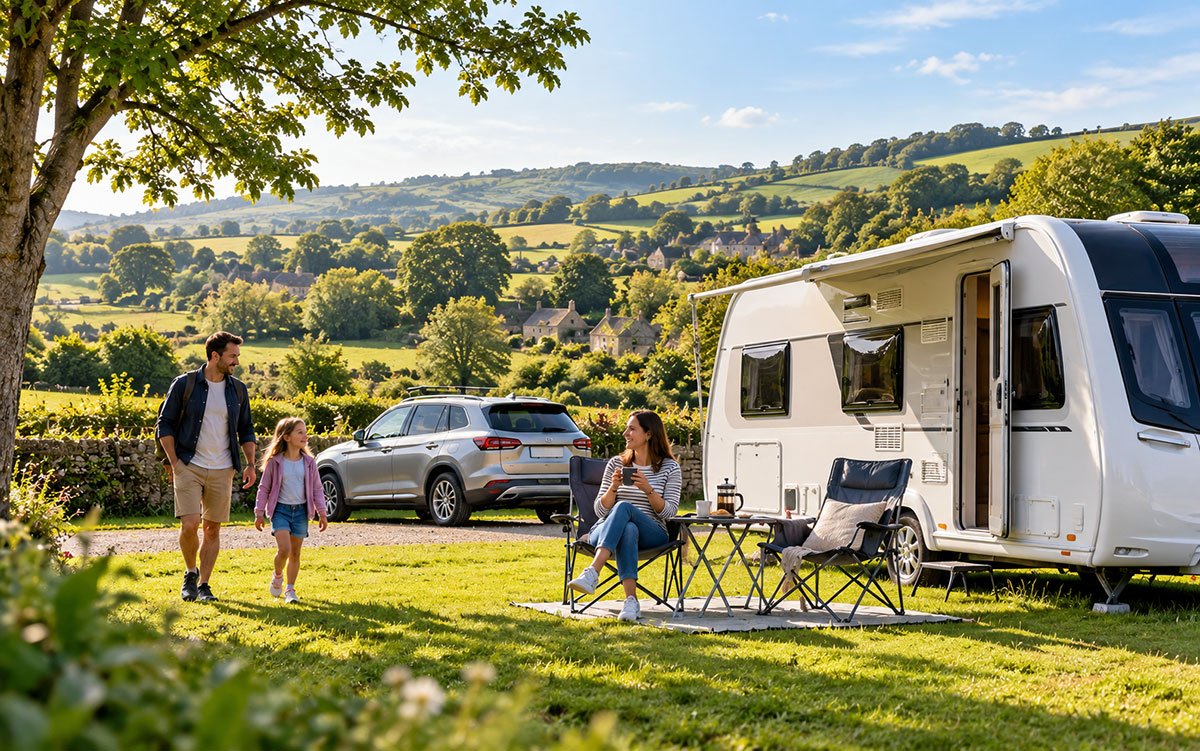
A touring caravan holiday offers the flexibility to explore Britain’s countryside while enjoying comfortable accommodation close to nature.
Caravan Hire UK: A Practical Guide to Renting and Touring
Imagine waking up beside a peaceful lake, enjoying breakfast overlooking the countryside and choosing where to explore next. That sense of flexibility is one of the biggest attractions of a caravan holiday.
Hiring a caravan allows you to enjoy Britain’s countryside, coastal areas and rural destinations without committing to buying your own holiday vehicle. Depending on your choice, you can settle into a comfortable caravan at one campsite or travel between destinations in a motorhome.
However, caravan hire in the UK involves more than selecting a vehicle and planning a scenic route. You need to consider the type of accommodation, driving requirements, rental insurance, campsite facilities and overall holiday budget.
This guide explains how to choose the right caravan, understand the practical arrangements and prepare for an enjoyable trip.
Why Hire a Caravan for Your UK Holiday?
A caravan holiday offers a different experience from staying in hotels or moving between holiday apartments.
Instead of following a fixed schedule, you can enjoy a more relaxed pace and spend additional time exploring places that interest you.
For many travellers, the attraction lies in having their own space while staying close to nature.
Freedom to Explore at Your Own Pace
A touring caravan or motorhome allows you to plan a holiday around scenic drives, countryside walks and quieter destinations.
You can spend several nights near a national park, explore a coastal village or discover rural attractions that may be less convenient to reach by public transport.
However, freedom does not mean you can park or camp overnight anywhere. You must follow local restrictions and use permitted overnight locations.
More Control Over Your Accommodation
Many caravans include sleeping areas, seating and basic cooking facilities.
Depending on the model, you may also have a refrigerator, heating, shower and toilet.
These facilities can make a considerable difference during a family holiday, especially when travelling with children or staying somewhere with limited dining options.
Potential Savings on Longer Holidays
Hiring a caravan can offer good value, particularly when several people share the accommodation and prepare some of their meals.
Nevertheless, caravan holidays are not automatically cheaper than hotels.
Rental charges, campsite fees, fuel, insurance and additional equipment can increase the overall expense.
Compare the full cost before deciding whether caravan hire represents good value for your itinerary.
Types of Caravans and Motorhomes Available for Hire
Before booking, understand the differences between the main options.
The term caravan hire often describes several types of holiday accommodation, but they offer very different experiences.
| Accommodation type | How it works | Best suited for |
|---|---|---|
| Touring caravan | A separate caravan towed behind a suitable vehicle | Travellers who want a campsite base and their own car |
| Static caravan | A caravan that remains at a fixed holiday park | Families and couples who prefer one location |
| Campervan | A compact motor vehicle adapted for sleeping and basic living | Couples and travellers who prefer easier manoeuvring |
| Motorhome | A larger motor vehicle with integrated living accommodation | Families and travellers planning multi-stop holidays |
Touring Caravan Hire
A touring caravan is a separate living unit that you tow using a suitably equipped vehicle.
After arriving at your campsite, you can unhitch the caravan and use your car for sightseeing or shopping.
This arrangement can be convenient when you intend to stay in one area for several days.
However, towing requires preparation and driving skills. You must check that your vehicle, licence and towing equipment meet the applicable requirements.
Some businesses also provide touring caravans already delivered and positioned at a campsite. This can be a useful alternative for people who want the experience without towing.
Static Caravan Hire
A static caravan stays at a designated holiday park rather than being towed between destinations by guests.
It often provides a more conventional holiday accommodation experience, with cooking facilities, living space and separate sleeping arrangements depending on the unit.
Static caravan hire may suit families who want easy access to the coast, countryside or holiday park facilities.
You do not need to tow the caravan or drive a large vehicle.
However, your accommodation remains in one location throughout the stay.
Campervan Hire
Campervans are generally more compact than larger motorhomes.
Their smaller size can make them attractive to couples or travellers who plan to explore several destinations.
Facilities vary considerably. Some provide only basic sleeping and cooking arrangements, while others include additional equipment.
Check the layout carefully before booking, particularly if you need a toilet, shower, heating or adequate luggage storage.
Motorhome Hire
Motorhomes combine a vehicle and living accommodation in one unit.
They can be convenient for road trips involving several overnight stops because you do not need to tow a separate caravan.
Larger models may offer more space and facilities, although their dimensions can make narrow roads, low bridges and restricted parking areas more challenging.
Always check the motorhome’s weight, dimensions and approved passenger capacity before booking.
How to Choose the Right Caravan for Your Trip
The best option depends on your travel plans rather than the size or appearance of the caravan.
Start by considering how you intend to spend your holiday.
Consider Your Group Size
A caravan described as having four or six berths may not provide the same level of privacy or comfort as a hotel with separate bedrooms.
Some sleeping arrangements require converting seating areas into beds.
Check the actual floor plan, bed dimensions and available storage.
If you are renting a campervan or motorhome, also verify the number of approved travelling seats with suitable seat belts.
Sleeping capacity does not necessarily equal passenger capacity.
Decide How Often You Want to Move
If you plan to spend a week exploring one coastal region, a static or touring caravan could be suitable.
If you want to visit several destinations, a campervan or motorhome may offer greater convenience.
However, frequent relocation also means more driving, more campsite arrangements and additional time preparing the vehicle for travel.
A relaxed itinerary with fewer stops may provide a better holiday experience.
Check the Facilities That Matter Most
Before choosing a rental, find out whether it includes:
- Suitable beds and bedding
- Cooking facilities and kitchen equipment
- Heating and ventilation
- A refrigerator
- Toilet and shower facilities
- Fresh-water and wastewater systems
- Electrical hook-up equipment
- Outdoor furniture or an awning
- Secure storage for luggage
Do not assume every advertised caravan includes all these facilities.
Ask the rental company for a complete equipment list and clarify which items cost extra.
How Much Does Caravan Hire Cost in the UK?
The cost of hiring a caravan varies according to the type of accommodation, rental duration, location, season and facilities.
Static caravans, touring caravans and self-drive motorhomes may also follow different pricing structures.
Rather than comparing headline rental rates alone, calculate the complete cost of your holiday.
Expenses to Include in Your Budget
| Expense | What to check |
|---|---|
| Rental charge | Daily, weekend or weekly rate and any minimum rental period |
| Campsite fees | Pitch charges, electrical hook-up and additional guests |
| Insurance | Included protection, excess and optional cover |
| Security deposit | Deposit amount and conditions for its return |
| Fuel | Driving distance, vehicle fuel consumption and local prices |
| Mileage charges | Whether the rental has a mileage allowance |
| Equipment | Bedding, outdoor furniture, child seats or other extras |
| Cleaning | Cleaning fees and waste-emptying requirements |
| Travel expenses | Parking, tolls, ferries and attraction tickets |
When Is Caravan Hire Better Value?
A longer stay at one campsite may reduce fuel use and repeated travel expenses.
Travelling outside the busiest holiday periods may also provide greater choice, although prices depend on demand and individual operators.
Cooking some meals in your caravan can help control food spending.
However, remember to compare the total rental cost with alternative accommodation. A hotel or holiday cottage could offer better value for some short breaks.
Practical tip: Request a written breakdown of the full rental price before making a payment. Check cancellation conditions and additional charges rather than relying only on the advertised rate.
UK Driving Licence Rules for Caravan and Motorhome Hire
Driving requirements are among the most important considerations when hiring a touring caravan or motorhome.
The rules depend on your driving entitlement, vehicle weight and the type of combination you intend to drive.
Can You Tow a Caravan with a Standard UK Driving Licence?
In Great Britain, holders of a full category B car licence can generally tow a trailer with a maximum authorised mass (MAM) of up to 3,500kg, subject to the vehicle’s permitted towing limits and other applicable requirements.
MAM refers to the maximum permitted weight of a vehicle or trailer when fully loaded.
However, having the relevant driving entitlement does not mean your car can safely or legally tow every caravan.
You must also check:
- The towing capacity of your particular car
- The permitted combined weight of the car and caravan
- The caravan’s maximum authorised mass
- Towbar and coupling limitations
- The manufacturer’s requirements
- Your insurance arrangements
Rules can differ for some licence holders, including drivers in Northern Ireland. Check your individual licence entitlement before booking.
If you have never towed a caravan, consider professional towing instruction before your first trip.
What Licence Do You Need to Drive a Motorhome?
For a typical petrol or diesel motorhome in Great Britain, a full category B licence generally covers vehicles with a MAM of up to 3,500kg.
A motorhome with a MAM above 3,500kg and up to 7,500kg generally requires category C1 entitlement.
Vehicles above 7,500kg generally require category C.
Always confirm the particular vehicle’s weight and your licence entitlement rather than relying on its appearance or sleeping capacity.
If you are visiting from overseas, check whether your driving licence is valid in Great Britain and whether the rental company accepts it.
Essential Safety Tips for Towing a Caravan
Towing a caravan changes how your car accelerates, brakes and handles corners.
Even experienced drivers need to adjust their driving style when pulling a large trailer.
Check Your Vehicle Before Departure
Before setting off, inspect the caravan and towing arrangement.
Important checks include:
- Tyres, pressures and visible damage
- Brake and indicator lights
- Towbar and coupling connections
- Breakaway cable or required secondary coupling
- Caravan brakes
- Towing mirrors where required
- Secure windows, roof vents and doors
- Correct weight distribution and secure luggage
Follow the rental company’s handover instructions and the vehicle manufacturer’s guidance.
Do not drive away if you identify a safety problem.
Understand UK Caravan Towing Speed Limits
In Great Britain, cars towing caravans are generally subject to the following national speed limits, unless a lower limit applies:
| Road type | Maximum speed |
|---|---|
| Single carriageway | 50 mph |
| Dual carriageway | 60 mph |
| Motorway | 60 mph |
Built-up-area limits and locally signed restrictions also apply. Motorhomes follow different speed-limit rules depending on their classification and unladen weight.
When towing, you must not use the right-hand lane of a motorway with three or more lanes.
Always adjust your speed for road conditions, weather and the caravan’s handling.
Allow More Space and Take Your Time
A caravan increases your overall vehicle length and can affect braking distances.
Leave more space between your vehicle and the traffic ahead.
Approach junctions, roundabouts and sharp bends carefully, and avoid sudden steering or braking.
Reversing can be particularly difficult for beginners. Practise manoeuvring in a suitable open area before attempting a confined campsite entrance.
Strong winds can also affect caravan stability. Check weather forecasts and avoid unnecessary journeys when conditions make towing unsafe.
Booking the Right Caravan Campsite
Choosing a suitable campsite is almost as important as selecting the caravan.
A beautiful countryside location may not be practical if it lacks the facilities required by your vehicle or travelling group.
What to Look for in a Campsite
Check the following before booking:
- Whether the site accepts touring caravans, campervans or motorhomes
- Availability of suitable pitches
- Electrical hook-up facilities
- Fresh-water supply
- Wastewater and toilet disposal points
- Shower and toilet facilities
- Vehicle size and access restrictions
- Arrival and departure arrangements
- Pet policies, where relevant
- Seasonal opening dates
Some campsites offer hardstanding pitches, which can be useful during wet conditions.
Others provide grass pitches that may offer a more traditional countryside camping atmosphere.
Choose according to your vehicle, the weather and the facilities you need.
Can You Park a Caravan Anywhere Overnight?
No. Hiring a caravan or motorhome does not give you unrestricted permission to camp on public or private land.
In England and Wales, overnight stays in vehicles generally require a permitted location or appropriate landowner permission. Local parking restrictions may also apply.
Scotland has broader responsible access rights for lightweight tent camping, but these rights do not extend to motor vehicles.
Do not assume that a roadside lay-by, public car park or scenic viewpoint permits overnight camping.
Use designated campsites, authorised overnight parking facilities or other locations where you have permission to stay.
Planning a Caravan Road Trip Around Britain
A successful caravan holiday balances sightseeing with realistic driving distances.
Trying to cover too many destinations can leave little time to enjoy the places you visit.
Choose a Manageable Route
Start with one region rather than attempting to explore the entire country during a short holiday.
The Lake District, parts of Wales, the Scottish countryside and England’s coastal regions can all offer appealing landscapes for caravan holidays.
However, road suitability and overnight accommodation vary considerably within each destination.
Check your intended route for narrow roads, steep gradients, low bridges and other restrictions.
Motorhome drivers should know their vehicle’s exact height, width and weight.
Build Flexibility Into Your Itinerary
Allow enough time for rest breaks, traffic delays and changes in the weather.
Avoid planning a long drive immediately before a campsite’s latest permitted arrival time.
For touring caravans, remember that arrival also involves positioning and setting up your accommodation.
If you intend to travel during school holidays or other busy periods, booking suitable campsites in advance can help avoid unnecessary disruption.
Prepare for British Weather
Weather can change quickly in many rural and coastal areas.
Pack suitable waterproof clothing, warm layers and footwear for outdoor activities.
If you intend to travel outside the warmer months, check the caravan’s heating arrangements and whether the chosen campsite remains open.
Pay particular attention to strong-wind warnings when towing or driving larger vehicles.
Caravan Rental Insurance and Breakdown Cover
Before signing a rental agreement, understand what protection is included.
Insurance conditions differ between rental operators, so never assume that every vehicle includes the same coverage.
Questions to Ask Before Booking
Check whether the rental agreement covers:
- Accidental vehicle damage
- Theft and attempted theft
- Damage to windows, tyres and other components
- Third-party liability
- Approved additional drivers
- Roadside breakdown assistance
- Recovery of a touring caravan
- Travel into other countries, if relevant
Also ask about the insurance excess, security deposit and any exclusions.
A breakdown policy that covers your towing car may not automatically cover recovery of the caravan.
For motorhome rentals, check whether the vehicle’s height, weight and dimensions affect roadside assistance arrangements.
Keep the rental company’s emergency contact information accessible throughout the trip.
What to Check When Collecting Your Hired Caravan
The vehicle handover is your opportunity to understand the equipment and identify problems before leaving.
Take enough time to inspect everything.
Exterior Inspection
Walk around the caravan or motorhome with the rental representative.
Check the bodywork, windows, lights, tyres and external equipment.
Photograph any existing damage and ensure it appears on the condition report.
Interior and Equipment Inspection
Check the sleeping areas, cupboards, kitchen facilities, heating and water systems.
Ask the rental representative to demonstrate how to operate unfamiliar equipment.
Confirm whether the vehicle has working smoke and carbon monoxide alarms.
Check that you understand the emergency exits and basic fire safety procedures.
Understand the Departure Checklist
Before driving, confirm how to secure the vehicle.
This may involve closing roof vents, locking cupboards, retracting external steps and disconnecting electrical hook-up cables.
For touring caravans, the hitching and towing checklist is particularly important.
Never rely on memory alone if the rental company provides written instructions.
Staying Safe and Comfortable During Your Caravan Holiday
Caravan living involves a few responsibilities that may be unfamiliar to first-time guests.
Use Gas and Electrical Equipment Correctly
Follow the manufacturer’s instructions for cooking, heating and electrical systems.
Use campsite electrical hook-ups only with suitable equipment and avoid overloading the available supply.
Never use a barbecue, disposable charcoal grill or unsuitable portable fuel-burning heater inside a caravan, motorhome or enclosed awning.
These devices can create a serious fire or carbon monoxide hazard.
Keep ventilation openings clear and know how to shut off the gas supply.
If you notice damaged electrical equipment, unusual smells or other safety concerns, stop using the affected system and contact the rental operator.
Dispose of Waste Responsibly
Many touring caravans and motorhomes have wastewater tanks or chemical toilets.
Use the designated disposal facilities provided by campsites or other approved service points.
Never empty chemical toilet waste or wastewater into rivers, lakes, roadside drains or unsuitable locations.
Follow local waste and recycling arrangements.
Respect Other Campsite Guests
Keep noise at a considerate level, particularly during designated quiet hours.
Follow campsite rules regarding barbecues, pets, parking and the placement of outdoor equipment.
Leave your pitch clean and avoid damaging grass, trees or surrounding vegetation.
Responsible behaviour helps preserve the countryside for everyone.
Is Hiring a Caravan Suitable for First-Time Travellers?
Yes. A caravan holiday can work well for beginners, provided they choose an appropriate vehicle and prepare carefully.
If you have no towing experience, consider a static caravan, a delivered touring caravan or a compact campervan that you are legally entitled and comfortable to drive.
These options can reduce some of the difficulties associated with towing and manoeuvring a large caravan.
For your first trip, a short stay at a well-equipped campsite may be more manageable than a long multi-destination road trip.
Choose accommodation with clear instructions, suitable facilities and accessible support from the rental provider.
You can always plan a more adventurous itinerary after gaining experience.
Frequently Asked Questions About Caravan Hire in the UK
Is caravan hire cheaper than staying in a hotel?
Sometimes, especially for families or longer stays. However, the total cost depends on the caravan rental, campsite fees, fuel, insurance and equipment. Compare all expenses before booking.
Can I hire a caravan without a towing vehicle?
Yes. Some operators offer touring caravans that are already positioned at a campsite or delivered to an agreed location. Static caravan rentals also require no towing.
Alternatively, you can hire a campervan or motorhome that combines transport and accommodation.
Can I drive a motorhome with a normal driving licence?
Many motorhomes with a maximum authorised mass of up to 3,500kg can be driven on a standard full category B licence in Great Britain. Larger vehicles may require C1 or C entitlement. Always check your licence and the specific motorhome.
Is caravan towing difficult for beginners?
Towing requires different skills from ordinary car driving, particularly when reversing, cornering and braking.
Beginners should consider practical training and start with manageable routes.
Do I need to book campsites in advance?
Booking ahead is sensible during busy holiday periods and when you need specific facilities. Some campsites may accept last-minute arrivals, but availability cannot be guaranteed.
Can I sleep in a caravan while it is being towed?
No. Passengers should travel in the towing vehicle using approved seats and appropriate restraints, not inside a touring caravan while it is being towed.
Can I take a hired caravan or motorhome to Europe?
That depends on the rental company’s conditions, insurance and the legal requirements of the countries you intend to visit.
Obtain the necessary permission and check all relevant documents before planning an international journey.
What is the best time of year for a caravan holiday in Britain?
Spring and summer can offer pleasant opportunities for outdoor activities and longer daylight hours. Autumn may also suit countryside trips.
However, British weather remains unpredictable. Campsite opening dates and suitable vehicle facilities matter more than choosing a particular month.
Final Thoughts: Enjoy the Freedom of Caravan Travel
Hiring a caravan can be an enjoyable way to discover Britain’s countryside, explore coastal destinations and experience a slower style of travel.
The key is choosing accommodation that matches your needs and planning enough to avoid preventable difficulties.
Compare the different caravan types, understand the complete rental cost, confirm your driving and insurance arrangements, and book suitable places to stay.
If you are new to caravan holidays, start with a manageable journey and allow plenty of time to become familiar with the vehicle.
With sensible preparation and a flexible itinerary, a caravan holiday can provide the independence, comfort and connection with nature that make a road trip memorable.
