
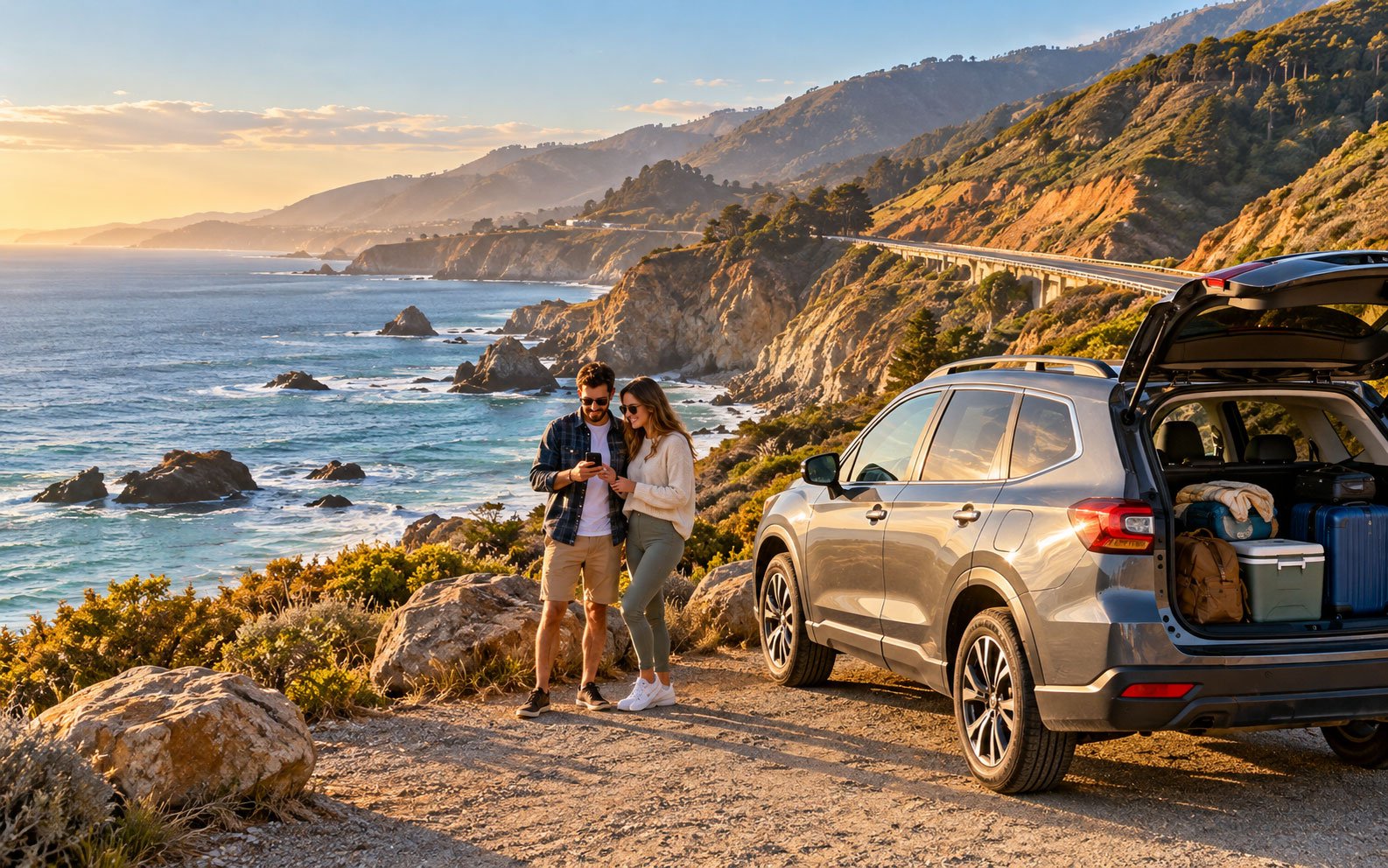
Choosing a comfortable, practical vehicle makes it easier to enjoy scenic road trips, from coastal highways to mountain destinations.
Best Cars for Road Trips: 7 Smart Choices for Every Journey
A memorable road trip begins long before you reach your first destination. The route, scenery and people travelling with you all shape the experience. However, the vehicle you choose can make the difference between an enjoyable journey and hours of uncomfortable driving.
The best cars for road trips combine comfortable seating, practical luggage space, suitable fuel efficiency and the ability to handle the roads you intend to travel.
A family exploring America’s national parks may need a spacious SUV or minivan. A couple planning a coastal drive might prefer a comfortable sedan or convertible. Meanwhile, travellers heading into snowy mountain regions should pay particular attention to tyres, traction and winter road conditions.
There is no single car that suits every adventure. The right choice depends on your passengers, luggage, destination, budget and travel style.
This guide compares seven practical types of road trip vehicles, highlights real-world model examples and explains what to consider before choosing your next travel companion.
What Makes a Car Good for Road Trips?
The ideal road trip vehicle should be comfortable over long distances, economical enough for your budget and suitable for the roads you intend to use.
Before choosing a vehicle, consider these essential factors.
Comfortable seating and cabin space
Comfort matters more as driving hours accumulate.
Look for supportive seats, sufficient legroom, adjustable driving positions and a cabin that does not become excessively noisy on the highway.
If several people are travelling, check the comfort of the rear seats rather than concentrating only on the driver and front passenger.
Luggage capacity
Suitcases, coolers, sports equipment, camping supplies and children’s belongings can occupy more space than expected.
Choose a vehicle that accommodates passengers and luggage without obstructing visibility or requiring unsafe packing.
Remember that some three-row vehicles offer limited luggage space when every seat is occupied.
Fuel economy and driving range
Fuel can represent a significant portion of a road trip budget.
Smaller cars and efficient hybrids may reduce fuel expenses, while larger vehicles can be worthwhile when they carry more passengers or bulky equipment.
If you plan to drive an electric vehicle, charging availability and the time needed for charging stops become additional considerations.
Safety and driving conditions
Modern driver-assistance systems can be helpful, but they do not replace an attentive driver.
Review the vehicle’s safety ratings, tyre condition, braking performance and suitability for the intended route.
For winter or mountain trips, suitable tyres and compliance with local traction requirements are especially important.
Best Cars for Road Trips: Quick Comparison
| Vehicle Type | Best Suited For | Main Advantage | Main Consideration |
|---|---|---|---|
| Hybrid sedan | Couples and smaller families | Fuel efficiency and highway comfort | Limited space for bulky equipment |
| Compact SUV | Small families and mixed destinations | Flexible passenger and luggage space | Economy and comfort vary by model |
| AWD crossover or wagon | Mountain and outdoor holidays | Traction options and practical storage | Correct tyres remain essential |
| Minivan | Larger families and group trips | Spacious, flexible seating | Large vehicle dimensions |
| Three-row SUV | Families needing additional seats | Passenger capacity and versatility | Luggage space with all seats occupied |
| Electric vehicle | Routes with reliable charging | Quiet driving and electric efficiency | Charging time and availability |
| Convertible | Couples and scenic coastal drives | Open-air travel experience | Limited luggage and passenger space |
These categories are starting points. The features, seating capacities and fuel economy of individual vehicles can vary by model, year and specification.
1. Hybrid Sedans: Excellent for Long Highway Journeys
A well-equipped sedan can be a comfortable and economical choice for long-distance travel.
For couples and smaller families, there is often little reason to rent a large SUV when a sedan can accommodate everyone and their luggage.
Modern hybrid sedans are particularly attractive because they combine petrol engines with electric motors to improve fuel efficiency.
Why choose a hybrid sedan?
Hybrid sedans can offer a useful balance of highway comfort, manageable dimensions and reduced fuel consumption.
They are also generally easier to park than larger SUVs or pickup trucks.
A comfortable driving position, supportive seats and a quiet cabin may matter more during a lengthy journey than extra ground clearance you never use.
Road trip car to consider: Toyota Camry Hybrid
The Toyota Camry is a practical example of a hybrid sedan suitable for long journeys.
Current versions offer a hybrid powertrain, seating for five and available all-wheel drive in the US market.
Its conventional sedan layout makes it worth considering for highway holidays involving relatively light luggage.
However, the boot may not accommodate the bulky equipment required for camping or extended outdoor adventures.
Best for: Couples, two adults with a child, business travellers and long journeys on well-maintained roads.
Consider another option if: You need to transport large amounts of equipment or have several passengers with substantial luggage.
2. Compact SUVs: Versatile Cars for Family Road Trips
Compact SUVs are popular choices for travellers who want a balance between passenger comfort, practical storage and everyday usability.
They generally offer a higher seating position than conventional sedans and provide flexible cargo space through folding rear seats.
This makes them useful for journeys that combine highways, cities, countryside destinations and outdoor attractions.
Why a compact SUV works well
A compact SUV can accommodate family luggage, picnic supplies and everyday travel equipment without the dimensions of a full-size vehicle.
Some models also offer hybrid powertrains and all-wheel-drive options.
However, SUVs are not automatically more fuel-efficient or comfortable than sedans.
Compare individual vehicles rather than assuming every SUV offers the same advantages.
Road trip car to consider: Honda CR-V Hybrid
The Honda CR-V Hybrid is an example of a compact SUV suited to small-family travel.
Its five-seat layout and flexible rear cargo area can work well for road trips involving suitcases and recreational equipment.
Available all-wheel-drive versions may be useful for certain driving conditions, although the appropriate tyres remain important.
For travellers who do not need a third row of seats, a compact SUV can offer sufficient space without moving into a much larger vehicle.
Best for: Small families, weekend adventures, national park visits and mixed urban and countryside journeys.
Consider another option if: More than five people are travelling or you need a large amount of luggage space while all seats remain occupied.
3. All-Wheel-Drive Crossovers: Suitable for Mountain Adventures
Mountain road trips require more preparation than ordinary highway journeys.
Travelling through the Rocky Mountains in Colorado, the Black Hills of South Dakota or other elevated regions can expose drivers to changing weather, steep roads and winter conditions.
An all-wheel-drive crossover or wagon may be a practical option, particularly when combined with tyres appropriate for the weather.
Understanding all-wheel drive
All-wheel drive, commonly abbreviated as AWD, distributes driving power between the front and rear wheels according to the vehicle’s system.
This can improve traction when accelerating on slippery surfaces.
However, AWD does not eliminate the risk of sliding on ice or shorten stopping distances simply because all four wheels receive power.
Tyre grip, vehicle speed and road conditions remain essential factors.
Road trip car to consider: Subaru Outback
The Subaru Outback combines the practicality of a crossover with substantial cargo flexibility.
The model offers standard all-wheel drive in the US market and is designed with outdoor travel in mind.
It can accommodate luggage, hiking equipment and other supplies for a mountain holiday.
Nevertheless, choosing an AWD vehicle is only one part of winter preparation.
Check mountain road requirements
Road authorities may require approved winter tyres, chains or other traction equipment under particular conditions.
For example, Rocky Mountain National Park applies specific traction requirements when winter driving restrictions are in force.
Some mountain roads also close seasonally, regardless of the vehicle being driven.
Check official road information before setting off and avoid travelling during hazardous weather simply because your vehicle has AWD.
Best for: Mountain holidays, winter destinations, hiking trips and outdoor adventures.
Consider another option if: Your route involves extreme off-road terrain beyond the vehicle’s design and capabilities.
4. Minivans: Practical for Large Family Road Trips
When several adults or children are travelling together, a minivan deserves serious consideration.
Although SUVs often attract more attention, a minivan may offer a more convenient passenger layout for long family journeys.
Sliding doors can make entry and exit easier in tight parking spaces, while flexible seating helps accommodate different family arrangements.
Why families may prefer a minivan
Minivans are designed around passenger transportation.
Depending on the model, they may provide spacious seating across three rows, multiple storage areas and convenient access to the rear seats.
This can be particularly helpful when travelling with children who require appropriate car seats or booster seats.
A minivan also makes sense when grandparents or other family members join the trip.
Road trip cars to consider: Toyota Sienna and Honda Odyssey
The Toyota Sienna uses a hybrid powertrain and offers configurations suitable for larger family groups.
The Honda Odyssey provides flexible seating arrangements and substantial passenger and cargo versatility.
Both are worth comparing if your priorities include family accommodation, storage and long-distance practicality.
The best choice depends on the particular seating arrangement, equipment and luggage requirements.
Check luggage space with all seats occupied
A vehicle advertised as seating seven or eight people may not accommodate seven or eight large suitcases behind the final row.
Examine the usable luggage area with every required seat in place.
If you need to fold seats for luggage, those seats will no longer be available for passengers.
Best for: Larger families, multigenerational holidays and group road trips.
Consider another option if: You are travelling alone or as a couple and would gain little from the additional space.
5. Three-Row SUVs: Flexible for Families and Outdoor Travel
A three-row SUV is another option for families who require additional passenger capacity.
These vehicles can be especially useful when a holiday includes countryside travel, sports equipment or several passengers.
However, the category varies significantly.
Some three-row SUVs are primarily designed for family use on ordinary roads, while larger models provide additional towing capabilities.
What to look for in a three-row SUV
Before choosing one, check the third-row seating dimensions and the available cargo space.
Also consider the vehicle’s size. Large SUVs can be less convenient in crowded cities, narrow parking areas and busy tourist destinations.
Fuel economy varies considerably between conventional petrol engines, hybrid systems and different vehicle sizes.
Road trip car to consider: Toyota Grand Highlander
The Toyota Grand Highlander is one example of a family-oriented three-row SUV.
It offers petrol and hybrid powertrain options, a flexible seating arrangement and different drivetrain choices in the US market.
It may suit families who want additional passenger capacity without choosing a full-size minivan.
For particularly large loads or towing requirements, a larger SUV or pickup truck may be more appropriate.
However, towing capacity must be checked against the exact vehicle specification, trailer weight and applicable legal requirements.
Best for: Families needing three rows, longer holidays and trips with varied luggage requirements.
Consider another option if: You rarely need the additional seating and would prefer a smaller, more economical vehicle.
6. Electric Vehicles: A Comfortable Choice for Planned Routes
Electric vehicles have become an increasingly practical option for road trips on routes with suitable charging infrastructure.
They can provide quiet driving, smooth acceleration and a comfortable experience on long stretches of highway.
However, choosing an EV requires a slightly different approach to journey planning.
Road trip car to consider: Hyundai IONIQ 5
The Hyundai IONIQ 5 is an electric crossover that offers a spacious cabin and DC fast-charging capability.
Its driving range varies by battery, drivetrain and model specification.
The IONIQ 5 is one example of a vehicle worth considering for travellers interested in electric road trips, particularly where compatible charging stations are available.
Plan charging before departure
Before setting off, investigate charging stations along your route.
Check the charging connectors supported by the vehicle, charging speeds, access restrictions and available payment methods.
The US Department of Energy’s Alternative Fueling Station Locator can help identify stations along a journey.
Having an alternative charging location is sensible in case the first station is occupied or unavailable.
Account for weather and driving conditions
Cold temperatures, high speeds, hilly terrain and heavy vehicle loads can affect an electric vehicle’s real-world driving range.
Do not assume that an advertised maximum range will be achievable throughout every journey.
Build a reasonable reserve into your charging plan, especially when travelling through remote regions.
An electric vehicle can be a suitable choice for a scenic holiday, but its practicality depends on the route and available infrastructure.
Best for: Travellers using well-served highways, planned itineraries and destinations with convenient charging.
Consider another option if: Your route involves long stretches without reliable charging access.
7. Convertibles: Enjoyable for Scenic Coastal Road Trips
Not every road trip requires a large family vehicle.
For couples planning a relaxed coastal holiday, a convertible can turn an ordinary drive into a memorable experience.
Imagine travelling along a scenic section of California’s coastline, stopping at viewpoints and enjoying the changing landscape.
A convertible can be appealing when the journey itself is an important part of the holiday.
Road trip car to consider: Ford Mustang Convertible
The Ford Mustang Convertible is an example of an open-top car suitable for travellers seeking a more recreational driving experience.
Different engine and equipment options are available, so comfort, fuel consumption and rental costs depend on the version.
Before choosing one, consider whether the boot can accommodate your luggage with the roof in its intended position.
Why convertibles are not ideal for every trip
Open-top driving is enjoyable in suitable conditions, but strong sunlight, wind, rain and cold weather can make the experience less comfortable.
Convertibles also tend to offer less practical luggage space than family-oriented vehicles.
If children are travelling, ensure that appropriate child restraints can be correctly installed and that everyone has suitable seating.
A convertible should be chosen because it suits the passengers and itinerary, not simply because it looks appealing.
Best for: Couples, scenic coastal drives, short leisure breaks and travellers who value the driving experience.
Consider another option if: You need substantial luggage space, regularly travel with several passengers or expect difficult weather.
Are Pickup Trucks Good for Road Trips?
Pickup trucks can be useful when a holiday involves towing, transporting outdoor equipment or carrying loads that would not fit inside a conventional passenger vehicle.
For example, travellers towing a camping trailer or carrying equipment for certain recreational activities may benefit from a suitably equipped truck.
However, a large pickup is not automatically the best choice for a family holiday.
Some models consume considerably more fuel than smaller cars, and an open cargo bed generally provides less protection from weather and theft than an enclosed luggage compartment.
Passenger space also varies between cab configurations.
If towing is your main reason for choosing a pickup, verify the vehicle’s towing rating, payload, trailer equipment and relevant legal requirements.
For ordinary sightseeing journeys, a sedan, crossover or minivan may offer a more suitable balance of comfort and practicality.
Which Car Is Best for Different Road Trip Destinations?
The type of journey can help narrow your choices.
| Road Trip Destination | Suitable Vehicle Type | Main Consideration |
|---|---|---|
| Colorado Rocky Mountains | AWD crossover or suitably equipped SUV | Winter tyres, traction rules and road closures |
| South Dakota Black Hills | Sedan or SUV suited to seasonal conditions | Weather, mountain roads and route restrictions |
| California coastal highways | Sedan, compact SUV or convertible | Scenic driving, luggage and road closures |
| Florida beach holiday | Sedan, hybrid or compact SUV | Passenger comfort, air conditioning and parking |
| National park road trip | Compact SUV, wagon or minivan | Luggage, fuel availability and permitted roads |
| Cross-country highway trip | Comfortable hybrid sedan, SUV or minivan | Fuel costs, driving comfort and rest stops |
| EV-friendly urban and highway route | Electric vehicle | Compatible charging and backup locations |
These are general recommendations, not guarantees that a particular road will be accessible.
Always verify the driving conditions and vehicle restrictions for your intended route.
How to Choose a Comfortable Car for Long-Distance Driving
Vehicle size is not the only factor that affects comfort.
Before renting or selecting a car for an extended journey, examine the features you will use throughout the trip.
Supportive seats and a good driving position
The driver’s seat should allow a comfortable view of the road and easy access to the pedals and controls.
Adjustable lumbar support can be useful on long journeys.
Passengers should have sufficient headroom and legroom, particularly if they will be seated for several hours.
Cabin noise and ride quality
Wind noise, tyre noise and a harsh suspension can make driving more tiring.
If possible, test the vehicle on different types of road before committing to a long journey.
Climate control
Effective air conditioning, heating and window demisting are important in varying weather conditions.
Consider rear-seat ventilation when travelling with several passengers.
Navigation and connectivity
A reliable navigation system can simplify route planning, especially when exploring unfamiliar destinations.
Phone integration and charging ports can also be useful.
However, navigation systems can occasionally suggest unsuitable or restricted roads. Follow official road signs and local restrictions.
Safety assistance
Features such as automatic emergency braking, lane-departure warnings and adaptive cruise control may support the driver when used appropriately.
Check which systems are fitted to the specific vehicle.
Remember that driver-assistance features are not a substitute for paying attention to the road.
Is It Better to Rent a Car or Use Your Own?
Travellers often assume that driving their own vehicle is automatically the most economical option.
That may be true, but the calculation depends on the condition of your car, expected mileage and rental costs.
When using your own car makes sense
Your own vehicle may be preferable when it is well maintained, comfortable and suitable for the journey.
You already understand its controls and handling characteristics, and you may avoid rental charges.
However, you should still account for fuel, maintenance, tyre wear and the impact of additional mileage.
When renting may be worthwhile
A rental vehicle can make sense when your own car is too small, mechanically unsuitable or poorly equipped for the destination.
Renting may also be convenient if you fly to the starting point of a road trip.
Before booking, compare the complete rental price.
Check mileage limits, insurance arrangements, additional-driver fees, fuel policies, toll administration, deposits and any one-way return charges.
If travelling through snow, ask the rental company whether suitable tyres and permitted traction equipment are available.
Do not assume that every rental SUV is equipped for severe winter conditions.
Understand the insurance arrangements
Car insurance, rental damage protection and travel insurance are not interchangeable.
Your existing motor insurance or credit card may provide certain rental benefits, but coverage depends on the policy and circumstances.
Check the applicable terms before declining or purchasing additional coverage.
Essential Vehicle Checks Before a Road Trip
Even the most suitable road trip car needs proper preparation.
A vehicle that performs well during everyday commuting may require attention before a lengthy journey.
Pre-departure checklist
- Tyres: Check inflation pressure, tread depth and visible damage, including the spare tyre where fitted.
- Brakes: Investigate unusual noises, vibration or changes in braking performance.
- Fluid levels: Check engine oil, coolant and other fluids according to the vehicle handbook.
- Battery: Check its condition, particularly before cold-weather travel.
- Lights: Test headlights, brake lights, indicators and other required lighting.
- Wipers: Replace worn blades and ensure there is suitable washer fluid.
- Safety equipment: Carry an appropriate emergency kit and the vehicle’s recommended tyre-repair equipment.
- Recalls and maintenance: Check for outstanding safety recalls and complete any necessary servicing.
The US National Highway Traffic Safety Administration provides official guidance on vehicle preparation and a searchable recall database.
For important mechanical concerns, consult a qualified professional rather than attempting unfamiliar repairs immediately before departure.
Road Trip Safety Tips for Different Weather Conditions
Weather should influence both vehicle choice and travel planning.
Driving in snow and ice
Reduce speed and increase following distance on slippery roads.
Use tyres appropriate for the weather and comply with local traction requirements.
All-wheel drive can help with traction, but it cannot overcome the limitations of icy road surfaces.
Keep warm clothing, essential supplies and a means of communication available.
If authorities warn against unnecessary travel, consider changing your departure time or route.
Driving in hot weather
Check the vehicle’s cooling system and air conditioning before travelling through very hot regions.
Carry drinking water and avoid leaving children or pets unattended inside a parked vehicle.
Make sure your route includes appropriate places to stop and rest.
Driving through remote areas
Check fuel or charging availability before entering sparsely populated areas.
Download maps for offline use if mobile coverage may be unreliable.
Let someone know your expected route and arrival time.
Avoid relying solely on a navigation application’s estimated travel time, particularly when mountain roads or remote destinations are involved.
How to Reduce Road Trip Fuel and Travel Costs
Choosing an economical vehicle is helpful, but the way you plan and drive also affects expenses.
Consider these practical approaches:
- Compare fuel economy: Use official fuel economy information for the exact vehicle and model year.
- Avoid unnecessary weight: Carry what you need without overloading the vehicle.
- Plan sensible routes: Reduce unnecessary detours while allowing time for worthwhile stops.
- Maintain correct tyre pressure: Follow the manufacturer’s recommendation for the vehicle and load.
- Drive smoothly: Avoid unnecessary aggressive acceleration and braking.
- Check tolls and parking: Include road charges and destination parking costs in your budget.
- Plan rest stops: Fatigue can undermine safety, regardless of how comfortable the vehicle feels.
If travelling in an electric vehicle, compare public charging prices rather than assuming every charging station offers the same cost.
The aim is to reduce unnecessary spending without turning the holiday into an exercise in rushing between destinations.
Frequently Asked Questions About the Best Cars for Road Trips
What type of car is best for a long road trip?
A comfortable sedan, crossover or minivan can all be suitable. The right choice depends on the number of passengers, luggage requirements, route conditions and budget. Supportive seats and reliable mechanical condition matter more than vehicle size alone.
Are SUVs better than sedans for road trips?
Not necessarily. SUVs often provide flexible luggage space and a higher seating position. Sedans can offer excellent highway comfort and fuel economy. Choose according to your intended journey rather than assuming one category is always superior.
What is the best car for a family road trip?
For smaller families, a compact SUV or comfortable sedan may be sufficient. Larger families may benefit from a minivan or three-row SUV. Check child-seat compatibility, passenger comfort and luggage capacity with all required seats occupied.
Are hybrid cars good for long-distance driving?
Yes. Many conventional hybrid vehicles are well suited to long journeys and can offer favourable fuel economy. Actual consumption depends on speed, terrain, driving conditions and the specific model.
Do you need an SUV for a mountain road trip?
No. Many paved mountain roads can be travelled in an appropriately equipped sedan. However, severe weather, clearance requirements and road restrictions may influence the choice. Proper tyres and safe driving are essential.
Can an electric car handle a cross-country road trip?
Yes, provided the route has suitable, accessible charging infrastructure and the vehicle’s real-world range is accounted for. Check charging compatibility, station availability and alternative charging locations before departure.
Are convertibles suitable for families?
Some convertibles have rear seats, but passenger space, child-seat compatibility and luggage capacity vary considerably. They are generally more practical for couples or smaller groups travelling with limited luggage.
Choosing the Right Car for Your Next Adventure
The best road trip vehicle is not necessarily the largest, most expensive or most powerful car available.
A fuel-efficient sedan can be ideal for a long highway journey. A compact SUV offers practical flexibility for a small family, while a minivan may provide the space needed for a multigenerational holiday.
An AWD crossover can be useful in certain mountain conditions, an electric vehicle may suit a carefully planned route, and a convertible can add enjoyment to a scenic coastal drive.
Ultimately, comfort, safety, luggage capacity and suitability for the route should guide your decision.
Choose a vehicle that fits your needs, prepare it properly and allow enough time to enjoy the journey. After all, a great road trip is about more than reaching the destination.
