
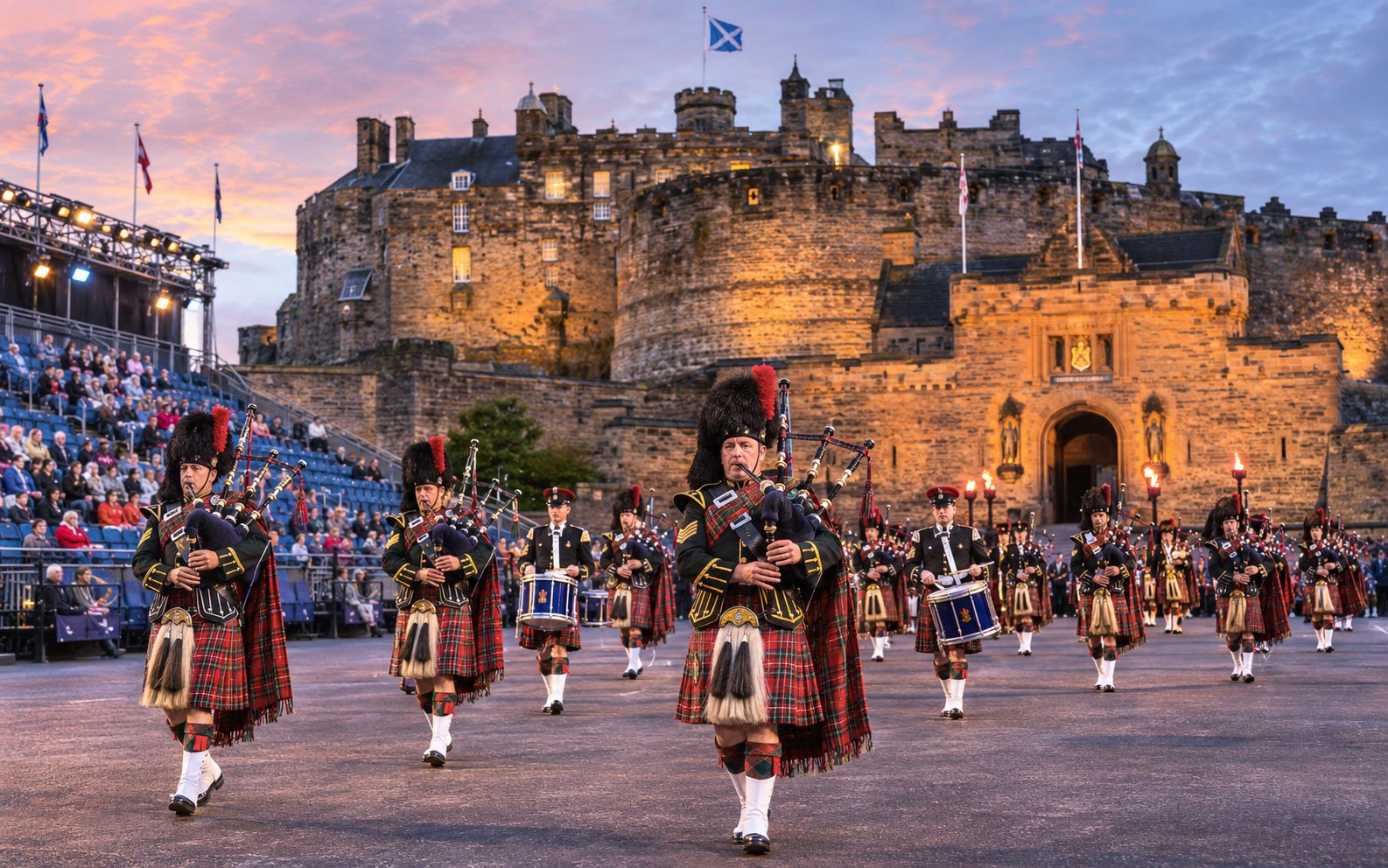
The Royal Edinburgh Military Tattoo celebrates Scotland’s musical and military traditions with spectacular pipe band performances against the historic backdrop of Edinburgh Castle.
12 Best Cultural Events in Scotland: Festivals and Traditions
Scotland’s cultural events offer some of the best opportunities to experience the country’s music, history, traditions and creative life. From the world-famous Edinburgh festivals to horseback celebrations in the Scottish Borders, these gatherings reveal a side of Scotland that goes far beyond its castles and dramatic landscapes.
Summer brings outdoor celebrations, Highland dancing, military pageantry and major performing arts festivals. Autumn offers illuminated forests, historic buildings and Gaelic cultural events. Winter fills Glasgow with traditional music and brings torchlit celebrations to Edinburgh and Shetland.
Whether you love live music, architecture, literature or traditional Scottish ceremonies, there is something worth planning a holiday around.
This guide explores 12 of the best cultural events in Scotland, explaining what makes each special, when to visit and how to make the most of the experience.
When Is the Best Time to Experience Scottish Festivals?
Scotland hosts cultural celebrations throughout the year, but the best time to visit depends on your interests.
- January: Celtic Connections in Glasgow and Up Helly Aa in Shetland.
- May to August: Highland Games and Common Riding festivals in towns and communities across Scotland.
- August: Edinburgh Festival Fringe, Edinburgh International Festival, Royal Edinburgh Military Tattoo and Edinburgh International Book Festival.
- September: Glasgow Doors Open Days Festival and heritage celebrations across Scotland.
- October: The Enchanted Forest in Pitlochry and the Royal National Mòd.
- Late December: Edinburgh’s Hogmanay celebrations.
August provides the greatest concentration of major arts festivals, particularly in Edinburgh. However, visitors seeking traditional community celebrations or quieter cultural experiences may prefer other seasons.
Event dates, venues and programmes can change annually, so always consult the organisers before booking accommodation or transport.
1. Royal Edinburgh Military Tattoo – Edinburgh
WHEN: AUGUST · WHERE: EDINBURGH CASTLE ESPLANADE
The Royal Edinburgh Military Tattoo is one of Scotland’s most recognisable cultural spectacles. Each August, the esplanade in front of Edinburgh Castle becomes an outdoor performance arena.
Military musicians, pipers, drummers and dancers from Scotland and around the world perform against the illuminated castle walls. Precision marching, traditional music, theatrical lighting and contemporary production techniques combine to create a distinctive evening experience.
The Massed Pipes and Drums are among the event’s best-known features, while the Lone Piper provides a memorable moment of reflection.
The Tattoo is particularly appealing to visitors interested in Scottish military heritage, music and ceremonial traditions.
Planning your visit: Performances take place outdoors, and Edinburgh evenings can feel cool even in August. Reserve tickets in advance and check seating accessibility, arrival arrangements and the official performance schedule.
2. Edinburgh Festival Fringe – Edinburgh
WHEN: AUGUST · WHERE: VENUES THROUGHOUT EDINBURGH
The Edinburgh Festival Fringe transforms Scotland’s capital into an international centre for live entertainment.
The festival welcomes performers from around the world, presenting comedy, theatre, dance, circus, cabaret, music and experimental productions.
What makes the Fringe different is its open-access approach. Established performers appear alongside emerging artists, independent theatre companies and performers testing new ideas.
Shows take place in conventional theatres, temporary spaces, bars, community venues and other locations across the city.
Free street performances add to the atmosphere, particularly around the Royal Mile and central festival areas.
Planning your visit: The programme contains both free and ticketed events. Reserve popular performances early, but leave space for discovering smaller productions. Checking venue locations carefully will help you avoid rushing between shows.
3. Edinburgh International Festival – Edinburgh
WHEN: AUGUST · WHERE: EDINBURGH
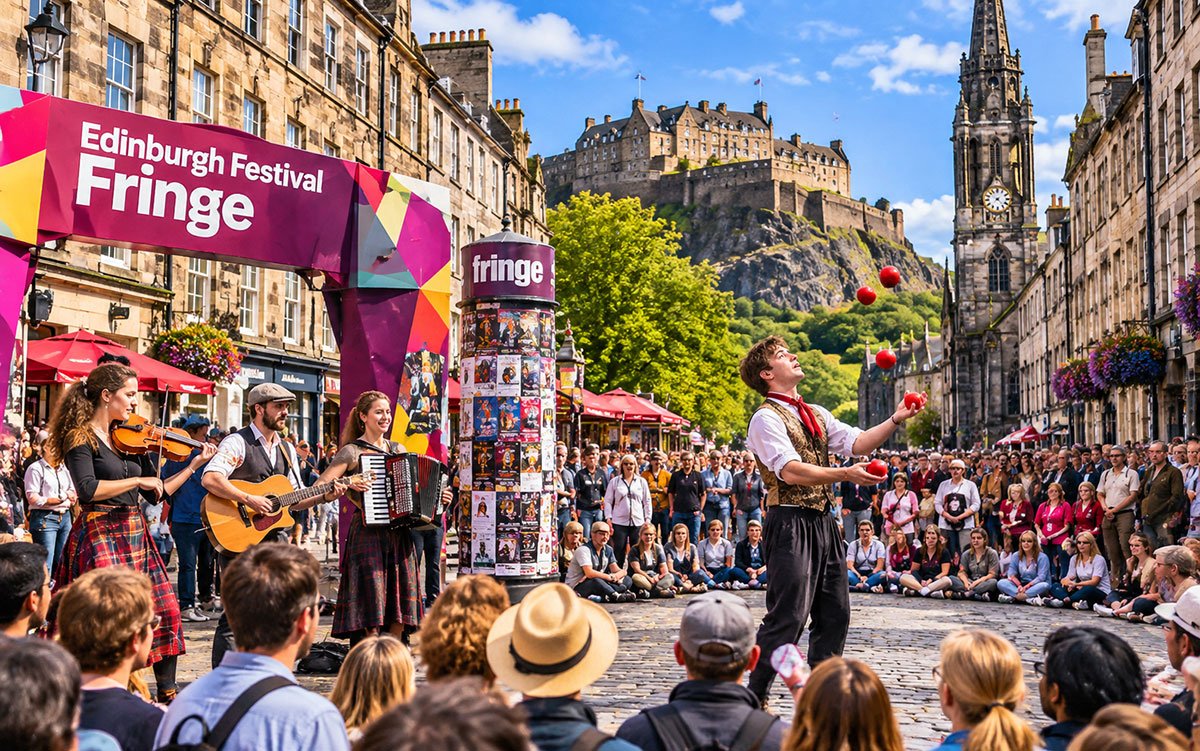
The Edinburgh Festival Fringe brings Edinburgh’s historic streets to life with colourful performances, live music, comedy and international entertainment every August.
Running alongside the city’s wider August festival season, the Edinburgh International Festival presents a curated programme of music, opera, theatre and dance.
The festival brings leading artists and companies from around the world to Edinburgh’s concert halls and theatres.
Unlike the open-access Fringe, the International Festival selects and commissions productions for its programme.
Visitors can experience orchestral concerts, contemporary dance, major theatrical productions and performances that combine different artistic traditions.
The festival is especially rewarding for travelers who enjoy carefully produced performances and international cultural exchange.
Planning your visit: Review the programme before traveling, as different productions run on different dates. Some performances may have limited availability.
4. Edinburgh International Book Festival – Edinburgh
WHEN: AUGUST · WHERE: EDINBURGH
Literature lovers will find plenty to enjoy at the Edinburgh International Book Festival.
The event brings together authors, poets, journalists, historians and thinkers for conversations about books, culture and contemporary issues.
Its programme typically includes author interviews, panel discussions, readings, workshops and events for children and families.
The festival offers an opportunity to hear writers discuss their work directly and discover books that might otherwise remain unfamiliar.
It also provides a quieter cultural experience for visitors seeking a break from Edinburgh’s busier street performances.
Planning your visit: Check the current festival venue and programme. Entry to the main festival site may be free, while individual talks and performances can require tickets.
5. Highland Games – Across Scotland
WHEN: MAY–SEPTEMBER · WHERE: MULTIPLE LOCATIONS
Few events capture Scotland’s traditional sporting and musical heritage as vividly as the Highland Games.
Held in towns and villages across the country, these outdoor gatherings combine athletic competitions, music, dancing and community celebrations.
Visitors can watch the caber toss, hammer throwing and other traditional heavy athletics events. Pipe bands and Highland dancing competitions are also central features at many gatherings.
Several Highland Games have particularly strong historical connections.
Famous Highland Games to Consider
- Braemar Gathering, Aberdeenshire: Known for its traditional competitions, pipe bands and royal connections.
- Cowal Highland Gathering, Dunoon: A major celebration featuring Highland dancing, piping and competitive events.
- Atholl Gathering, Blair Atholl: Held in the grounds of Blair Castle and associated with the Atholl Highlanders.
- Ceres Highland Games, Fife: A historic community gathering with a longstanding local tradition.
A Highland Games event offers more than a spectacle. It is also an opportunity to experience how Scottish communities preserve and celebrate their heritage.
Planning your visit: Games are held on different dates and may have separate ticketing arrangements. Rural venues can have limited public transport, so check local access before traveling.
6. Common Riding Festivals – Scottish Borders
WHEN: LATE MAY–AUGUST · WHERE: SCOTTISH BORDERS AND SOUTHERN SCOTLAND
The Common Riding festivals are among Scotland’s most distinctive living traditions.
Their origins lie in a time when communities rode around their boundaries, known as marches, to protect land and maintain territorial rights.
During the centuries of border conflict and reiving, these patrols served a practical purpose. Today, local communities preserve the tradition through horseback processions, ceremonies and celebrations.
Towns including Hawick, Selkirk, Melrose, Kelso and Galashiels organise their own festivals, each with distinctive customs.
What Happens at a Common Riding?
The events often include large groups of riders following historic routes, accompanied by community celebrations.
Depending on the town, visitors may encounter:
- Ceremonial horseback processions
- Traditional songs and music
- Local parades and flag ceremonies
- Community gatherings and sporting events
- Commemorations of important historical events
The atmosphere differs from a commercial festival because local history and community participation remain central to the celebrations.
Planning your visit: Some ceremonies are public, while others have restricted access or require tickets. Horseback processions may also involve temporary road closures. Confirm spectator arrangements with the local organisers.
7. Glasgow Doors Open Days Festival – Glasgow
WHEN: SEPTEMBER · WHERE: GLASGOW
Glasgow is celebrated for its architectural heritage, and its annual Doors Open Days Festival gives visitors an opportunity to explore parts of the city that are not normally accessible.
Organised by Glasgow Building Preservation Trust, the festival features free building visits, guided walks, talks and cultural activities.
Participating locations can include historic buildings, theatres, industrial spaces, places of worship and contemporary cultural venues.
The programme changes each year, giving returning visitors opportunities to discover new aspects of the city.
Discover Glasgow’s Architectural Heritage
The festival is particularly interesting for visitors who appreciate Victorian architecture, industrial history and urban design.
Glasgow also has strong associations with architect and designer Charles Rennie Mackintosh, whose work remains an important part of the city’s cultural identity.
Alongside the festival, visitors can explore Mackintosh-related attractions such as the Mackintosh House at the University of Glasgow’s Hunterian Art Gallery, subject to current visitor arrangements.
Planning your visit: Many Doors Open Days activities are free, but some tours require advance reservations because of limited capacity. Consult the festival programme for participating buildings and accessibility details.
8. The Enchanted Forest – Pitlochry
WHEN: OCTOBER–EARLY NOVEMBER · WHERE: FASKALLY WOOD, PITLOCHRY
The Enchanted Forest is one of Scotland’s most atmospheric autumn cultural events.
Held in Faskally Wood near Pitlochry in Perthshire, the event transforms a natural woodland setting into an immersive sound and light experience.
Creative lighting installations, original music and visual storytelling combine with the forest’s trees and water features.
Visitors follow a designated woodland route through illuminated scenery, discovering installations that change with each edition.
The autumn setting adds to the experience. Trees take on seasonal colours, and the early evening darkness provides a natural backdrop for the lighting.
The Enchanted Forest is especially popular with families, couples and visitors interested in outdoor art.
How to Visit the Enchanted Forest
The event uses organised transport from Pitlochry to the woodland venue.
Visitors should book through the official organiser and follow its instructions for shuttle departures, ticket requirements and access.
The event is not a conventional drive-up attraction, and visitors should not assume they can park at the show entrance.
As it takes place outdoors, warm clothing and suitable footwear are important.
9. Royal National Mòd – Various Scottish Locations
WHEN: OCTOBER · WHERE: CHANGES ANNUALLY
The Royal National Mòd is one of Scotland’s most important celebrations of Gaelic language and cultural heritage.
Organised by An Comunn Gàidhealach, the festival brings together performers, speakers and communities to celebrate Gaelic music, poetry, literature and the arts.
Competitions form a central part of the programme, with participants of different ages performing songs, recitations and other works.
Visitors can also enjoy concerts, ceilidhs, workshops and traditional music sessions.
Unlike festivals that remain in a single city, the Royal National Mòd rotates between host locations.
The festival was held in Glasgow in 2026, while the Western Isles are scheduled to host the event in October 2027.
Planning your visit: Confirm the host destination before arranging transport. Some competitions and community activities may be free to attend, while major performances can require tickets.
10. Celtic Connections – Glasgow
WHEN: JANUARY · WHERE: GLASGOW
Glasgow’s Celtic Connections festival brings music and cultural exchange into the heart of the Scottish winter.
Although Scottish and Celtic music traditions are central to its identity, the festival also celebrates folk, roots, world music and other contemporary genres.
Concerts bring established musicians together with emerging performers, often creating collaborations that audiences may not hear elsewhere.
Traditional instruments, Gaelic singing and international musical influences all contribute to the programme.
The festival offers a rewarding experience for travelers interested in Scotland’s living musical traditions rather than only its historical attractions.
What Can Visitors Expect?
The programme includes concerts at different Glasgow venues, ranging from large halls to more intimate performance spaces.
Workshops and collaborative performances may also feature, depending on the edition.
Planning your visit: Celtic Connections takes place across multiple venues. Check the programme for performance locations and allow enough travel time between events.
11. Up Helly Aa – Lerwick, Shetland
WHEN: LAST TUESDAY OF JANUARY · WHERE: LERWICK, SHETLAND
Up Helly Aa is one of Scotland’s most visually striking winter traditions.
Held in Lerwick, the capital of Shetland, the festival celebrates the islands’ cultural heritage through elaborate costumes, processions and ceremonial fire.
The event draws inspiration from Shetland’s Norse heritage and later community traditions.
Its best-known spectacle is the evening torchlit procession, when costumed participants known as guizers carry flaming torches through Lerwick.
The celebration culminates in the ceremonial burning of a specially constructed galley.
Up Helly Aa is more than a tourist performance. It is a major community occasion, with extensive preparation undertaken by local volunteers.
Visiting Shetland for Up Helly Aa
Lerwick’s event takes place on the last Tuesday of January.
The official public procession is a major attraction, but the celebrations also include private or ticketed hall events.
Visitors should not assume that admission to evening halls is included with general festival attendance.
Planning your visit: Shetland is separated from mainland Scotland, so air or ferry travel must be arranged. Winter conditions can affect journeys, making advance planning particularly important.
12. Edinburgh’s Hogmanay – Edinburgh
WHEN: LATE DECEMBER–NEW YEAR · WHERE: EDINBURGH
Scotland’s New Year celebrations are known as Hogmanay, and Edinburgh hosts one of the country’s largest organised festivities.
The city’s programme combines contemporary concerts and large-scale outdoor entertainment with Scottish traditions.
Depending on the annual schedule, highlights include the Torchlight Procession, the famous Street Party, concerts and fireworks around Edinburgh Castle.
The celebrations attract visitors from around the world who want to welcome the New Year in the historic Scottish capital.
Experience Scottish New Year Traditions
Hogmanay has cultural significance beyond Edinburgh’s organised events.
Traditional customs include first-footing, in which the first person to enter a home after midnight brings good wishes for the coming year.
Music and gatherings with friends and family remain important parts of the celebrations.
Edinburgh’s public festivities offer visitors an introduction to these traditions, although individual events may focus more heavily on live entertainment.
Planning your visit: Major Hogmanay events use separate tickets and entry arrangements. Some have age restrictions, and central Edinburgh becomes extremely busy. Check official guidance for transport changes, permitted items, accessibility and weather-related announcements.
How to Plan a Cultural Holiday in Scotland
With so many festivals taking place across the country, choosing the right itinerary can make a significant difference.
Combine Events With Nearby Attractions
Edinburgh is particularly convenient for an August cultural holiday.
Visitors can combine festival performances with Edinburgh Castle, the Royal Mile, the National Museum of Scotland and the city’s historic neighbourhoods.
Glasgow offers a different experience, with renowned museums, music venues, Victorian architecture and Mackintosh-related attractions.
Travelers attending Highland Games or Common Ridings can use the festivals as a starting point for exploring surrounding towns and countryside.
An autumn visit to Pitlochry can combine the Enchanted Forest with Highland Perthshire’s woodland walks and scenic landscapes.
Book Accommodation Early
Accommodation demand rises during major festivals, particularly in Edinburgh during August and the New Year period.
Compare properties by their location and public transport connections rather than choosing solely on price.
Visitors staying in Edinburgh should also account for the city’s visitor levy. Eligible paid overnight accommodation stays are subject to a 5% levy on the accommodation cost before VAT, charged on the first five nights.
Check the total accommodation cost before confirming a reservation.
Travel Between Scotland’s Cultural Destinations
Rail services connect major Scottish cities, including Edinburgh, Glasgow, Stirling, Perth and other regional centres.
For many urban festivals, public transport is more convenient than driving because of traffic restrictions and limited parking.
National Rail and ScotRail provide journey-planning information, while Traveline Scotland helps visitors check wider public transport connections.
Rural Highland Games and Common Riding events may require more careful planning because local services can be limited.
Prepare for Scotland’s Weather
Scottish weather can change quickly, even during summer.
For most outdoor cultural events, consider carrying:
- A lightweight waterproof jacket
- Comfortable walking shoes
- An additional warm layer
- A compact umbrella where permitted
- A portable phone charger
- Digital or printed ticket confirmations
For winter events such as Up Helly Aa and Hogmanay, warmer clothing and protection from wind and rain are especially important.
Check Entry Requirements Before Traveling
International visitors should check the UK government’s current entry requirements before making non-refundable travel bookings.
Depending on nationality and immigration status, visitors may need a visa or an Electronic Travel Authorisation (ETA).
The UK government’s official visa-checking service explains the relevant requirements.
Frequently Asked Questions About Cultural Events in Scotland
What is the most famous cultural festival in Scotland?
The Edinburgh Festival Fringe is among Scotland’s most internationally recognised arts festivals. The Royal Edinburgh Military Tattoo and Edinburgh International Festival are also major cultural events.
Which month has the most festivals in Scotland?
August is particularly busy, especially in Edinburgh, where several major arts and cultural festivals take place simultaneously.
However, traditional events such as Highland Games and Common Ridings run across a broader summer season.
Are there free cultural events in Scotland?
Yes. Glasgow Doors Open Days offers free heritage activities, while the Edinburgh Festival Fringe includes free performances and street entertainment.
Some Highland Games and community festivals also offer free public activities, although access arrangements vary.
Where can visitors experience traditional Scottish culture?
Highland Games are particularly suitable for visitors interested in Scottish music, dancing and traditional athletics.
The Common Ridings preserve historic community ceremonies, while the Royal National Mòd celebrates Gaelic language, music and literature.
Are Scottish cultural festivals suitable for families?
Many are family-friendly, including selected Fringe performances, Highland Games and the Enchanted Forest.
However, certain events have age restrictions or challenging outdoor conditions. Check individual organisers’ guidance when traveling with children.
Is Edinburgh or Glasgow better for a cultural holiday?
Edinburgh is an excellent choice for theatre, literature, major August festivals and historic attractions.
Glasgow is particularly appealing for live music, architecture, museums and events such as Celtic Connections and Doors Open Days.
Both cities offer different but complementary cultural experiences.
Experience Scotland Beyond Its Famous Landmarks
Scotland’s cultural calendar provides an opportunity to understand the country’s traditions through the communities that preserve them.
A Highland Games gathering reveals the continuing appeal of traditional sport and music. A Common Riding connects present-day towns with their historic boundaries, while the Royal National Mòd celebrates the importance of Gaelic language and identity.
Edinburgh and Glasgow showcase Scotland’s creative energy through international performances, literature and contemporary arts.
By including one or more cultural events in your itinerary, you can experience Scotland not simply as a destination of castles, mountains and historic streets, but as a country with a rich and active cultural life.
