
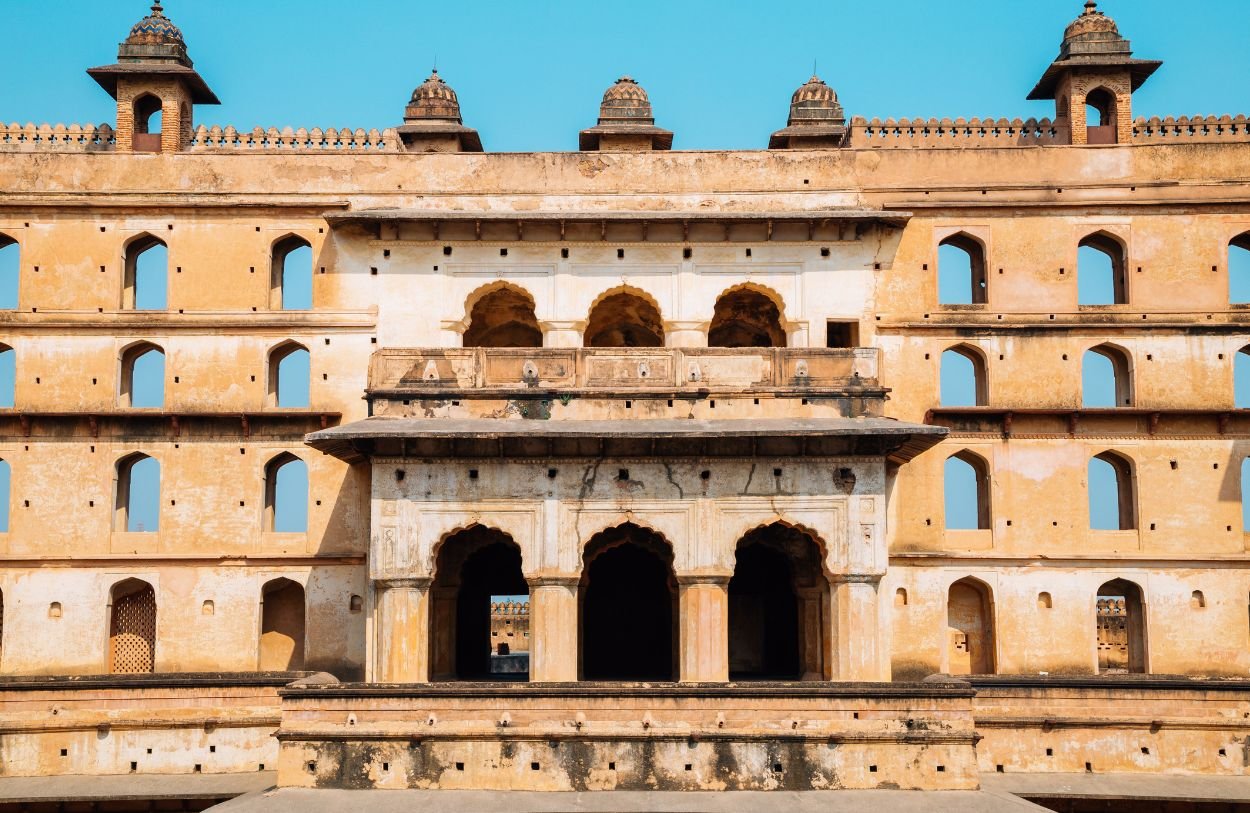
The historic Raja Mahal in Orchha showcases traditional Bundela architecture through its grand courtyard, elegant arches and multi-storeyed royal galleries.
Raja Mahal Orchha: History, Architecture, Murals and Travel Guide
Raja Mahal in Orchha is one of the most remarkable surviving royal palaces of the Bundela dynasty in Madhya Pradesh. Known for its imposing courtyards, elegant arches and richly decorated interiors, the palace offers visitors a fascinating glimpse into the history and artistic traditions of medieval Bundelkhand.
Located within the historic Orchha Fort Complex, Raja Mahal Orchha stands beside the more elaborate Jahangir Mahal. Although its exterior appears relatively simple, the palace contains beautiful wall paintings depicting scenes from Hindu mythology, particularly the Ramayana and the life of Lord Krishna.
Built and developed during the 16th century, Raja Mahal served as a royal residence for the Bundela rulers. Its architecture combines Rajput traditions with elements that also appear in Mughal buildings, creating a distinctive regional style.
Today, travellers can explore its courtyards, historic chambers, decorative paintings and architectural details while discovering the heritage of one of central India’s former royal capitals.
History of Raja Mahal in Orchha
The history of Raja Mahal reflects the rise of the Bundela dynasty and the development of Orchha as an important political centre.
Bundela chief Rudra Pratap Singh established Orchha in the early 16th century. His successors developed the town into a fortified royal capital beside the Betwa River.
Raja Mahal belongs to this period of expanding royal architecture.
Historical accounts associate the palace’s early construction with Rudra Pratap Singh and its development with subsequent Bundela rulers, including Bharti Chand and Madhukar Shah.
Official heritage descriptions differ on the precise sequence of construction. However, they consistently place the palace’s main development within the 16th-century Bundela period.
Raja Madhukar Shah and the Royal Palace
Raja Madhukar Shah ruled Orchha during the second half of the 16th century and was a contemporary of Mughal Emperor Akbar.
He played an important role in the kingdom’s political, religious and cultural life.
Raja Mahal became closely associated with his reign and the artistic traditions that flourished under Bundela royal patronage.
Madhukar Shah is also remembered in the religious traditions of Orchha, particularly the stories surrounding Lord Rama and the royal family.
His wife, Queen Ganesh Kunwari, features prominently in local accounts of how Lord Rama came to Orchha.
These traditions remain important to the town’s identity, especially at the nearby Ram Raja Temple.
Architecture of Raja Mahal: Rajput and Mughal Influences
Raja Mahal presents an interesting contrast between its restrained exterior and decorated interior spaces.
The palace reflects the Bundeli architectural tradition, which developed through a combination of regional Rajput styles and architectural influences associated with the Mughal period.
Its design emphasises proportion, symmetry and the careful arrangement of courtyards, residential chambers and upper-storey pavilions.
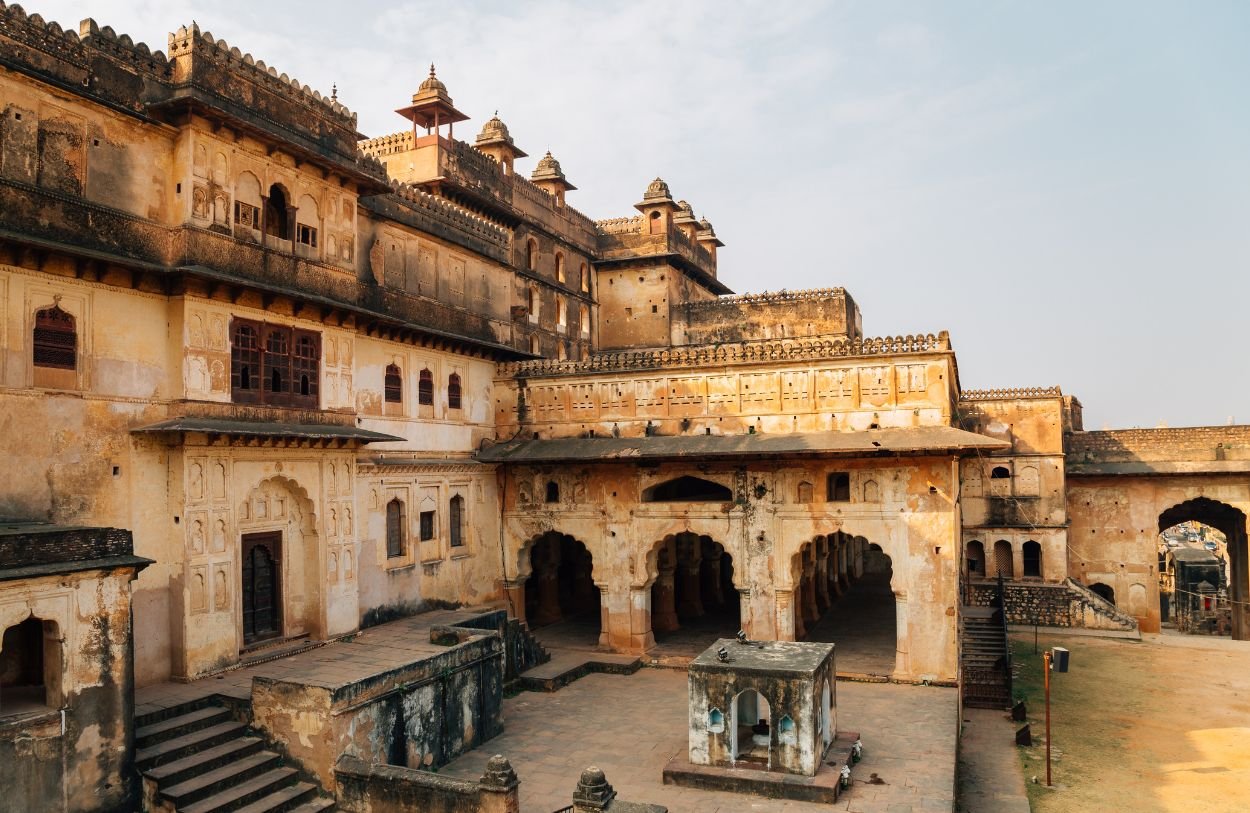
The historic Raja Mahal within Orchha Fort Complex in Madhya Pradesh, India, showcases magnificent Bundela architecture, weathered sandstone walls, ornate arches and traditional royal courtyards.
A Simple Yet Imposing Exterior
Unlike the highly ornamental Jahangir Mahal, Raja Mahal has a comparatively austere exterior.
Its substantial walls, repeated architectural elements and carefully arranged openings create a strong visual impression without elaborate external decoration.
Domed pavilions called chhatris rise above parts of the structure, contributing to its traditional royal appearance.
Projecting balconies and ornamental stonework provide additional architectural interest.
The palace’s relatively simple outer surfaces make its decorated interior even more striking.
The Grand Central Courtyard
One of Raja Mahal’s defining features is its large central courtyard.
Multi-storeyed galleries surround the open space, creating a balanced arrangement of arches, balconies and interconnected rooms.
The courtyard formed an important part of the palace’s design, connecting different sections of the royal residence.
Visitors can appreciate how the surrounding galleries create changing patterns of light and shadow throughout the day.
From suitable viewing points, the arrangement also reveals the impressive scale of the historic building.
The courtyard provides an excellent introduction to the geometry and spatial planning characteristic of Bundela palace architecture.
Arches, Balconies and Stone Latticework
Raja Mahal incorporates several architectural features associated with royal buildings of its period.
These include:
- Decorative arches and pillared galleries.
- Projecting balconies overlooking the courtyards.
- Domed chhatris and elevated pavilions.
- Carved stone lattice screens known as jalis.
- Interconnected chambers and passages.
- Upper-level spaces offering different architectural viewpoints.
The stone screens and open galleries demonstrate how the designers balanced decoration with practical requirements such as daylight and ventilation.
Together, these features contribute to the palace’s distinctive appearance.
The Beautiful Murals of Raja Mahal
The surviving murals are among the most important reasons to visit Raja Mahal.
While the exterior showcases the palace’s architectural strength, the interior paintings reveal the artistic interests and religious traditions of the Bundela court.
The wall and ceiling decorations include intricate compositions inspired by Hindu religious narratives.
Paintings from the Ramayana
Several surviving paintings draw inspiration from the Ramayana.
These artworks reflect the importance of Lord Rama and the broader Vaishnava tradition in Bundelkhand’s cultural history.
The compositions use figures, decorative patterns and narrative arrangements to communicate religious themes.
Visitors interested in Indian art should take time to examine the surviving details rather than rushing through the painted chambers.
Krishna Leela and Hindu Mythology
Other paintings feature episodes associated with Lord Krishna.
These scenes belong to the artistic tradition often described as Krishna Leela, which illustrates events and stories from Krishna’s life.
Decorative borders, floral motifs and carefully arranged figures enhance the paintings.
The murals also reveal the relationship between royal patronage and religious artistic expression.
Paintings in the Royal Chambers
The palace’s former audience halls, traditionally identified as the Diwan-e-Aam and Diwan-e-Khas, are particularly associated with the surviving decorative paintings.
Some murals retain vivid colours and intricate details, while others show the effects of age and exposure.
This contrast makes the importance of conservation immediately apparent.
Visitors should avoid touching painted walls and follow all restrictions on photography and flash.
Even where photography is permitted, photographing without flash is a sensible precaution around historic artwork.
The Royal Audience Halls
Raja Mahal contains spaces traditionally associated with the public and private functions of the royal court.
Diwan-e-Aam
The Diwan-e-Aam, or public audience hall, reflects the formal nature of royal administration.
Such spaces allowed rulers to conduct official business, receive visitors and interact with representatives of their kingdom.
Its architectural features help visitors imagine the palace as an active centre of government rather than simply a royal residence.
Diwan-e-Khas
The Diwan-e-Khas, or private audience hall, served a more restricted ceremonial and administrative role.
The decorative details associated with these spaces provide insight into how architecture expressed royal authority and prestige.
Together, the audience halls and residential chambers help explain the different functions of the palace.
Raja Mahal and the Religious Traditions of Orchha
Raja Mahal’s history connects with the religious traditions surrounding Madhukar Shah and his royal family.
According to local legend, Madhukar Shah was devoted to Lord Krishna, while Queen Ganesh Kunwari worshipped Lord Rama.
The queen’s pilgrimage to Ayodhya and the subsequent arrival of Lord Rama in Orchha form an important part of the town’s religious heritage.
Tradition holds that the queen installed an image of Lord Rama in her palace, where it remained.
That former palace became the Ram Raja Temple, where devotees worship Lord Rama as the king of Orchha.
Raja Mahal and Ram Raja Temple are separate historic buildings. Visitors should not confuse the royal residence within the fort complex with the former queen’s palace that now functions as a temple.
Exploring both sites helps travellers understand the close relationship between royal history and religious life in Orchha.
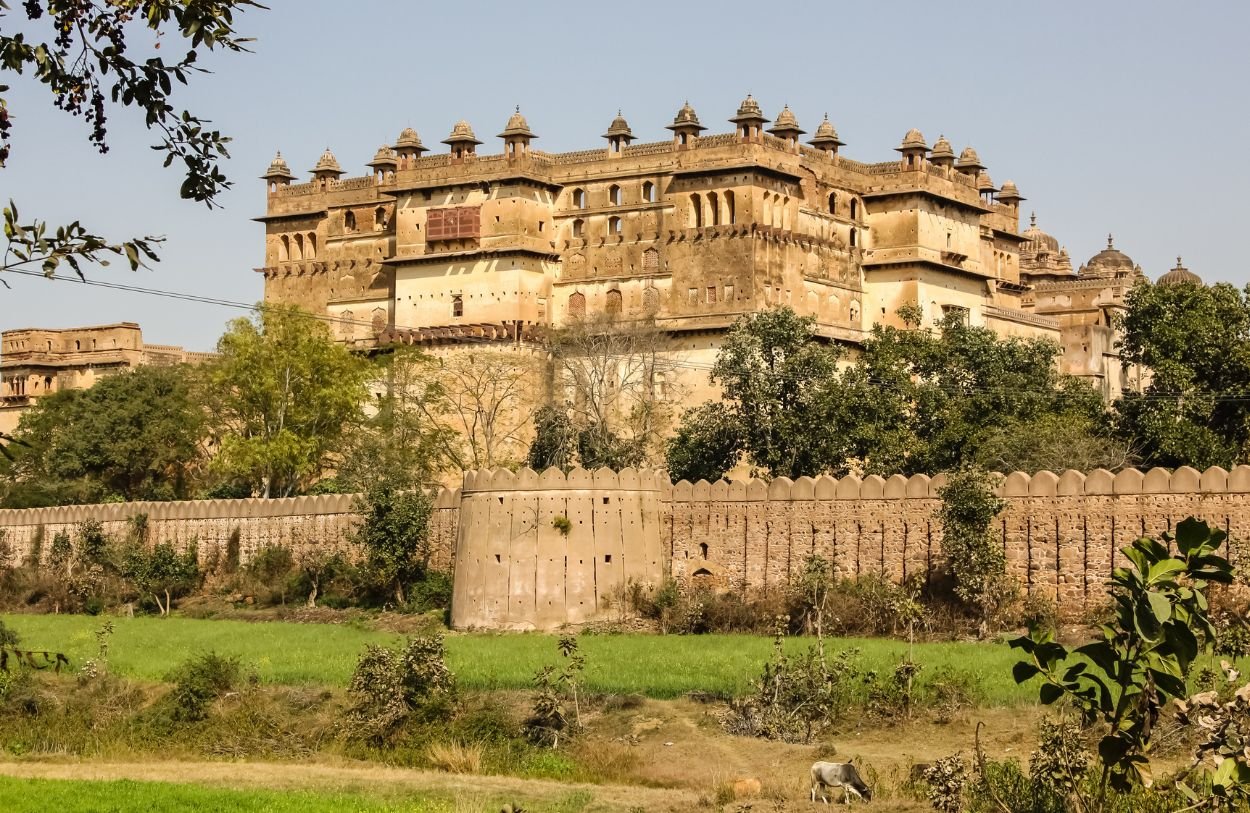
The magnificent Raja Mahal in Orchha, Madhya Pradesh, rises above historic fortified walls, showcasing the impressive sandstone architecture and royal heritage of the Bundela dynasty.
Raja Mahal and the Historic Ensemble of Orchha
Raja Mahal forms part of Orchha’s wider historic landscape, which includes palaces, temples, gardens and royal cenotaphs.
The buildings reflect centuries of Bundela architectural development beside the Betwa River.
In 2019, India included the Historic Ensemble of Orchha on its UNESCO World Heritage Tentative List.
The recognition highlights the cultural and architectural importance of the town, including its distinctive combination of Rajput and Mughal influences.
However, a Tentative List entry does not mean the site has received formal UNESCO World Heritage inscription.
Raja Mahal contributes to this historic ensemble through its royal architecture, surviving paintings and association with the Bundela court.
Visiting Raja Mahal in Orchha
Raja Mahal stands inside the Orchha Fort Complex, close to Jahangir Mahal.
The palace is one of the principal stops on a heritage tour of Orchha.
Opening Hours and Entry Tickets
Incredible India, the official tourism portal of the Government of India, lists Raja Mahal as open daily from sunrise to sunset.
However, actual ticket-counter arrangements, access to individual chambers and visitor restrictions may change.
Entry normally forms part of the ticketed monument-visiting arrangements for Orchha’s fort complex.
Before visiting, confirm the current admission charges, ticket validity and permitted areas at the official entrance.
Avoid relying on old online ticket prices, particularly when planning a group visit.
How Long Should You Spend at Raja Mahal?
Allow approximately one to two hours for a relaxed visit, depending on your interest in architecture and historical painting.
Travellers who mainly want to see the courtyard and principal rooms may need less time.
However, photography enthusiasts and visitors interested in Bundela history may prefer to explore at a slower pace.
It is also worth allowing additional time for neighbouring Jahangir Mahal.
Best Time to Visit
October to March is generally the most comfortable period for sightseeing in Orchha.
During these months, visitors can explore the open courtyards and surrounding monuments without the intense heat associated with peak summer.
Early morning is particularly pleasant for photography, as the softer light brings out architectural details.
During April, May and June, temperatures can become extremely high.
Carry drinking water and avoid spending too much time in exposed courtyards during the hottest hours.
The monsoon brings greener surroundings but may make historic stone surfaces slippery.
How to Reach Raja Mahal Orchha
Raja Mahal is located in Orchha, Niwari district, Madhya Pradesh.
The town is approximately 16 kilometres from Jhansi, making it accessible as a day trip or part of a longer heritage itinerary.
By Train
Virangana Lakshmibai Jhansi Junction, formerly known as Jhansi Junction, is the nearest major railway station.
It offers connections with several important Indian cities.
From Jhansi, visitors can continue to Orchha by taxi or local road transport.
Orchha also has a smaller railway station, but it offers fewer train options than Jhansi.
By Road
Orchha has road connections with Jhansi, Gwalior and Khajuraho.
Visitors arriving by private vehicle or taxi can travel directly towards the historic town and fort complex.
Check current road conditions and parking arrangements before travelling.
By Air
Gwalior and Khajuraho are the principal airports to consider when planning a trip to Orchha.
Both require an onward road journey.
Flight availability varies, so compare current connections before choosing your route.
Other Attractions Near Raja Mahal
Raja Mahal is ideally situated for exploring several of Orchha’s other major landmarks.
Jahangir Mahal
Jahangir Mahal stands beside Raja Mahal within the fort complex.
Built during the reign of Bir Singh Deo, the palace is associated with Mughal Emperor Jahangir.
Its imposing courtyards, balconies, decorative gateways and domes provide a striking contrast to Raja Mahal’s simpler architecture.
Sheesh Mahal
Sheesh Mahal forms another part of Orchha’s historic palace complex.
The building has served as a heritage hotel under Madhya Pradesh Tourism.
Visitors should distinguish between areas open for heritage sightseeing and spaces reserved for hotel guests.
Ram Raja Temple
The Ram Raja Temple is among Orchha’s most important religious attractions.
Its royal traditions and distinctive history make it a valuable addition to a palace-focused itinerary.
The temple continues to function as an active place of worship.
Chaturbhuj Temple
Chaturbhuj Temple dominates the town’s skyline with its massive towers and distinctive architectural form.
Its design combines characteristics of monumental Hindu temple architecture with fort-like elements.
The temple is particularly interesting when viewed from different parts of the historic town.
Royal Cenotaphs Along the Betwa River
The Bundela royal cenotaphs, known as chhatris, stand beside the Betwa River.
Their domed pavilions and tall towers create one of Orchha’s most recognisable landscapes.
Late afternoon can be a rewarding time to photograph the cenotaphs from safe riverside viewpoints.
Sound-and-Light Show at Orchha Fort
Orchha Fort hosts a sound-and-light experience that introduces visitors to the history of the Bundela rulers.
The presentation combines narration, illumination and music to bring the town’s royal past to life.
It is worth considering if you plan to stay in Orchha after sunset.
However, official tourism sources publish different seasonal timings and admission figures.
Confirm the current schedule, language, ticket price and operating status locally before planning your evening around the show.
Practical Tips for Visiting Raja Mahal
A few precautions can improve your visit and help protect the historic monument.
- Wear comfortable shoes: Stairways, stone paths and older floor surfaces may be uneven.
- Carry drinking water: The open courtyards can become hot during the summer.
- Protect the murals: Do not touch or lean against historic painted surfaces.
- Follow photography rules: Ask before using flash, tripods or professional camera equipment.
- Stay within permitted areas: Some upper sections or chambers may have restricted access.
- Consider a local guide: A knowledgeable guide can explain the palace’s architecture and history.
- Combine nearby attractions: Jahangir Mahal and the surrounding fort complex are convenient additions.
- Check current arrangements: Verify tickets, opening access and evening show details at the visitor entrance.
Frequently Asked Questions About Raja Mahal Orchha
Who built Raja Mahal in Orchha?
Raja Mahal developed during the 16th-century Bundela period. Historical accounts associate its beginnings with Rudra Pratap Singh and later construction with subsequent rulers, especially Madhukar Shah. Sources differ on the precise construction sequence.
What is Raja Mahal famous for?
Raja Mahal is famous for its Bundela royal architecture, large central courtyard, chhatris, decorative galleries and beautiful murals depicting Hindu religious themes.
Where is Raja Mahal located?
Raja Mahal stands within the Orchha Fort Complex in Niwari district, Madhya Pradesh, close to Jahangir Mahal.
Is Raja Mahal the same as Jahangir Mahal?
No. Raja Mahal and Jahangir Mahal are separate buildings within the Orchha Fort Complex. Raja Mahal served as a royal residence, while Jahangir Mahal is particularly associated with Bir Singh Deo and Mughal Emperor Jahangir.
Can tourists visit Raja Mahal?
Yes. Raja Mahal is a recognised heritage attraction open to visitors under the fort complex’s admission arrangements. Check current ticket prices and access restrictions before visiting.
What paintings can visitors see inside Raja Mahal?
The surviving wall paintings include religious scenes inspired by the Ramayana and Krishna Leela, along with decorative motifs characteristic of Bundela artistic traditions.
Is Raja Mahal a UNESCO World Heritage Site?
No. Raja Mahal forms part of the Historic Ensemble of Orchha, which appears on India’s UNESCO World Heritage Tentative List. The ensemble has not received formal World Heritage inscription.
How far is Raja Mahal from Jhansi?
Orchha is approximately 16 kilometres from Jhansi. Raja Mahal lies within the town’s historic fort complex and can be reached by road.
Experience the Royal Heritage of Raja Mahal
Raja Mahal reveals an important chapter of Orchha’s history through its monumental courtyards, elegant architectural details and surviving wall paintings.
The palace’s simple exterior contrasts with its richly decorated chambers, reflecting the distinctive artistic vision of the Bundela rulers.
Visitors can explore the royal residence while discovering how Rajput traditions and Mughal influences shaped the architecture of medieval Bundelkhand.
Together with Jahangir Mahal, Ram Raja Temple and the riverside cenotaphs, Raja Mahal offers a rewarding introduction to the history and cultural heritage of Orchha.
For travellers interested in historic Indian palaces, architecture and traditional mural painting, Raja Mahal remains one of the town’s essential attractions.
