
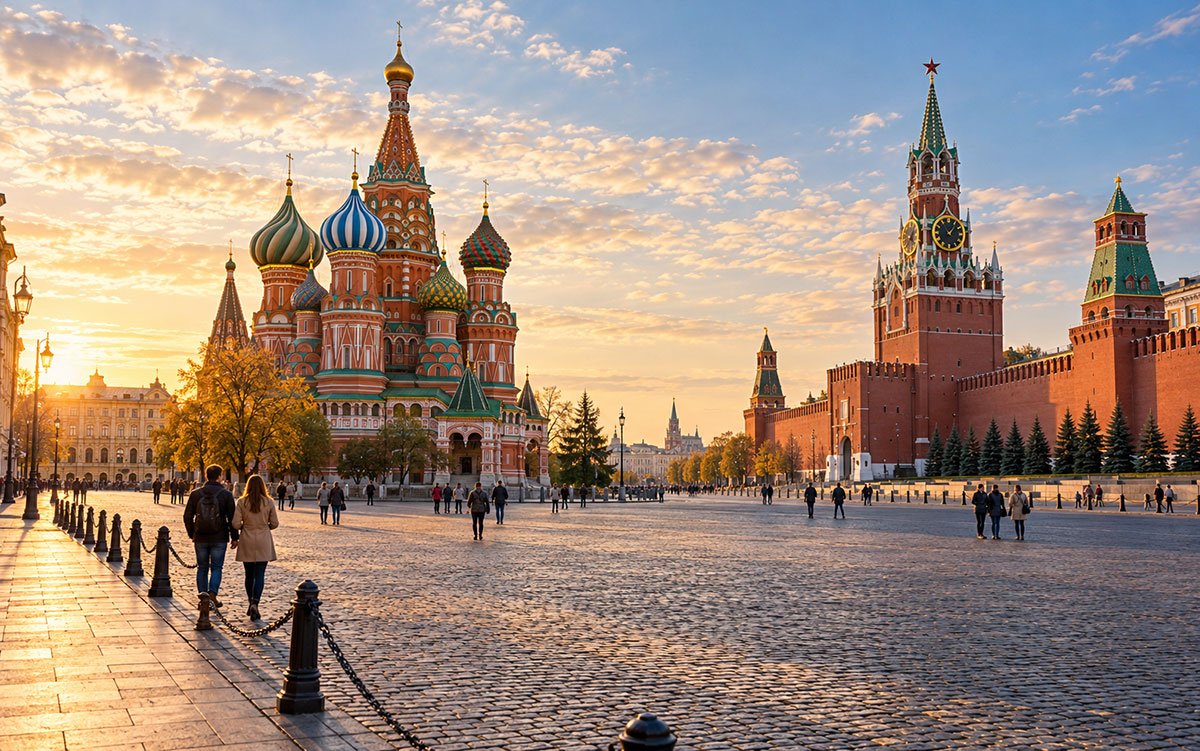
Red Square and St Basil’s Cathedral are among Russia’s most recognisable historic landmarks, reflecting Moscow’s remarkable architectural heritage.
Places to Visit in Russia: 5 Remarkable Landmarks and Travel Tips
Russia stretches across Europe and Asia, encompassing historic cities, vast forests, mountain ranges and some of the world’s most remarkable freshwater landscapes. Its cultural heritage is equally varied, from Moscow’s colourful cathedral domes to the ornate imperial palaces of St Petersburg and the traditional wooden churches of Karelia.
Among the most fascinating places to visit in Russia are Red Square in Moscow, Mount Elbrus in the Caucasus Mountains, Kizhi Island on Lake Onega, Lake Baikal in Siberia and the State Hermitage Museum in St Petersburg.
Each destination reveals a different aspect of the country’s geography, architecture and history. However, Russia’s enormous size means that exploring these attractions requires careful planning. The distances are considerable, seasonal conditions vary dramatically, and access to some remote areas depends on specialised transport.
There is also an important consideration for international travellers. Several governments, including those of the United Kingdom, United States and Australia, currently advise against travelling to Russia because of security risks associated with the ongoing war in Ukraine, possible detention, transport disruptions and limited consular assistance.
This guide explores five remarkable Russian landmarks, explains what makes them significant and outlines the practical and safety considerations travellers should understand when researching a future journey.
1. Mount Elbrus: Discover the Highest Peak in the Caucasus
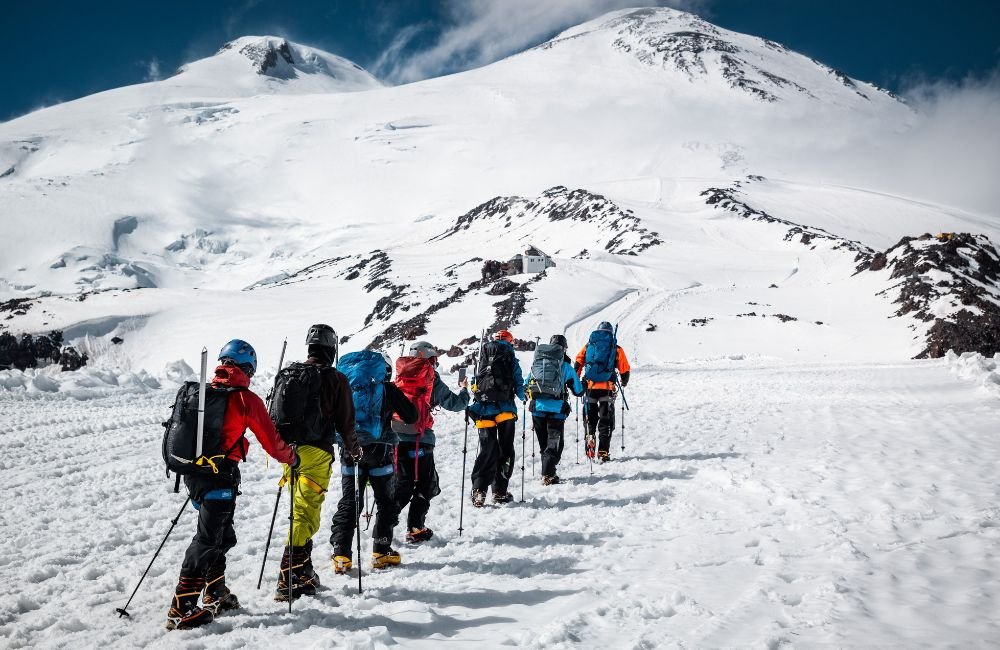
Mountaineers ascend the snow-covered slopes of Mount Elbrus, Europe’s highest mountain, rising 5,642 metres above the Caucasus landscape in southern Russia.
Mount Elbrus rises above the Caucasus Mountains in southern Russia, near the border with Georgia.
At 5,642 metres (18,510 feet), it is the highest mountain in Russia and is generally recognised as Europe’s highest peak under the geographical convention that places the Greater Caucasus within Europe.
It is also one of the Seven Summits, the highest mountains on each of the world’s seven continents.
Its enormous snow-covered slopes, glaciers and twin summits create one of Russia’s most distinctive mountain landscapes.
What makes Mount Elbrus special?
Unlike many mountain peaks, Elbrus is a stratovolcano with two prominent summits.
The western summit reaches 5,642 metres, while the eastern summit stands at approximately 5,621 metres.
The volcano’s last known eruption is dated to around 50 CE by the Smithsonian Institution’s Global Volcanism Program.
Today, the mountain is associated with mountaineering, high-altitude skiing and outdoor recreation.
The surrounding Prielbrusye National Park contains dramatic mountain valleys, glaciers and alpine scenery.
Can visitors reach Mount Elbrus without climbing?
The Elbrus resort area has cable cars that provide access to high mountain viewpoints and ski areas.
The lift system reaches approximately 3,847 metres, although operating arrangements depend on the weather and resort conditions.
Visitors interested primarily in mountain scenery do not necessarily need to attempt the summit.
However, ascending to such elevations can still cause altitude-related illness, even without undertaking a strenuous climb.
Anyone considering a high-altitude excursion should obtain appropriate medical advice and assess their physical condition.
Is Mount Elbrus suitable for beginner climbers?
Reaching the summit is a serious mountaineering undertaking.
Although some routes are less technically difficult than climbs on other major peaks, Elbrus presents substantial risks.
These include severe weather, extreme cold, glacier crevasses, poor visibility, exhaustion and altitude sickness.
The presence of cable cars does not make the summit a casual hiking destination.
A successful ascent requires suitable experience, equipment, acclimatisation and professional mountain guidance.
Travellers should also recognise that the North Caucasus has additional regional security concerns. Official foreign travel advice must take priority over recreational climbing plans.
Best for: Mountain enthusiasts, experienced climbers, alpine landscape photography and travellers interested in Russia’s geography.
2. Red Square, Moscow: Explore the Heart of Russian History
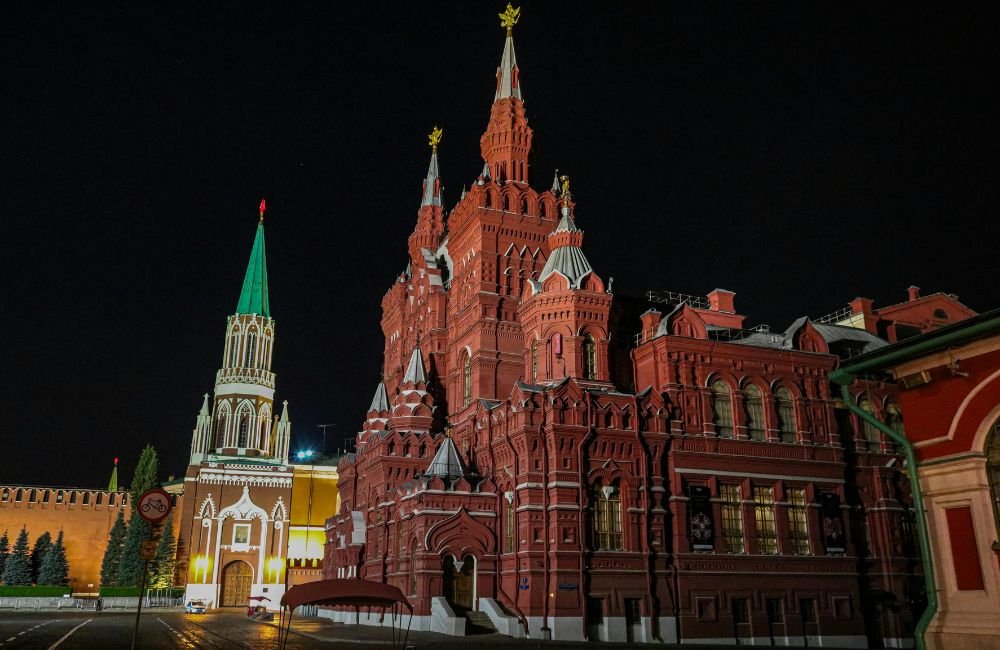
The magnificent State Historical Museum and Nikolskaya Tower illuminate Moscow’s historic Red Square, showcasing Russia’s distinctive architectural heritage after dark.
Red Square is one of Russia’s most recognisable historic landmarks.
Located beside the Moscow Kremlin, the square has been associated with important events in the country’s political, religious and cultural history.
The Kremlin and Red Square were inscribed together on the UNESCO World Heritage List in 1990.
The surrounding buildings represent several periods of Russian architecture, creating a remarkable setting for anyone interested in the country’s heritage.
What can you see around Red Square?
Several important landmarks surround the square.
St Basil’s Cathedral
Known for its colourful onion-shaped domes, St Basil’s Cathedral is among Moscow’s most distinctive architectural monuments.
The cathedral was constructed during the reign of Ivan IV in the sixteenth century.
Its unusual arrangement of chapels, towers and decorative details makes it a major example of Russian religious architecture.
The Moscow Kremlin
The Kremlin stands beside Red Square and contains historic walls, towers, churches and government buildings.
Its architectural ensemble reflects centuries of political and religious history.
Some areas serve official government functions, and public access is subject to security arrangements.
The State Historical Museum
The State Historical Museum occupies an imposing red-brick building near the northern end of Red Square.
Its collections explore different periods of Russian history, archaeology and material culture.
GUM Department Store
GUM is a historic shopping complex facing Red Square.
Its elaborate nineteenth-century architecture provides a contrast to the surrounding religious and civic monuments.
Is Red Square open to visitors?
Red Square is a public space, but access may be temporarily restricted for ceremonies, security operations or major events.
Nearby museums and historic buildings operate under separate admission arrangements.
Visitors should not assume that access to the square guarantees entry to the Kremlin or cathedral.
Where applicable, confirm admission details through official museum websites.
Why is Red Square worth exploring?
The square offers an unusually concentrated collection of important Russian landmarks.
It is particularly interesting for travellers who want to understand how architecture, religion and public life have shaped Moscow over several centuries.
The surrounding historic streets and buildings also provide context beyond the most familiar photographs of St Basil’s Cathedral.
Best for: History enthusiasts, architecture lovers, photographers and travellers interested in Russian cultural heritage.
3. Kizhi Island: Discover Russia’s Extraordinary Wooden Churches
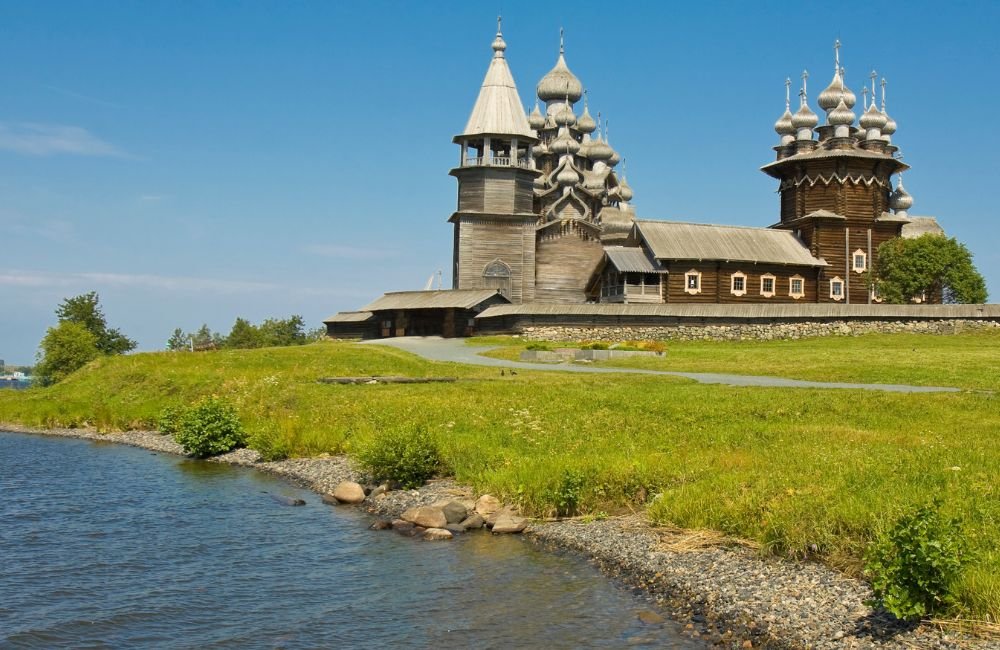
The remarkable wooden churches of Kizhi Island stand beside Lake Onega in Russia’s Republic of Karelia, showcasing traditional Russian architecture and UNESCO World Heritage.
Kizhi Island lies in Lake Onega, in the Republic of Karelia in northwestern Russia.
The island is internationally recognised for its historic wooden architecture and traditional craftsmanship.
Its most celebrated attraction is Kizhi Pogost, a UNESCO World Heritage Site comprising two wooden churches and an octagonal bell tower.
The buildings are remarkable not only for their appearance but also for the traditional construction methods used by their builders.
The Church of the Transfiguration
The Church of the Transfiguration is the best-known structure at Kizhi Pogost.
Its most distinctive feature is the arrangement of 22 onion-shaped domes rising above the wooden church.
The complex design demonstrates the skill of traditional Russian carpenters, who developed elaborate structural forms using timber.
The domes create a particularly memorable silhouette against the surrounding lake and countryside.
The church is an outstanding example of traditional northern Russian ecclesiastical architecture.
The Church of the Intercession
The nearby Church of the Intercession has a more restrained appearance.
Its central dome is surrounded by eight smaller domes, creating another example of the region’s distinctive wooden architectural traditions.
Together with the bell tower, the churches form a coherent historic ensemble.
Their setting on a narrow part of Kizhi Island adds to their visual significance.
Explore the Kizhi Open-Air Museum
Beyond the UNESCO-listed churches, the island contains traditional wooden buildings associated with rural life in Karelia.
The wider museum collection includes houses, chapels and other historic structures.
Visitors can learn about local craftsmanship, architecture and the daily lives of earlier generations.
The museum’s exhibitions help explain how people adapted to the climate and natural environment of northern Russia.
How do visitors reach Kizhi Island?
Kizhi Island is commonly reached by water transport from Petrozavodsk, the capital of Karelia.
During the warmer months, scheduled hydrofoil services provide access to the island.
Services generally operate seasonally, with schedules dependent on weather and navigation conditions.
The museum itself has arrangements for visits outside the principal summer season, but winter access requires different transport planning.
Travellers should check both the official Kizhi Museum website and the relevant transport operator before arranging a visit.
Museum admission and boat transport are normally separate expenses.
When is the best time to explore Kizhi?
Late spring to early autumn generally provides the most straightforward conditions for exploring the island.
During these months, visitors can appreciate the wooden buildings against green meadows and the blue waters of Lake Onega.
However, even summer weather can be changeable.
Carry suitable outerwear and allow flexibility for transport disruptions.
Kizhi is especially rewarding for visitors who prefer historic architecture and cultural heritage rather than conventional city sightseeing.
Best for: Architecture enthusiasts, heritage travellers, photographers and visitors interested in traditional craftsmanship.
4. Lake Baikal: Experience Siberia’s Extraordinary Freshwater Landscape
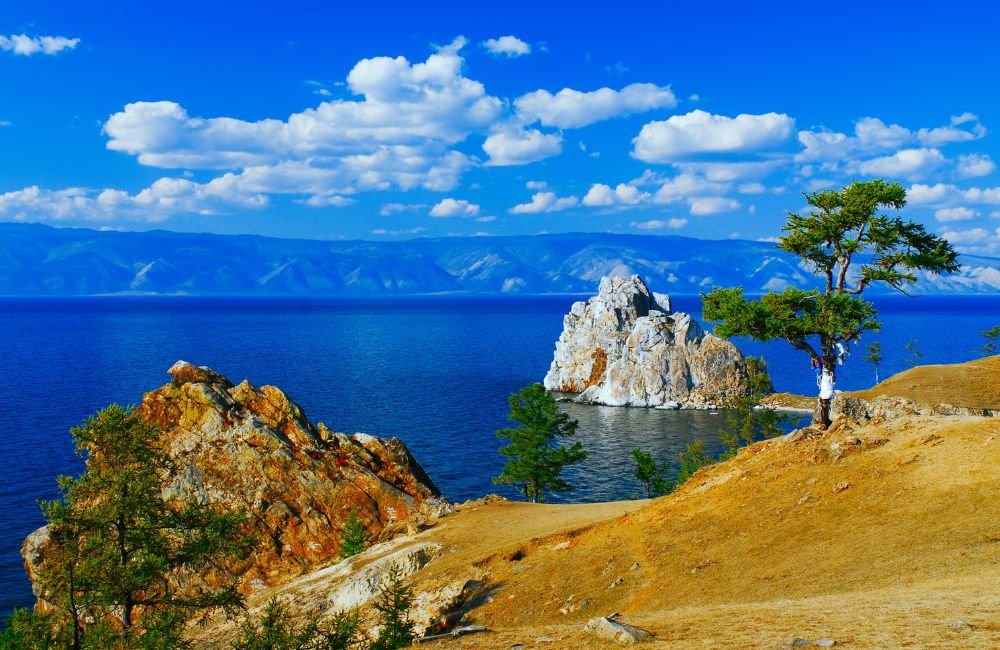
Lake Baikal in Siberia offers breathtaking scenery, with crystal-blue waters, rugged rock formations and mountain landscapes surrounding the world’s deepest freshwater lake.
Lake Baikal is one of the world’s most remarkable natural landmarks.
Located in southeastern Siberia, it is recognised by UNESCO as the oldest and deepest freshwater lake on Earth.
The lake is estimated to be approximately 25 million years old and reaches a maximum depth of more than 1,600 metres.
It contains around one-fifth of the world’s unfrozen surface freshwater reserves.
Its exceptional age, depth and isolation have allowed distinctive ecosystems to develop, making it internationally important for biodiversity and scientific research.
What makes Lake Baikal unique?
Baikal is surrounded by mountains, forests, rocky shorelines and protected natural landscapes.
Its waters are known for remarkable clarity in certain locations and seasons.
The lake also supports wildlife found nowhere else on Earth.
One of its most famous inhabitants is the Baikal seal, or nerpa, a freshwater seal species endemic to the lake.
The surrounding environment contains a rich variety of plants and animals associated with the Siberian landscape.
Places of interest around Lake Baikal
The lake is enormous, so visitors should focus on specific areas rather than attempting to explore its entire shoreline.
Listvyanka
Listvyanka is a settlement on the southwestern side of Lake Baikal, accessible by road from Irkutsk.
It provides an introduction to the lake’s geography and local environment.
Olkhon Island
Olkhon is the largest island in Lake Baikal.
It is known for rocky shorelines, open landscapes and places of cultural significance to local communities.
Transport to the island depends on seasonal conditions, and visitors should verify current access arrangements.
Circum-Baikal Railway
Sections of the historic Circum-Baikal Railway follow the lake’s southwestern shoreline.
Its tunnels, bridges and lakeside views illustrate the engineering challenges of constructing rail infrastructure through this landscape.
Available excursion services and access arrangements should be checked with the relevant operators.
Lake Baikal in summer
The warmer months offer opportunities to appreciate the surrounding forests, shorelines and mountain scenery.
Walking, landscape photography and organised nature excursions are among the activities associated with the region.
Even during summer, the lake’s water can remain dangerously cold.
Swimming should only be considered where local conditions and safety guidance make it appropriate.
Lake Baikal in winter
Winter transforms parts of the lake into a dramatic frozen landscape.
Ice formations, snow-covered shores and clear winter skies can create striking photographic conditions.
However, frozen lake surfaces are not uniformly safe.
Ice thickness, fractures, currents and weather can create serious hazards.
Visitors should never travel across the ice independently without verified local safety information and suitable professional arrangements.
Can you drink water directly from Lake Baikal?
No traveller should assume that untreated lake water is safe to drink simply because it appears clear.
Natural water can contain microorganisms or other contaminants that are not visible.
Use treated drinking water or an appropriate purification method.
Protecting Lake Baikal
Lake Baikal’s UNESCO World Heritage status reflects its exceptional ecological importance.
Tourism can place pressure on its fragile environment, particularly in heavily visited areas.
Travellers should respect protected-area rules, dispose of waste responsibly and avoid disturbing wildlife.
Choose responsible operators who follow conservation requirements and respect local communities.
Best for: Nature enthusiasts, landscape photographers, wildlife observers and travellers interested in Siberia’s natural heritage.
5. The Winter Palace and Hermitage Museum, St Petersburg: Discover Imperial Art and Architecture
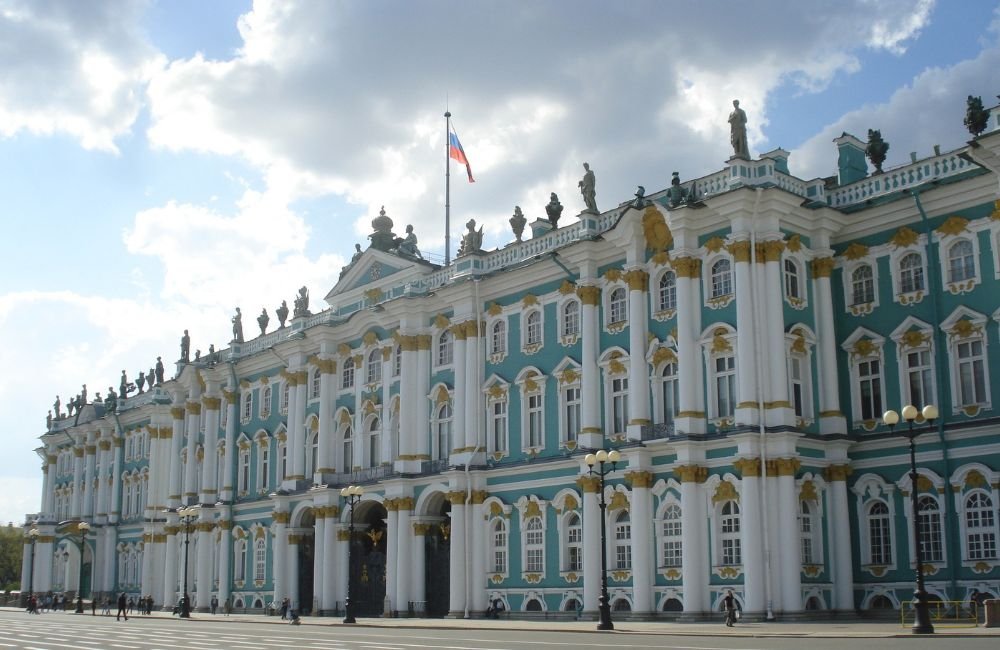
The magnificent Winter Palace in St Petersburg houses the State Hermitage Museum, one of the world’s leading art museums and a celebrated landmark of Russian imperial architecture.
St Petersburg is renowned for its grand architecture, rivers and canals.
Among its most important landmarks is the Winter Palace, a magnificent building associated with the city’s imperial history.
The palace forms part of the State Hermitage Museum‘s main complex, one of the world’s major art and cultural institutions.
The wider historic centre of St Petersburg is recognised as a UNESCO World Heritage Site.
The Winter Palace
The Winter Palace stands beside Palace Square, close to the Neva River.
Its elaborate Baroque architecture reflects the grandeur of imperial St Petersburg.
The building is particularly recognisable for its extensive façade, classical columns, decorative details and large ceremonial interiors.
For many visitors, the palace architecture is as memorable as the artworks displayed inside.
What can you see at the State Hermitage Museum?
The museum’s collections cover an extensive range of artistic and historical periods.
Visitors can explore:
- European painting and sculpture.
- Ancient Greek and Roman art.
- Egyptian antiquities.
- Decorative arts and historic furnishings.
- Imperial interiors and ceremonial halls.
- Exhibitions exploring different cultures and artistic traditions.
The museum includes works by major European artists, although individual artworks may be moved or temporarily unavailable.
Check the official museum website if you intend to see a particular collection.
How much time should you allow for the Hermitage?
The Hermitage is a large museum complex.
Trying to see everything in one visit is unrealistic.
A more rewarding approach is to identify the galleries, collections or historic interiors that interest you most.
Allow several hours for a focused visit rather than rushing through numerous rooms.
The main museum complex and associated buildings have different admission arrangements.
The Winter Palace of Peter the Great
Visitors should distinguish the main Winter Palace from the separately operated Winter Palace of Peter the Great.
The latter is another Hermitage museum attraction associated with Peter I and the early history of St Petersburg.
It has its own guided-tour arrangements.
Check which museum or palace is included when researching or purchasing a ticket.
Planning a museum visit
The official State Hermitage Museum website provides information about admission, exhibitions, visitor rules and operating hours.
Museum schedules can change because of public holidays, special events or maintenance.
The central location also makes the surrounding architecture of Palace Square and the Neva embankment important parts of the city’s heritage landscape.
Best for: Art enthusiasts, history lovers, architecture photographers and cultural travellers.
Which Russian Landmarks Are Most Suitable for Different Interests?
These five destinations represent very different kinds of experiences.
| Destination | Region | Main attraction | Best suited to |
|---|---|---|---|
| Mount Elbrus | Northern Caucasus | High-altitude mountains and glaciers | Experienced mountaineers and mountain enthusiasts |
| Red Square | Moscow | Historic landmarks and architecture | Cultural and history travellers |
| Kizhi Island | Karelia | UNESCO-listed wooden churches | Architecture and heritage enthusiasts |
| Lake Baikal | Siberia | Freshwater ecosystems and natural scenery | Nature lovers and photographers |
| Winter Palace and Hermitage | St Petersburg | Imperial architecture and art collections | Art and museum enthusiasts |
The locations are widely separated geographically. They should not be treated as five convenient stops on a short city-break itinerary.
When Is the Best Time to Explore Russia’s Attractions?
Russia covers an enormous geographical area, so seasonal conditions differ considerably between regions.
Spring: Changing Landscapes
Spring brings longer daylight hours and gradual warming to many areas.
However, snow and ice may remain in northern and mountainous regions.
Some seasonal transport services do not begin operating until later in spring.
Summer: Historic Cities and Northern Landscapes
Summer generally provides favourable conditions for exploring outdoor attractions in Moscow, St Petersburg and Karelia.
It is also an important season for conventional visitor transport to Kizhi Island.
Lake Baikal’s surroundings can be attractive for hiking and landscape photography during the warmer months.
Mount Elbrus requires separate high-altitude weather and safety assessment, regardless of the season.
Autumn: Colourful Forests and Cooler Conditions
Autumn brings changing colours to many Russian forest landscapes.
Moscow and St Petersburg can also offer pleasant conditions for cultural sightseeing earlier in the season.
However, daylight hours shorten and temperatures decline.
Winter: Snow and Distinctive Northern Scenery
Winter transforms many regions into snow-covered landscapes.
Lake Baikal becomes associated with ice scenery, while mountain regions offer winter sports in suitable conditions.
However, severe cold, snowfall, limited daylight and transport disruptions can complicate journeys.
The correct season depends on the specific attraction and activity, not simply the country as a whole.
Is Russia Safe for International Tourists?
Russia’s cultural and natural attractions remain significant, but the country’s current security situation is an essential part of travel planning.
The UK Foreign, Commonwealth & Development Office advises against all travel to Russia.
The US Department of State also maintains its highest-level advisory, recommending that US citizens do not travel to the country.
These warnings reflect concerns that include the ongoing war in Ukraine, drone attacks, terrorism risks, detention, transport restrictions and limited diplomatic assistance.
The situation can affect major cities as well as areas closer to international borders.
What do these warnings mean for travellers?
Visitors should understand that:
- Flight services and airport operations can be disrupted without much warning.
- International payment services may not function normally.
- Access to consular support can be limited.
- Some travel insurance policies may exclude journeys undertaken against official advice.
- Regional security restrictions and local laws can affect movement and activities.
- Emergency departure arrangements may be difficult.
Mount Elbrus is located in the North Caucasus, where some governments identify additional security risks.
Given these conditions, travellers should follow their government’s official advice and consider postponing non-essential visits until circumstances permit safer travel.
This guide’s descriptions of attractions should not be interpreted as a recommendation to disregard those warnings.
Entry Requirements and Practical Travel Considerations
Anyone researching a future visit should understand that Russia has specific immigration, financial and transport arrangements.
These may change, so official information is essential.
Passport and visa requirements
Visa requirements vary according to nationality, travel purpose and intended duration.
Russia operates a unified electronic visa system for eligible nationalities.
Under current rules, a qualifying single-entry e-visa has a validity period of 120 days from issuance and allows a stay of up to 30 days, subject to the applicable conditions.
Not every nationality is eligible, and entry through the e-visa system is restricted to authorised border checkpoints.
Other visitors may require a conventional visa.
Check the Russian Ministry of Foreign Affairs or the appropriate Russian embassy for the requirements applicable to your passport.
Flights and connections
International air connections have been affected by sanctions, airspace restrictions and security conditions.
Direct flights between Russia and certain countries are unavailable, and some routes require connections through other regions.
Flight availability can change unexpectedly.
Avoid relying on old airline schedules, and do not assume that a journey shown by a booking service will remain available.
Money and payment cards
International banking restrictions can complicate ordinary travel expenses.
Visa and Mastercard cards issued outside Russia generally cannot be used for purchases or cash withdrawals within Russia.
Money transfers and access to some financial services may also be restricted.
Travellers must comply with applicable sanctions and currency rules.
Anyone with an essential reason to travel should seek appropriate official financial guidance before making arrangements.
Getting around Russia
Russia has an extensive railway network and domestic air connections, but distances can be substantial.
Moscow and St Petersburg offer urban public transport networks.
Travelling to Lake Baikal or Kizhi Island requires additional regional planning.
Remote areas may involve limited transport options and weather-dependent services.
Transport should never be assumed available without confirmation from an authorised operator.
Language and communication
Russian is the principal language used across most travel services.
English assistance may be limited, particularly outside major tourism centres.
Learning basic Russian expressions can be useful for understanding signs and everyday communication.
However, a translation application should not replace professional assistance when dealing with legal, medical or immigration matters.
Mobile connectivity and international communication services may also be disrupted.
Responsible Travel and Cultural Awareness
Russia’s heritage sites and protected landscapes deserve careful treatment.
Visitors researching these destinations should understand the responsibilities associated with cultural and nature tourism.
At museums and religious landmarks, follow photography restrictions, dress requirements and instructions from staff.
Do not touch fragile exhibits or enter restricted historic areas.
In natural environments, use approved paths and avoid damaging vegetation, disturbing wildlife or leaving rubbish.
For destinations such as Lake Baikal and Kizhi Island, conservation is particularly important because the natural landscapes and historic structures are sensitive to visitor pressure.
When conditions permit responsible international travel, choosing qualified local guides and authorised services can help travellers understand these places while respecting their heritage.
Frequently Asked Questions About Places to Visit in Russia
What are the most famous tourist attractions in Russia?
Russia’s well-known attractions include Red Square and the Kremlin in Moscow, the Winter Palace and State Hermitage Museum in St Petersburg, Lake Baikal in Siberia, Mount Elbrus in the Caucasus and the wooden churches of Kizhi Island.
Is Russia currently safe for a holiday?
Several governments, including the United Kingdom, United States and Australia, advise against travelling to Russia.
The warnings relate to security risks, possible detention, transport disruption and limited consular assistance.
Travellers should follow their own government’s official guidance and avoid treating ordinary sightseeing advice as evidence that travel is safe.
What is special about Mount Elbrus?
Mount Elbrus reaches 5,642 metres and is generally recognised as Europe’s highest mountain under the commonly used continental boundary.
It is a volcanic mountain with two summits and an extensive glaciated landscape.
Climbing it requires serious high-altitude preparation.
Why is Red Square famous?
Red Square has played an important role in Russian history for centuries.
It is surrounded by significant landmarks, including St Basil’s Cathedral, the Moscow Kremlin, the State Historical Museum and GUM.
The Kremlin and Red Square form a UNESCO World Heritage Site.
What is Kizhi Island known for?
Kizhi Island is famous for its traditional wooden architecture.
Its UNESCO-listed architectural ensemble includes the Church of the Transfiguration, known for its 22 domes, the Church of the Intercession and a wooden bell tower.
Is Lake Baikal the deepest lake in the world?
Yes. UNESCO recognises Lake Baikal as the world’s deepest and oldest freshwater lake.
It also contains an exceptionally large reserve of unfrozen freshwater and supports distinctive ecosystems, including endemic species.
Can you visit the Hermitage Museum inside the Winter Palace?
Yes. The main State Hermitage Museum complex includes the historic Winter Palace.
However, the museum operates several additional buildings and exhibitions with separate visitor arrangements.
Check the official museum website before planning a visit.
How many days are needed to explore these five places?
They are spread across different regions of a vast country, so visiting all five would require a substantial multi-region journey.
The necessary time depends on transport, seasonal access and activities.
A focused cultural visit to Moscow or St Petersburg is different from exploring remote Lake Baikal or undertaking a specialist mountain expedition.
Current security conditions should take priority over itinerary planning.
Final Thoughts
Russia’s remarkable geographical scale is reflected in its cultural landmarks and natural landscapes.
Moscow’s Red Square tells the story of centuries of religious and civic history, while St Petersburg’s Winter Palace and Hermitage Museum preserve an extraordinary artistic heritage.
Kizhi Island demonstrates the ingenuity of traditional wooden architecture, Lake Baikal reveals the importance of a unique freshwater ecosystem, and Mount Elbrus dominates the high mountains of the Caucasus.
These destinations remain important places for cultural appreciation, historical study and nature conservation.
However, responsible travel planning requires more than appreciating their beauty. International travel warnings, entry regulations, financial restrictions and personal safety must be considered before arranging any journey.
For now, travellers affected by official advice against visiting Russia can explore its heritage through museum collections, virtual exhibitions, books and educational resources while keeping future travel plans dependent on safer conditions.
