
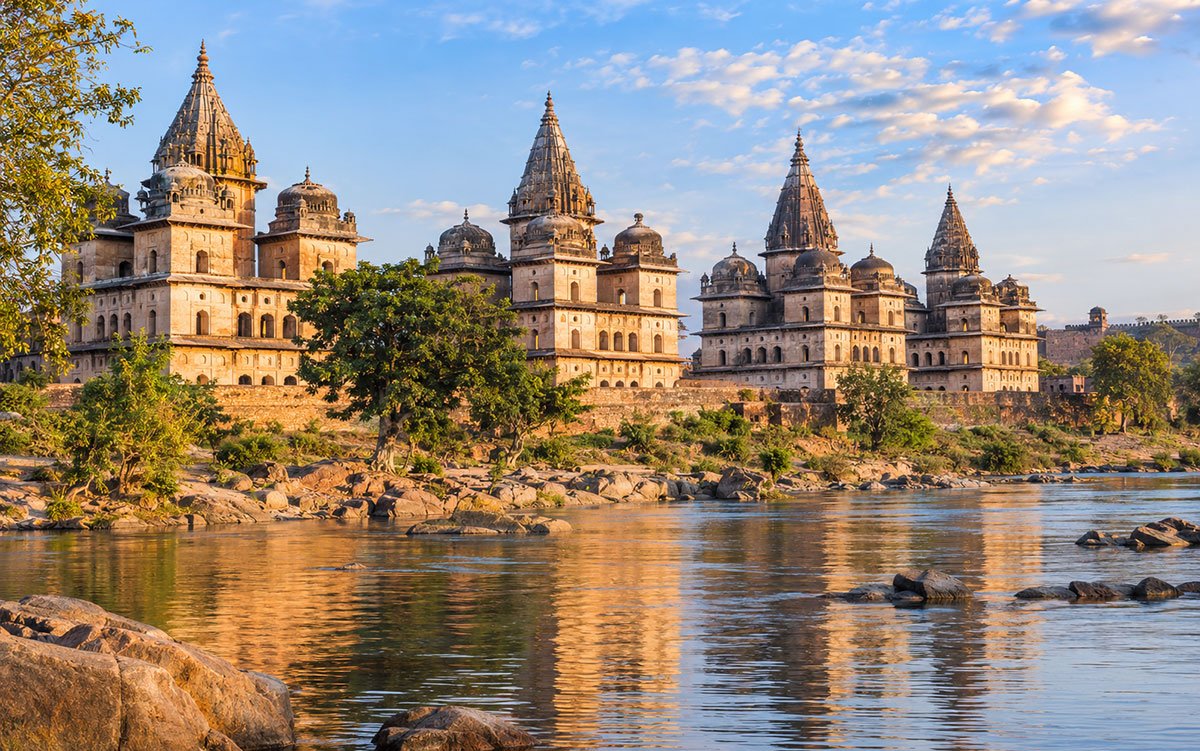
The historic royal cenotaphs of Orchha overlooking the scenic Betwa River in Madhya Pradesh.
Places to Visit in Orchha: Best Attractions and Travel Tips
Orchha is one of Madhya Pradesh’s most fascinating heritage destinations, known for its magnificent forts, historic temples, royal palaces and beautiful riverside monuments. Located in the Bundelkhand region, this historic town offers a memorable journey through India’s architectural and cultural heritage.
The best places to visit in Orchha include Jahangir Mahal, Raja Mahal, Ram Raja Temple, Chaturbhuj Temple, Laxmi Narayan Temple and the royal cenotaphs overlooking the Betwa River. Together, these landmarks reveal the extraordinary legacy of the Bundela rulers.
Unlike larger tourist cities, Orchha retains the atmosphere of a historic settlement where centuries-old buildings remain part of everyday life. Visitors can explore palace courtyards, admire traditional wall paintings, attend temple ceremonies and enjoy peaceful views of the Betwa River.
Whether you are planning a day trip from Jhansi or a longer journey through Madhya Pradesh, this Orchha travel guide covers the main attractions, local experiences and essential information for organising your visit.
Discover the History and Heritage of Orchha
Orchha was established in the 16th century by Bundela ruler Rudra Pratap Singh, who chose a strategically protected location beside the Betwa River.
The town developed into an important political and cultural centre under the Bundela dynasty. Its rulers constructed impressive palaces, temples, gardens and memorials that combined Rajput architectural traditions with elements of Mughal design.
One of Orchha’s most remarkable features is the relationship between its monuments and natural landscape. Fortifications overlook the river, temple towers rise above the town, and royal cenotaphs stand along the riverbank.
The historic ensemble of Orchha has been included on India’s UNESCO World Heritage Tentative List since 2019, recognising its potential cultural significance. It has not yet been inscribed on the World Heritage List.
Today, Orchha is particularly appealing to travellers interested in history, architecture, religious traditions and cultural photography.
Best Places to Visit in Orchha
1. Orchha Fort Complex and Jahangir Mahal
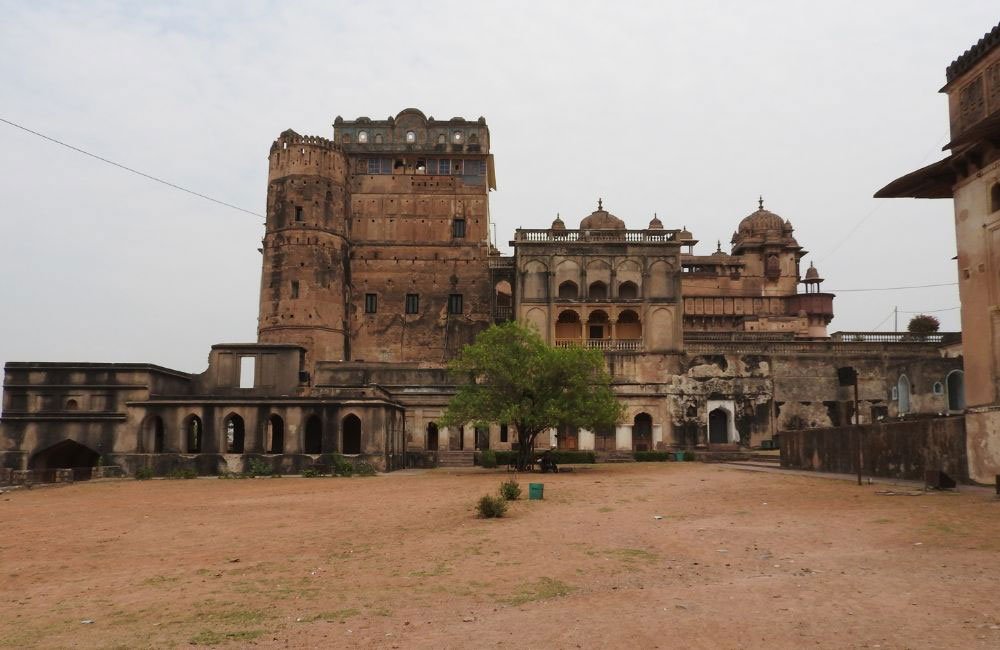
Jahangir Mahal at Orchha Fort, a magnificent example of Bundela-era architecture and one of the major tourist attractions in Orchha, Madhya Pradesh.
The Orchha Fort Complex is an excellent starting point for exploring the town’s royal heritage. Situated near the Betwa River, it contains some of Orchha’s most important palaces and historic buildings.
The complex is particularly famous for Jahangir Mahal, a magnificent palace associated with Bundela ruler Bir Singh Deo and Mughal Emperor Jahangir.
Constructed during the early 17th century, Jahangir Mahal represents a distinctive combination of Bundela, Rajput and Mughal architectural influences.
Its most impressive features include a large central courtyard, ornate balconies, projecting windows, carved stone screens and domed pavilions.
The multi-storeyed structure offers memorable views of the surrounding monuments and landscape from areas accessible to visitors.
What makes it special: Jahangir Mahal is one of the finest places in Orchha to appreciate the scale and sophistication of Bundela palace architecture.
Allow sufficient time to explore the complex rather than treating it as a quick photography stop.
2. Raja Mahal: Discover Orchha’s Royal Residence
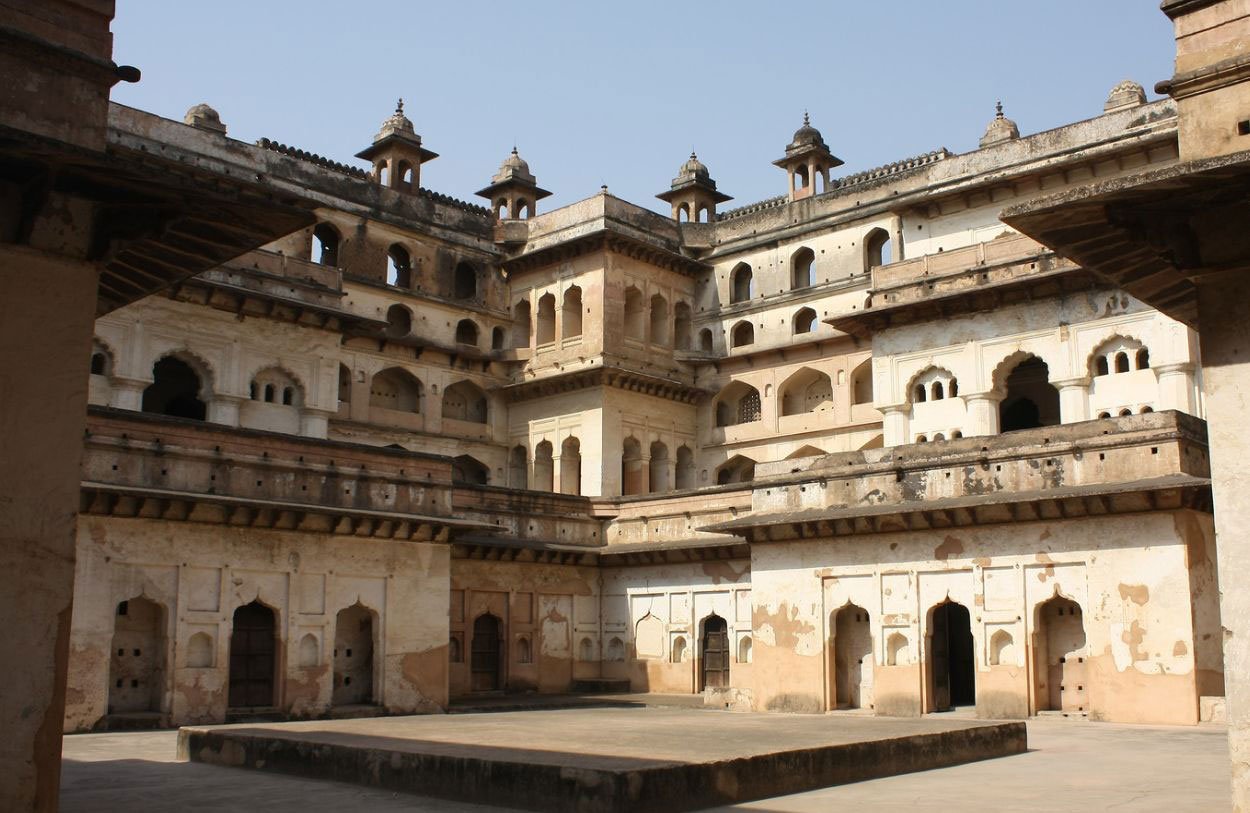
The historic courtyard of Raja Mahal Palace in Orchha, showcasing beautiful arched galleries, royal balconies and traditional Bundela architecture.
Raja Mahal, also known as Raj Mahal, is another major attraction within the fort complex.
Construction began during the reign of Rudra Pratap Singh and continued under subsequent Bundela rulers, including Madhukar Shah.
Although the palace has a relatively restrained exterior, its interiors reveal the artistic interests of Orchha’s royal court.
Visitors can discover courtyards, royal chambers, decorative ceilings and surviving wall paintings.
Several murals depict episodes from Hindu mythology, including scenes associated with the Ramayana, alongside representations of royal life.
The palace’s architectural layout was also designed to admit natural light and air through its courtyards and openings.
Travel tip: Take time to examine the surviving paintings, particularly in the royal chambers. Their details are easy to overlook when moving quickly between rooms.
3. Ram Raja Temple: Where Lord Rama Is Worshipped as King
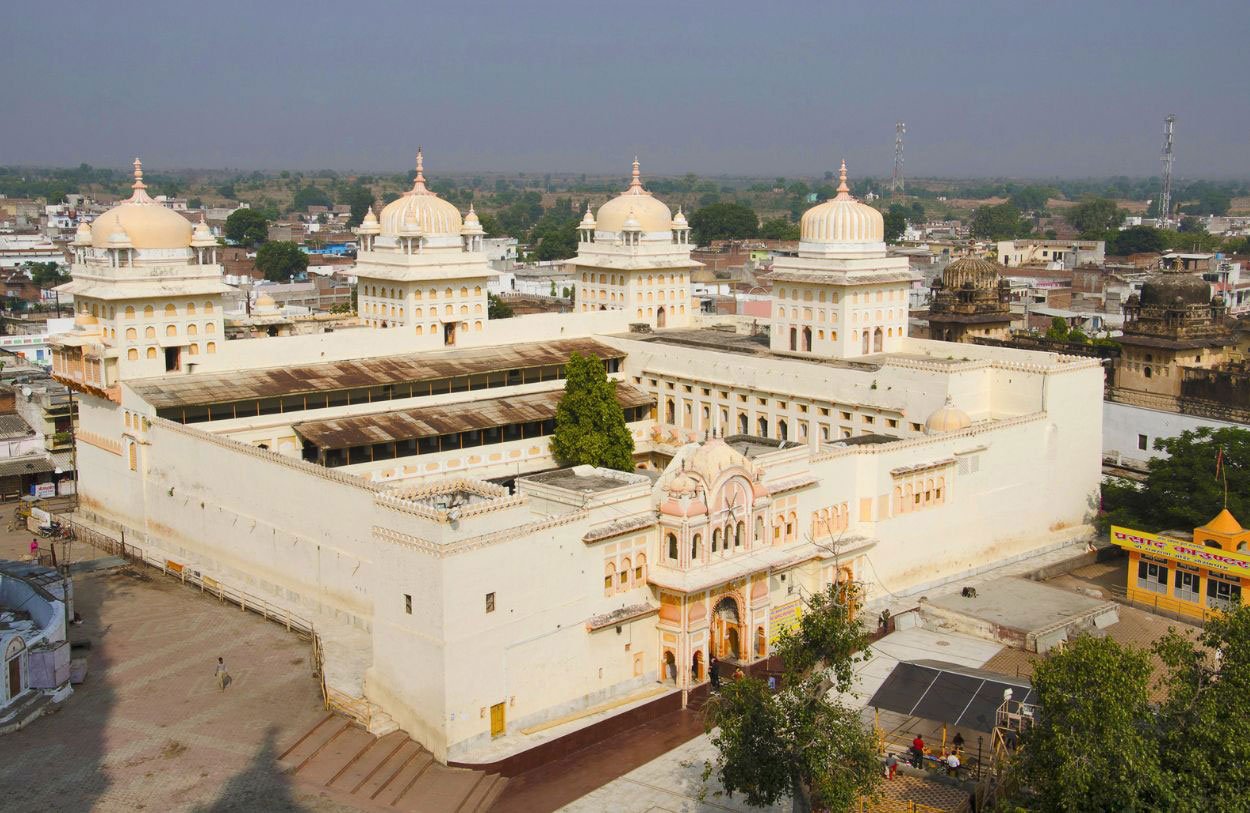
A panoramic view of Ram Raja Temple in Orchha, Madhya Pradesh, where Lord Rama is worshipped as a king inside a historic royal palace.
Ram Raja Temple is one of Orchha’s most important religious landmarks and a major pilgrimage destination.
Unlike conventional Hindu temples, the building originally served as a royal palace associated with Queen Ganesh Kumari, the wife of ruler Madhukar Shah.
The structure was later transformed into a temple dedicated to Lord Rama.
What makes the temple especially significant is Orchha’s tradition of worshipping Lord Rama as its king. This royal identity remains central to the town’s religious culture.
According to local tradition, the queen brought an image of Lord Rama from Ayodhya to Orchha. The image was temporarily placed in her palace while a separate temple was being prepared.
However, the legend explains that Lord Rama had expressed his wish to remain permanently at the place where the image was first installed.
As a result, the palace became the Ram Raja Temple, while the nearby Chaturbhuj Temple developed a different religious role.
The temple continues to attract devotees for daily worship and important celebrations, particularly Ram Navami.
Visitors should approach the site respectfully, follow temple regulations and allow extra time during major festivals.
4. Chaturbhuj Temple: Orchha’s Towering Architectural Landmark
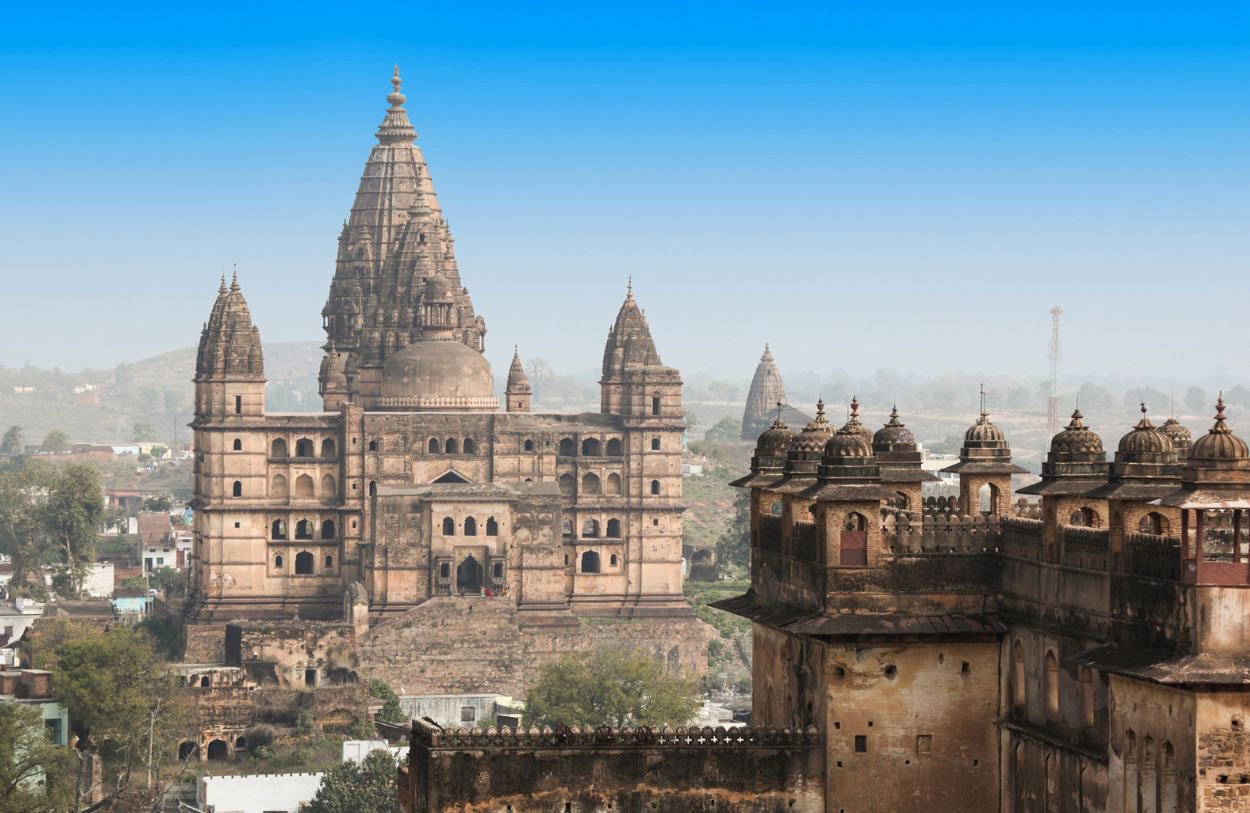
The magnificent Chaturbhuj Temple in Orchha, Madhya Pradesh, renowned for its towering spires, monumental stone architecture and Bundela heritage.
The Chaturbhuj Temple is among the most visually striking buildings in Orchha.
Its enormous towers rise prominently above the surrounding houses and streets, making it an unmistakable feature of the town’s skyline.
The temple was constructed during the Bundela period and was originally intended to house the image of Lord Rama.
However, the image remained in the palace that became the Ram Raja Temple.
Today, Chaturbhuj Temple is associated with Lord Vishnu, whose four-armed form gives the temple its name.
The architecture combines temple design with imposing, fortress-like proportions. Tall vaulted spaces, monumental stonework and elevated platforms contribute to its distinctive appearance.
Visitors must climb a series of steps to reach the temple, so comfortable footwear is useful.
Photography tip: The temple is particularly impressive when viewed from the surrounding streets, where its towers rise dramatically above Orchha’s historic buildings.
5. Laxmi Narayan Temple: Famous for Its Beautiful Murals
Laxmi Narayan Temple, also written as Lakshmi Narayan Temple, is one of Orchha’s most rewarding attractions for art and architecture enthusiasts.
Built during the reign of Bir Singh Deo, the temple is notable for its unusual combination of religious and defensive architectural features.
Rather than following a conventional temple layout, the structure incorporates fortified walls, galleries, battlement-like details and an enclosed courtyard.
Its greatest artistic treasures are the historic murals covering portions of the walls, ceilings and vaulted passages.
The paintings explore a remarkable range of subjects, including:
- Episodes from Hindu mythology and the Ramayana.
- Religious figures and symbolic imagery.
- Scenes associated with warfare and royal life.
- Animals, decorative patterns and aspects of everyday culture.
The paintings offer valuable insights into the artistic traditions of the Bundela period.
Travel tip: Explore the interior galleries carefully and avoid touching the murals. Their preservation is essential to Orchha’s architectural heritage.
6. Royal Chhatris: Cenotaphs Along the Betwa River
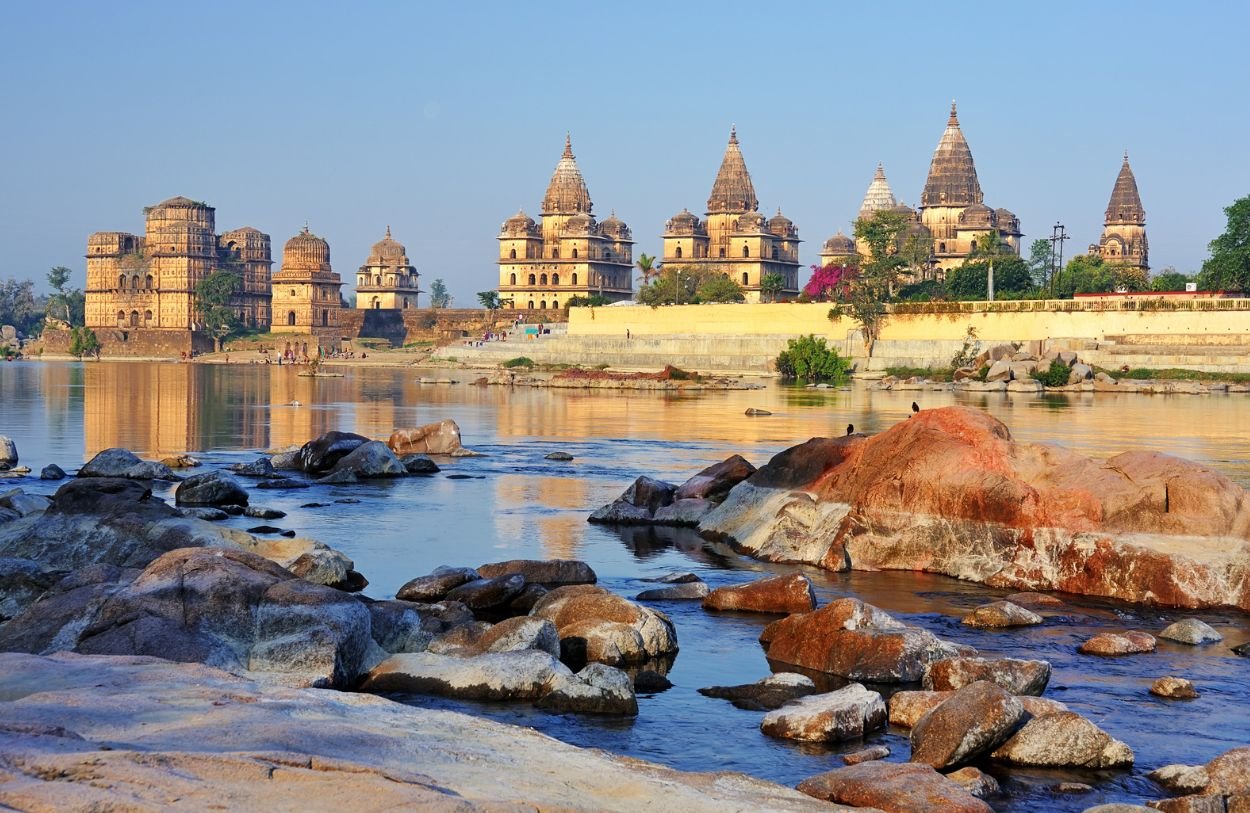
A beautiful sunset over the Betwa River, with the historic royal chhatris of Orchha silhouetted against the evening sky.
The royal chhatris are among the most photographed places in Orchha.
These imposing memorial structures stand along the banks of the Betwa River, forming a distinctive architectural landscape.
Built to commemorate members of the Bundela ruling family, the cenotaphs combine temple-inspired towers with domed pavilions and elaborate stonework.
Each structure contributes to the impressive skyline that visitors see from the riverbanks.
The cenotaph dedicated to Bir Singh Deo is particularly notable for its substantial, palace-like form.
The surrounding riverside setting makes this area ideal for appreciating the relationship between Orchha’s royal history and its natural environment.
Best time to visit: Late afternoon is particularly rewarding for photography, when the warmer light brings out the colours and textures of the historic buildings.
For a wider view, explore permitted areas along the opposite riverbank or nearby viewpoints.
7. Phool Bagh and the Sawan Bhadon Cooling System
Phool Bagh provides an insight into the sophisticated garden design and engineering techniques used by Orchha’s royal families.
This historic garden complex was created as a landscaped retreat, incorporating fountains, pavilions and architectural features designed to make the surroundings more comfortable during warm weather.
One of its most interesting elements is the underground summer retreat once used by the Bundela rulers.
The complex incorporated a water-based cooling arrangement associated with Chandan Katora, a bowl-shaped reservoir and fountain system.
Water was designed to circulate through parts of the structure, helping create a cooler environment.
Nearby, the Sawan Bhadon pillars are associated with traditional methods of directing airflow and improving cooling.
Although the historic systems should not be assumed to remain operational, their design illustrates the practical ingenuity of Bundela architecture.
Phool Bagh is worth visiting for travellers interested in historic gardens, traditional engineering and the quieter corners of Orchha.
8. Rai Praveen Mahal: A Palace of Poetry and Music
Rai Praveen Mahal is associated with one of the best-known cultural figures of the Bundela court.
Rai Praveen was celebrated for her poetry, music and artistic accomplishments.
The palace commemorates her connection with Orchha’s royal history and reflects the importance of artistic patronage within the kingdom.
Its architecture includes balconies, decorative details and garden spaces that create a more intimate atmosphere than the monumental Jahangir Mahal.
Local folklore connects Rai Praveen with Emperor Akbar and recounts stories of her intelligence and literary talent.
While these accounts are part of Orchha’s cultural tradition, they should be understood as historical narratives containing elements of legend.
The palace offers an interesting contrast to the grand royal residences and defensive structures elsewhere in the town.
9. Diwan Hardaul Palace and Memorial
Diwan Hardaul occupies an important place in the folklore of Bundelkhand.
The historic palace associated with him stands near the Ram Raja Temple.
Hardaul was a Bundela prince whose life and death became the subject of stories about loyalty, sacrifice and family relationships.
According to local tradition, he died after being falsely accused of improper conduct.
Over time, he became a revered figure in regional religious and cultural practices.
His story remains particularly associated with traditional wedding customs in parts of Bundelkhand.
Visitors interested in Orchha’s living heritage can explore the memorial and learn how local legends continue to influence community traditions.
10. Shahid Smarak: Remembering Chandrashekhar Azad
Orchha’s history extends beyond its royal past.
The Shahid Smarak, or Shaheed Smarak, commemorates the Indian freedom fighter Chandrashekhar Azad.
Azad is associated with Orchha because he spent time living and working in hiding in the area during 1926 and 1927 while participating in the independence movement.
This memorial offers an opportunity to explore a different period of Indian history.
It is particularly worthwhile for visitors interested in the freedom struggle and the historical connections between Orchha and neighbouring Jhansi.
11. Betwa River and Orchha Wildlife Sanctuary
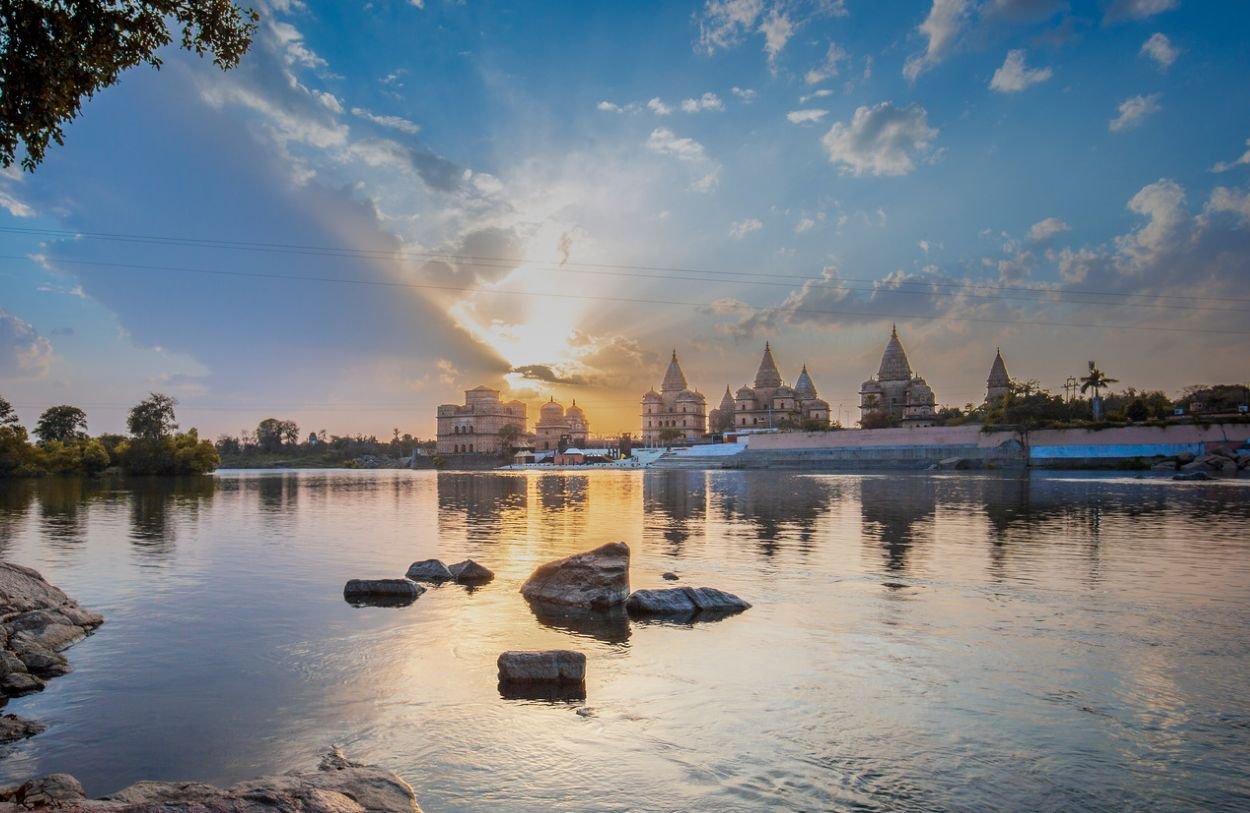
A peaceful view of the Betwa River surrounded by lush green trees and natural vegetation near Orchha Wildlife Sanctuary, Madhya Pradesh.
The Betwa River is an essential part of Orchha’s landscape.
Its rocky banks, flowing water and views of historic monuments provide an appealing contrast to the town’s densely built heritage areas.
Visitors can enjoy riverside walks, photography and opportunities to observe local birdlife.
Across the river, Orchha Wildlife Sanctuary offers a natural setting for visitors interested in birdwatching and the region’s environment.
The protected landscape includes riverine habitats, woodland and areas that support resident and migratory birds.
Wildlife sightings are never guaranteed, but patient visitors may encounter birds such as kingfishers, peafowl and other species associated with the region.
Orchha is also known for vultures that use some of its historic structures as nesting sites.
Maintain a respectful distance from wildlife and avoid disturbing nesting birds.
Important: River currents and water levels can change, especially during the monsoon. Do not enter the river or attempt water activities without appropriate local safety guidance.
Things to Do in Orchha Beyond Sightseeing
Experience the Sound and Light Show
Orchha’s fort complex hosts a sound and light presentation exploring the history of the Bundela dynasty.
The programme introduces visitors to important rulers, political events, architecture and local legends through narration and lighting effects.
It is a useful way to connect the monuments you have visited with the stories behind them.
Show languages, timings and ticket arrangements can change, so confirm the current programme through Madhya Pradesh Tourism before planning your evening.
Explore Orchha on Foot
Walking is one of the most enjoyable ways to discover the historic town.
The central area contains winding streets, traditional buildings, temple courtyards and small markets.
A heritage walk allows visitors to observe architectural details that are easily missed when travelling between attractions by vehicle.
Some locations involve uneven paths and steep staircases. Wear comfortable footwear and carry drinking water.
Try Local Bundeli Cuisine
Exploring the food of Bundelkhand adds another dimension to an Orchha visit.
Local eateries and homestays provide opportunities to sample regional preparations alongside familiar North Indian meals.
Travellers may find dishes such as dal, seasonal vegetables, traditional breads, poha and freshly prepared snacks.
Rather than searching only for large restaurants, consider exploring well-established local eateries or accommodation providers offering regional home-style cooking.
Enjoy the Betwa River Landscape
The river is especially attractive during the softer light of early morning and late afternoon.
Travellers interested in photography can capture the contrasting shapes of the cenotaphs, temple towers and rocky riverside scenery.
Seasonal rafting opportunities may also be available through authorised operators, depending on river conditions.
Confirm the availability of activities, safety arrangements and permitted access before making plans.
Best Time to Visit Orchha
For most travellers, October to March is a convenient period for visiting Orchha, particularly when exploring forts and temples on foot.
The cooler months generally provide more comfortable conditions for sightseeing than the height of summer.
However, the experience varies throughout the year.
October to March: Suitable for exploring monuments, heritage walks and outdoor sightseeing. Winter mornings and evenings can be cool.
April to June: Temperatures can become extremely high, making extended outdoor sightseeing uncomfortable. Early morning visits and regular breaks are advisable.
July to September: Monsoon rains can make the surrounding landscape greener and more atmospheric. However, slippery surfaces, rising river levels and interruptions to outdoor activities require extra caution.
Travellers primarily interested in heritage sightseeing will generally find the cooler, drier months easier to manage.
How to Reach Orchha
Orchha is located in Niwari district, Madhya Pradesh, close to the city of Jhansi in neighbouring Uttar Pradesh.
By Train
Virangana Lakshmibai Jhansi Junction, formerly known as Jhansi Junction, is the most useful major railway station for reaching Orchha.
The station is approximately 16–17 kilometres from Orchha and is connected with several important Indian cities.
From Jhansi, travellers can continue by taxi or other available local road transport.
Orchha also has its own railway station, but visitors should confirm train services and onward transport arrangements before choosing this option.
By Air
Gwalior and Khajuraho are important airport options for travellers visiting Orchha.
Flight availability and connections vary, so it is advisable to compare current services before selecting an arrival airport.
Travellers can continue to Orchha by road after landing.
By Road
Orchha is accessible by road from Jhansi, Gwalior and Khajuraho.
Many visitors include the town in a broader Bundelkhand or Madhya Pradesh heritage itinerary.
Private taxis can be convenient for travellers carrying luggage or visiting several attractions in a limited period.
Local transport options should be confirmed in advance, particularly for early departures or late arrivals.
How Many Days Do You Need in Orchha?
One full day is sufficient to visit several major landmarks, but staying overnight allows a more relaxed experience.
One-Day Orchha Sightseeing Itinerary
Morning
- Begin at Orchha Fort Complex and explore Jahangir Mahal.
- Visit Raja Mahal and admire its historic interiors.
- Continue to Ram Raja Temple and Chaturbhuj Temple.
Afternoon
- Visit Laxmi Narayan Temple to see its murals.
- Explore Phool Bagh and its historic cooling structures.
- Stop at Diwan Hardaul Palace if time permits.
Evening
- Enjoy the riverside views of the royal chhatris.
- Attend the sound and light show if it is operating.
Temple visits should be arranged around the actual opening and worship schedules.
Two-Day Orchha Itinerary
With two days available, follow the main heritage route on the first day.
On the second day, visit Rai Praveen Mahal, explore lesser-known historic structures and spend time around the Betwa River.
Nature enthusiasts can include a visit to Orchha Wildlife Sanctuary, while history lovers may prefer Shahid Smarak and a guided heritage walk.
A two-day stay also provides opportunities to experience the town early in the morning, before the main sightseeing period begins.
Practical Travel Tips for Visiting Orchha
A little preparation will make your visit more comfortable.
- Check monument access: Entry fees, opening arrangements and restricted sections can change. Confirm details locally or through official tourism sources.
- Respect religious customs: Dress appropriately when visiting active temples and follow instructions regarding footwear, photography and worship areas.
- Protect historic buildings: Avoid touching murals, climbing restricted structures or entering closed sections.
- Carry drinking water: Much of Orchha’s sightseeing involves walking in exposed areas.
- Plan for uneven surfaces: Historic staircases, stone pathways and raised platforms may be difficult for visitors with limited mobility.
- Use authorised guides: A knowledgeable local guide can explain Bundela history and help distinguish documented events from folklore.
- Take care around the river: Avoid swimming or crossing fast-moving water, particularly during and after heavy rainfall.
- Allow flexibility during festivals: Religious celebrations can attract large crowds and affect access to streets, temples and nearby facilities.
Frequently Asked Questions About Orchha
Is Orchha worth visiting?
Yes. Orchha is particularly rewarding for travellers interested in historic architecture, Hindu temples, Bundela history and riverside landscapes. Its compact historic centre also makes it suitable for a short cultural trip.
What is Orchha most famous for?
Orchha is best known for Jahangir Mahal, the Ram Raja Temple, Chaturbhuj Temple, Laxmi Narayan Temple and the royal chhatris beside the Betwa River.
It is also notable for its distinctive blend of Rajput and Mughal architectural traditions.
Can I visit Orchha in one day?
Yes. A day trip from Jhansi can cover the principal palaces and temples. However, an overnight stay provides more time for the riverside cenotaphs, evening activities and less-visited monuments.
Is Orchha a UNESCO World Heritage Site?
Orchha’s historic ensemble is included on India’s UNESCO World Heritage Tentative List. This means it has been identified for possible future nomination but does not currently have the status of an inscribed UNESCO World Heritage Site.
Is Orchha suitable for family travel?
Orchha can be a rewarding family destination, especially for those interested in history and culture. Families should plan around hot weather, steep monument staircases and the safety of younger children near the river.
Experience the Timeless Heritage of Orchha
Orchha brings together magnificent royal architecture, living religious traditions and the natural beauty of the Betwa River in a remarkably compact historic setting.
From the elaborate courtyards of Jahangir Mahal to the spiritual atmosphere of Ram Raja Temple and the riverside silhouettes of the royal chhatris, its attractions offer a distinctive perspective on the history of Bundelkhand.
Whether explored as a day trip or a relaxed overnight stay, Orchha deserves a place on any cultural journey through Madhya Pradesh.
