
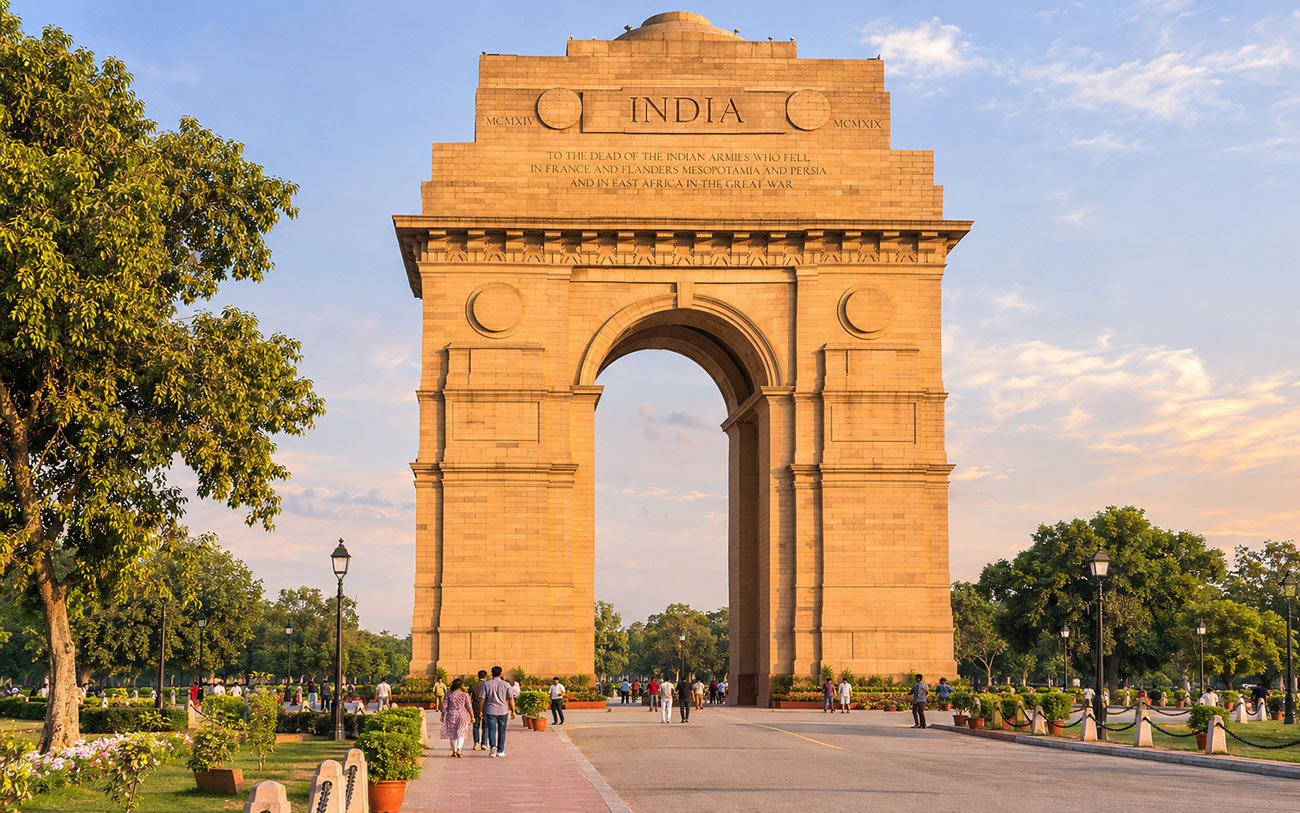
India Gate, designed by Sir Edwin Lutyens, is a historic war memorial standing at the eastern end of Kartavya Path in New Delhi.
India Gate Delhi: History, National War Memorial and Visitor Guide
Standing at the eastern end of Kartavya Path in the heart of New Delhi, India Gate Delhi is one of India’s most recognisable historical landmarks. The impressive sandstone arch commemorates soldiers who lost their lives during the First World War and the Third Anglo-Afghan War.
Designed by British architect Sir Edwin Lutyens, the monument rises 42 metres above its surroundings and forms an important part of New Delhi’s ceremonial landscape.
Today, India Gate attracts visitors interested in history, architecture and photography. The nearby National War Memorial adds another dimension to the experience, honouring Indian military personnel who have died in service since independence.
Whether you are visiting Delhi for the first time or exploring the capital’s historical attractions, this guide explains India Gate’s history, architectural significance, visiting arrangements and nearby places worth discovering.
History of India Gate: A Memorial to Fallen Soldiers
India Gate was originally known as the All India War Memorial.
It was constructed during British rule to commemorate soldiers of undivided India who died while serving in the First World War and related military campaigns, including the Third Anglo-Afghan War of 1919.
The First World War took Indian soldiers to several regions, including Europe, Africa and the Middle East.
Their service and sacrifices form an important chapter in the military history of the Indian subcontinent.
When Was India Gate Built?
The foundation stone of India Gate was laid on 10 February 1921 by the Duke of Connaught.
Construction continued over the following decade.
The monument was inaugurated in 1931 by Lord Irwin, who was then the Viceroy of India.
India Gate became one of the defining landmarks of New Delhi, which was developed as the new imperial capital during the British period.
After India’s independence, the monument continued to hold national significance as a place of remembrance.
Whose Names Are Inscribed on India Gate?
India Gate commemorates approximately 70,000 soldiers of undivided India who died during the First World War.
The monument also carries more than 13,000 inscribed names associated with the First World War and campaigns on the North-West Frontier, including British and Indian military personnel.
These inscriptions transform the monument from an impressive architectural structure into a place of historical remembrance.
Visitors can appreciate the scale of the memorial while reflecting on the lives represented by its names.
The Architecture of India Gate
India Gate is an example of early twentieth-century monumental architecture.
Designed by Sir Edwin Lutyens, the arch reflects the classical architectural traditions commonly used for commemorative structures.
Its appearance is often compared with the Arc de Triomphe in Paris, although India Gate has its own design and historical purpose.
A 42-Metre-High Sandstone Monument
India Gate stands approximately 42 metres tall.
The structure rises from a broad stone base, with a large central arch forming its most distinctive feature.
Its construction uses sandstone, giving the monument a warm appearance that changes subtly with the daylight.
The word “INDIA” is carved prominently above the arch.
The Roman numerals MCMXIV and MCMXIX, representing 1914 and 1919, are also visible on the structure.
These inscriptions recall the period associated with the First World War and the commemorated military campaigns.
Sir Edwin Lutyens and the Design of New Delhi
Sir Edwin Lutyens played a leading role in planning and designing New Delhi’s monumental government district.
India Gate forms part of this broader architectural vision.
The ceremonial avenue, landscaped surroundings and major government buildings were arranged to create a distinctive urban landscape.
Sir Herbert Baker also contributed significantly to the architecture of New Delhi, particularly its government buildings. However, India Gate itself is credited to Lutyens.
The monument remains an important example of the architectural legacy of this period.
India Gate and Kartavya Path
India Gate stands at the eastern end of Kartavya Path, the ceremonial boulevard extending towards Rashtrapati Bhavan.
The avenue was formerly known as Rajpath and, before independence, as Kingsway.
It was renamed Kartavya Path in September 2022.
The broad landscaped avenue forms part of New Delhi’s Central Vista area.
Walking Along Kartavya Path
Kartavya Path features formal lawns, pedestrian walkways, water channels and landscaped public spaces.
Its long, open sightlines provide impressive views of India Gate and the surrounding ceremonial district.
Visitors can enjoy a walk through the area while appreciating the architecture and urban planning of central New Delhi.
The boulevard is also associated with India’s Republic Day celebrations.
Every year, the Republic Day Parade takes place along this ceremonial route, although public access is subject to special arrangements during preparations and official events.
The Netaji Subhas Chandra Bose Statue
Another important landmark near India Gate is the statue of Netaji Subhas Chandra Bose.
The granite statue was unveiled on 8 September 2022 and stands beneath the historic canopy near the monument.
It commemorates the Indian freedom fighter and his role in the independence movement.
The statue adds another layer to the historical significance of the India Gate precinct.
Amar Jawan Jyoti: History and Significance
For many years, Amar Jawan Jyoti was one of the most familiar features associated with India Gate.
The memorial was established beneath the arch in January 1972, following the India-Pakistan War of 1971.
Its distinctive arrangement included an inverted rifle topped with a military helmet and an eternal flame.
Amar Jawan Jyoti became a prominent symbol of remembrance for Indian military personnel who sacrificed their lives in service.
Where Is the Amar Jawan Jyoti Flame Today?
On 21 January 2022, the Amar Jawan Jyoti flame at India Gate was ceremonially merged with the eternal flame at the nearby National War Memorial.
Therefore, visitors should not expect to see the original continuously burning flame beneath the India Gate arch.
The National War Memorial now provides the principal setting for the eternal flame and official commemorations of India’s fallen military personnel.
Understanding this distinction helps visitors appreciate the separate histories of India Gate and the National War Memorial.
Visit the National War Memorial Near India Gate
The National War Memorial is one of the most important attractions to include during a visit to India Gate.
Located within the same ceremonial precinct, it honours members of India’s armed forces who have died in service since the country gained independence.
The memorial was inaugurated on 25 February 2019.
Its design features landscaped spaces and concentric circles representing different aspects of military service, bravery, sacrifice and remembrance.
The Four Circles of the National War Memorial
The memorial includes four principal circles:
Amar Chakra – Circle of Immortality
The central circle contains an obelisk and the eternal flame, symbolising the enduring remembrance of fallen soldiers.
Veerta Chakra – Circle of Bravery
This section includes bronze murals depicting significant military actions and the courage of India’s armed forces.
Tyag Chakra – Circle of Sacrifice
The walls of honour contain granite tablets inscribed with the names of fallen military personnel.
Raksha Chakra – Circle of Protection
The outermost circle features rows of trees symbolising protection and the continuing commitment of India’s armed forces.
Param Yodha Sthal
The National War Memorial complex also includes Param Yodha Sthal.
This area honours recipients of the Param Vir Chakra, India’s highest military decoration for gallantry.
Visitors can see bronze busts and learn about the lives and service of the individuals commemorated.
Visiting the National War Memorial
Admission to the National War Memorial is free.
The official visitor information lists seasonal opening hours:
- November to March: 9:00 AM to 7:30 PM.
- April to October: 9:00 AM to 8:30 PM.
Last admission is generally 30 minutes before closing.
Entry may be restricted during ceremonial events, security arrangements or periods of heavy visitor traffic.
The memorial is a solemn place. Visitors should maintain respectful behaviour and follow the designated pathways.
Food, bags, suitcases and tripods are not permitted inside the memorial.
Check the official National War Memorial website before travelling for the latest visitor arrangements.
Things to Do at India Gate
Although India Gate is primarily a war memorial, its surrounding area offers an enjoyable sightseeing experience.
Visitors can combine historical exploration with walking, photography and nearby cultural attractions.
1. Admire the Monument’s Architecture
Take time to appreciate the large sandstone arch, carved inscriptions and architectural details.
The monument looks particularly striking when viewed from the broad approaches around Kartavya Path.
Its symmetrical design and open surroundings make it a rewarding subject for architectural photography.
2. Visit India Gate in the Evening
India Gate is especially attractive after sunset, when the monument is illuminated.
The lighting highlights its architectural form against the evening sky.
The surrounding avenues and public spaces also offer opportunities for an evening walk.
However, some areas may have restricted access after dark.
3. Explore Kartavya Path
Walk along the ceremonial boulevard and enjoy views towards Rashtrapati Bhavan.
The landscaped paths and open spaces provide an opportunity to experience one of Delhi’s most important urban landmarks.
Follow local signs and any temporary restrictions around government and ceremonial areas.
4. Pay Your Respects at the National War Memorial
Allow time to visit the National War Memorial rather than viewing India Gate only as a photographic landmark.
Its commemorative design and information displays provide insight into India’s military history after independence.
Visitors with an interest in history may find this one of the most meaningful parts of the experience.
5. See the Netaji Subhas Chandra Bose Statue
The statue near India Gate provides another opportunity to explore India’s modern historical heritage.
Its setting within the ceremonial precinct connects the area’s architectural past with the country’s independence movement.
India Gate Timings and Entry Fee
India Gate is an open-air monument, and its general visiting arrangements differ from those of a ticketed museum.
| Visitor information | Details |
|---|---|
| Location | Eastern end of Kartavya Path, New Delhi |
| Monument | India Gate, formerly the All India War Memorial |
| Entry fee | Free |
| General visiting arrangements | Accessible during the day and evening |
| Weekly closing day | None under normal arrangements |
| Best time for photography | Early morning or around sunset |
| Nearby attraction | National War Memorial |
| Recommended visit duration | Around one hour for India Gate, with additional time for the National War Memorial |
The surrounding area may have temporary access restrictions during major events, official ceremonies or security operations.
Check local announcements before travelling, especially around Republic Day.
Best Time to Visit India Gate
India Gate can be visited throughout the year, but Delhi’s seasonal weather makes some periods more comfortable than others.
October to March
The cooler months are often suitable for exploring outdoor attractions in New Delhi.
Walking around Kartavya Path can be more comfortable than during the peak summer heat.
However, winter mornings may be foggy, and air pollution can sometimes affect visibility and outdoor comfort.
Check weather and air-quality information before planning a lengthy outdoor visit.
April to June
Delhi can experience intense heat during late spring and early summer.
Avoid prolonged exposure to the midday sun.
An early morning or evening visit is generally more comfortable.
Carry drinking water, wear light clothing and use sun protection.
July to September
The monsoon season can bring rainfall, humid conditions and occasional travel disruption.
Check the forecast before visiting and wear footwear suitable for wet walkways.
Is India Gate Better at Night?
India Gate is particularly appealing in the evening because of its lighting.
Daylight, however, allows visitors to see the inscriptions and architectural details more clearly.
If possible, arrive shortly before sunset to experience both.
How to Reach India Gate Delhi
India Gate is located in central New Delhi and can be reached by Metro, taxi, auto-rickshaw or other local transport.
By Delhi Metro
The Delhi Metro is a practical way to travel across the city without relying entirely on road transport.
Stations serving the wider India Gate area include Mandi House, Khan Market and Central Secretariat.
The National War Memorial’s official visitor information lists Mandi House on the Blue Line and Khan Market on the Violet Line among the nearby stations.
Visitors should expect a walk or short onward journey from the Metro to the monument.
Check the latest Delhi Metro route map and use a navigation service to select the station that best suits your starting point.
By Taxi or Auto-Rickshaw
Taxis and app-based transport services can be convenient, especially for families and visitors unfamiliar with Delhi.
However, vehicles may not be able to stop immediately beside the monument.
Use designated drop-off points and follow traffic restrictions.
From Delhi Airport
Travellers arriving at Indira Gandhi International Airport can use airport transport connections, the Metro and taxis to reach central New Delhi.
The most convenient route depends on the terminal, luggage and accommodation location.
By Local Bus
Delhi’s public bus network also serves central areas of the city.
Check current routes and stops through official transport information before travelling.
Nearby Attractions to Visit After India Gate
India Gate is well positioned for exploring other important landmarks in New Delhi.
National War Memorial
The National War Memorial should be a priority for visitors interested in military history.
Its eternal flame, commemorative walls and landscaped grounds add historical depth to an India Gate visit.
Kartavya Path
This ceremonial boulevard connects India Gate with the wider government district.
Its formal layout, landscaped public spaces and views of Rashtrapati Bhavan make it an attractive walking route.
National Gallery of Modern Art
The National Gallery of Modern Art is located at Jaipur House near India Gate.
It houses an important collection of Indian modern and contemporary art.
The gallery is a worthwhile choice for travellers who want to combine history and architecture with a cultural attraction.
Check its exhibition programme, admission arrangements and opening hours before visiting.
Rashtrapati Bhavan
Rashtrapati Bhavan, the official residence of the President of India, stands at the western end of Kartavya Path.
Its imposing architecture is an important feature of New Delhi’s ceremonial landscape.
Visits inside the complex and access to specific areas require separate arrangements, so check the official Rashtrapati Bhavan visitor website if you wish to enter.
Suggested India Gate Sightseeing Itinerary
A relaxed visit to India Gate and its surroundings can form part of a half-day exploration of central New Delhi.
Late Afternoon: India Gate
Begin by exploring the India Gate monument.
Admire the sandstone structure, observe its inscriptions and take photographs from the permitted public areas.
Continue to the National War Memorial
Visit the nearby National War Memorial.
Allow approximately 45 minutes to one hour to explore its principal sections, following the official visitor guidance.
Explore Kartavya Path
Spend some time walking along the ceremonial avenue and enjoying the landscaped setting.
Take photographs of the wider architectural landscape.
Sunset and Evening
Return towards India Gate to see the monument illuminated as daylight fades.
If you prefer an indoor cultural attraction, consider visiting the National Gallery of Modern Art earlier in the afternoon, subject to its opening hours.
This itinerary allows time for both the historical and scenic aspects of the area without unnecessary rushing.
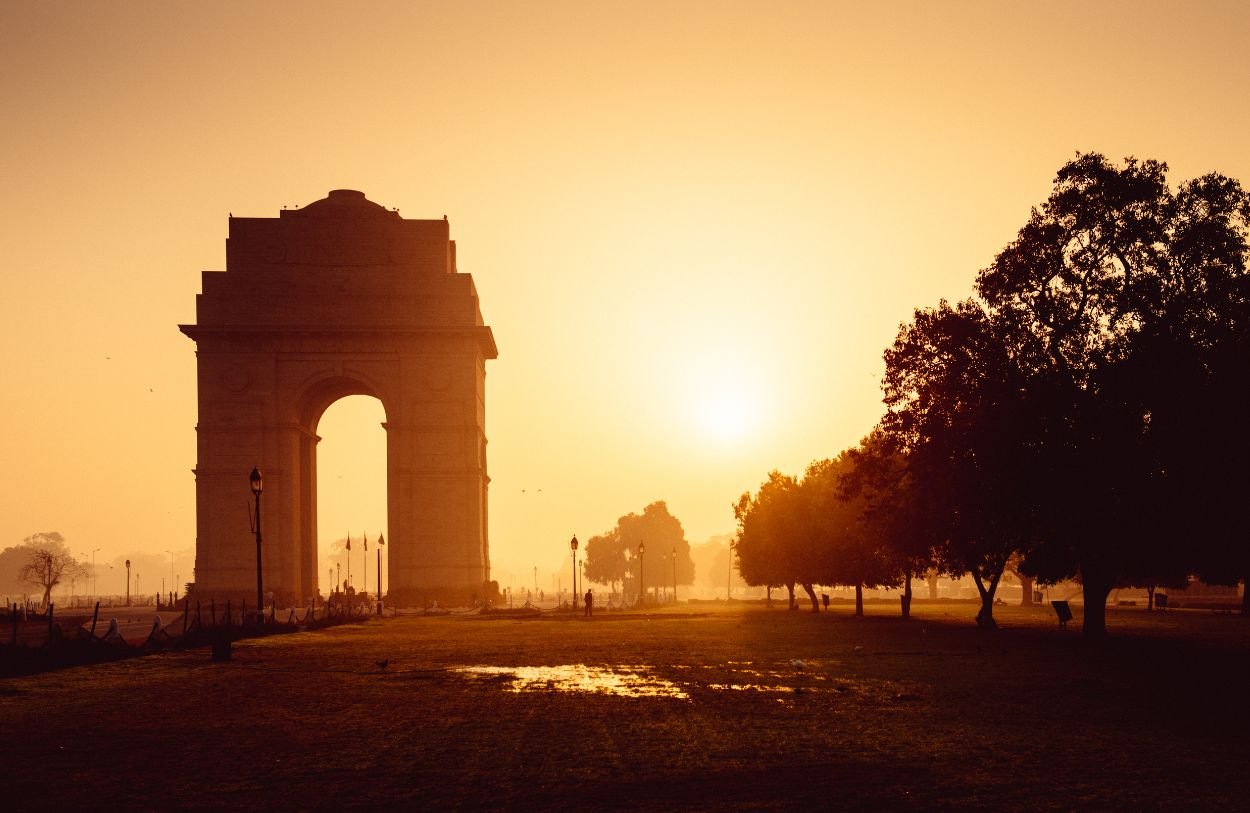
India Gate in New Delhi stands majestically against the golden morning sky, highlighting the beauty and historical significance of this iconic war memorial.
Practical Tips for Visiting India Gate
Keep these points in mind when planning your visit:
- Carry drinking water: Delhi can be hot, particularly during the warmer months.
- Wear comfortable footwear: Exploring the surrounding avenues involves walking.
- Respect memorial rules: The National War Memorial prohibits picnicking, food and certain personal items inside its premises.
- Travel light: Avoid carrying large bags if you intend to enter the National War Memorial.
- Check security arrangements: Access may be restricted during official ceremonies and major public events.
- Plan evening transport: Confirm your return route before arriving.
- Check air quality: Delhi occasionally experiences poor air quality, especially during cooler months.
- Allow enough time: India Gate and the National War Memorial are separate attractions, and both deserve attention.
Frequently Asked Questions About India Gate Delhi
Where Is India Gate Located?
India Gate stands at the eastern end of Kartavya Path in central New Delhi, India.
Who Designed India Gate?
India Gate was designed by Sir Edwin Lutyens, the British architect closely associated with the planning of New Delhi.
When Was India Gate Built?
Its foundation stone was laid in 1921, and the monument was inaugurated in 1931.
Why Is India Gate Famous?
India Gate is a major war memorial commemorating soldiers who died during the First World War and related military campaigns, including the Third Anglo-Afghan War. It is also one of New Delhi’s most recognisable architectural landmarks.
Is There an Entry Fee for India Gate?
No. General access to the India Gate monument is free. Admission to the nearby National War Memorial is also free.
Is India Gate Open at Night?
India Gate can be viewed in the evening, and its illumination makes it a popular destination after sunset. However, access to some areas may be restricted after dark or during official events.
Is Amar Jawan Jyoti Still Burning Under India Gate?
No. The flame previously located beneath India Gate was ceremonially merged with the eternal flame at the National War Memorial on 21 January 2022.
What Is the Difference Between India Gate and the National War Memorial?
India Gate commemorates military personnel who died during the First World War and related campaigns under British rule. The National War Memorial honours Indian armed forces personnel who have died in service since independence.
How Much Time Is Needed to Visit India Gate?
Around an hour is reasonable for viewing India Gate and its immediate surroundings. Allow additional time if you plan to explore the National War Memorial and Kartavya Path.
Which Metro Station Is Near India Gate?
Mandi House, Khan Market and Central Secretariat are among the stations serving the wider area. The most convenient option depends on your starting point and preferred walking distance.
Why India Gate Is Worth Visiting
India Gate is more than a familiar symbol of New Delhi. Its architecture, inscriptions and historical setting preserve the memory of soldiers whose lives were lost during a defining period of world history.
The surrounding Kartavya Path precinct also reflects the changing history of India’s capital, from its development under British rule to its role in modern national ceremonies.
Together with the National War Memorial and the Netaji Subhas Chandra Bose statue, India Gate offers visitors an opportunity to explore different chapters of India’s history in one important public space.
For travellers interested in architecture, remembrance and the heritage of New Delhi, India Gate remains an essential stop on a visit to the capital.
