
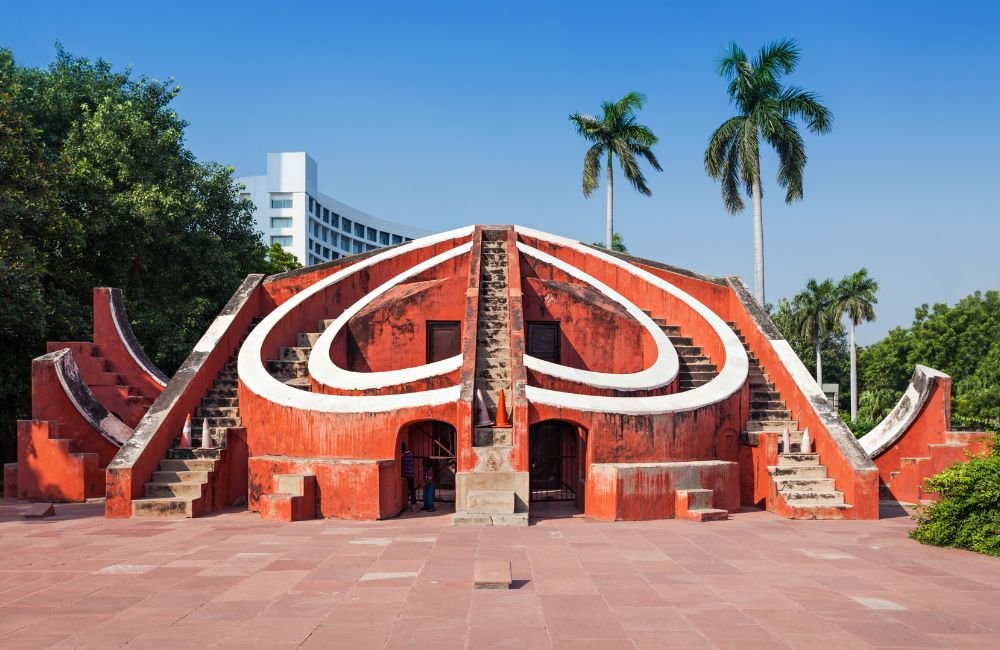
Jantar Mantar in New Delhi features monumental instruments built to study time and the movements of celestial bodies.
Jantar Mantar Delhi: History, Astronomical Instruments and Visitor Guide
In the heart of New Delhi, surrounded by the modern cityscape of Connaught Place, stands Jantar Mantar, an extraordinary astronomical observatory built in the 18th century. Its enormous geometric structures may resemble abstract sculptures, but each had a specific scientific purpose.
Commissioned by Maharaja Sawai Jai Singh II in 1724, Jantar Mantar Delhi reflects an important period in India’s history of astronomy, mathematics and architectural design. The observatory helped scholars study celestial positions, calculate time and compile astronomical tables using large, carefully designed masonry instruments.
Today, the complex offers visitors an opportunity to explore the relationship between science, architecture and India’s intellectual heritage.
The History of Jantar Mantar in Delhi
Maharaja Sawai Jai Singh II, the ruler of Jaipur, had a strong interest in astronomy and mathematical calculation. He commissioned a series of observatories across northern India to improve astronomical observations and develop more accurate tables of celestial movements.
Delhi’s Jantar Mantar was the first of these five observatories. The others were established in Jaipur, Ujjain, Varanasi and Mathura.
At the time, astronomers relied on instruments to calculate the positions and movements of the Sun, Moon and planets. Jai Singh II sought to improve the accuracy of these observations by constructing large instruments from masonry rather than relying only on smaller portable equipment.
The result was an observatory in which architecture served a practical scientific purpose. Curved walls, graduated surfaces, geometric alignments and carefully calculated angles helped observers make measurements of the sky.
Jantar Mantar is therefore more than a historical landmark. It represents an important chapter in the development of astronomical observation in India.
What Can You See at Jantar Mantar?
The Delhi observatory contains 13 astronomical instruments, according to India’s official tourism information. Among its best-known structures are the Samrat Yantra, Jai Prakash Yantra and Misra Yantra.
Samrat Yantra: The Giant Sundial
The Samrat Yantra is one of the observatory’s most recognisable instruments. Its enormous triangular structure functions as a sundial, using the movement of the Sun’s shadow to indicate local solar time.
The design demonstrates how geometry and the apparent movement of the Sun can translate into a practical measurement. Its scale also makes the instrument an impressive example of monumental scientific architecture.
Although the sundial helps visitors understand the principles behind traditional time measurement, surrounding modern buildings can obstruct precise observations today.
Jai Prakash Yantra: Mapping the Sky
The Jai Prakash Yantra uses a hemispherical structure marked with observational scales. Its design allows observers to relate the positions of celestial bodies to markings on the instrument.
Unlike a conventional telescope, this masonry instrument works through geometry, sightlines and carefully arranged reference points.
It offers an interesting way to understand how earlier astronomers translated observations of the sky into measurable positions.
Misra Yantra: Comparing Celestial Measurements
The Misra Yantra combines several components designed for astronomical calculations. Among its historical functions was helping observers determine the longest and shortest days of the year.
Its design demonstrates that an observatory can use several instruments together rather than relying on one device for every calculation.
Look closely at the arrangement of its different structures to appreciate how the entire complex functioned as a system of scientific instruments.
Why Was Jantar Mantar Built?
The observatory’s main purpose was to improve astronomical observation and help scholars calculate celestial positions and movements.
Its instruments supported work such as:
- Measuring local solar time.
- Observing the positions of celestial bodies.
- Studying the apparent movements of the Sun, Moon and planets.
- Preparing astronomical tables and calendar calculations.
These activities belonged to the scientific tradition of observational astronomy. Historical astronomy in India also intersected with calendar-making and astrological traditions, but the instruments themselves were designed to support measurements and calculations.
Modern observatories use technologies such as optical telescopes, cameras and electronic sensors. Jantar Mantar instead demonstrates how scholars approached astronomical questions using geometry, mathematics and naked-eye observation.
Architecture, Conservation and the Modern City
One of Jantar Mantar’s most interesting features is the way its instruments combine scientific function with architectural form.
The structures use geometric shapes, carefully aligned surfaces and graduated markings. Their monumental scale makes the relationship between mathematics and physical design visible to visitors.
However, the observatory now sits within a densely developed urban environment. Delhi Tourism and India’s official film-location directory note that nearby tall buildings limit the precision of observations from the historic instruments.
Consequently, visitors should view Jantar Mantar primarily as an important historic scientific site rather than assume that every instrument still functions as it did in the 18th century.
Conservation also plays an important role in protecting the complex. The National Culture Fund, working with the Archaeological Survey of India and a corporate partner, has documented conservation and enhancement work at the Delhi observatory, including improvements to its entrance and visitor facilities.
Visitors should follow posted instructions, avoid climbing on the instruments and refrain from damaging their surfaces or markings.
How to Visit Jantar Mantar Delhi
Jantar Mantar is located on Parliament Street near Connaught Place in New Delhi. Its central location makes it convenient to include in a wider sightseeing itinerary.
Opening Hours and Entry Fees
Delhi Tourism currently lists the observatory as open daily, from sunrise to sunset. Its published visitor information lists entry fees of ₹25 for Indian visitors and ₹300 for foreign visitors.
These details can change, so check the official Delhi Tourism listing or the Archaeological Survey of India’s ticketing service before visiting. Also confirm any temporary access restrictions or conservation-related closures.
How to Reach Jantar Mantar
The official Delhi Tourism listing identifies Patel Chowk as the nearby metro station.
Delhi Metro provides a practical way to reach the central city without depending on road traffic. From the station, check the walking route and exit that best suit your starting point.
You can also reach the area by other local transport options available in central Delhi. Check current route and traffic conditions before setting out.
Best Time to Visit
The cooler months, generally from October to March, are often more comfortable for walking around Delhi’s outdoor heritage sites.
During the hotter months, consider visiting earlier in the day and carrying drinking water and sun protection. Delhi’s weather can vary considerably between seasons, so check the forecast before your visit.
Allow enough time to walk around the complex, understand the major instruments and read the available interpretation material without rushing.
What Else Can You Explore Nearby?
Jantar Mantar’s location makes it easy to combine the observatory with other activities in central Delhi.
Connaught Place offers a variety of shops, cafés and restaurants, making it a convenient area for a meal or a break after sightseeing.
You can also include Jantar Mantar in a broader Delhi itinerary featuring museums, historical monuments and other cultural attractions. Plan the day’s route around opening hours and travel time rather than trying to visit too many distant places at once.
Frequently Asked Questions
Who built Jantar Mantar in Delhi?
Maharaja Sawai Jai Singh II of Jaipur commissioned the Delhi observatory in 1724. He also established four other observatories at Jaipur, Ujjain, Varanasi and Mathura.
What is Jantar Mantar famous for?
Jantar Mantar is known for its monumental astronomical instruments, which were designed to measure time and study celestial positions and movements. Its combination of geometry, science and architecture makes it an important historical landmark.
Can the instruments still be used for accurate astronomical observations?
The historic instruments demonstrate important astronomical principles, but modern buildings around the site obstruct precise observations. Visitors should not assume that the instruments retain all their original observational accuracy in today’s urban environment.
Where is Jantar Mantar located?
Jantar Mantar is on Parliament Street near Connaught Place in New Delhi. Delhi Tourism identifies Patel Chowk as the nearby metro station.
What are the opening hours and entry fees?
Delhi Tourism currently lists daily opening from sunrise to sunset, with entry fees of ₹25 for Indian visitors and ₹300 for foreign visitors. Confirm the latest details through official sources before departure.
Is Jantar Mantar in Delhi the same as Jantar Mantar in Jaipur?
No. They are separate observatories established under Maharaja Sawai Jai Singh II. Both belong to the same historical tradition, but they are in different cities and have different surviving collections of instruments.
Discover Delhi’s Scientific Heritage
Jantar Mantar offers a different perspective on India’s heritage. Instead of a palace or conventional museum, visitors encounter a collection of monumental instruments that reveal how astronomers used mathematics, geometry and observations of the sky to understand the natural world.
Its central location makes it a useful addition to a Delhi sightseeing itinerary, especially for travellers interested in history, architecture and science. By understanding the purpose behind the structures, visitors can appreciate why this observatory remains significant long after its original scientific role changed.
