
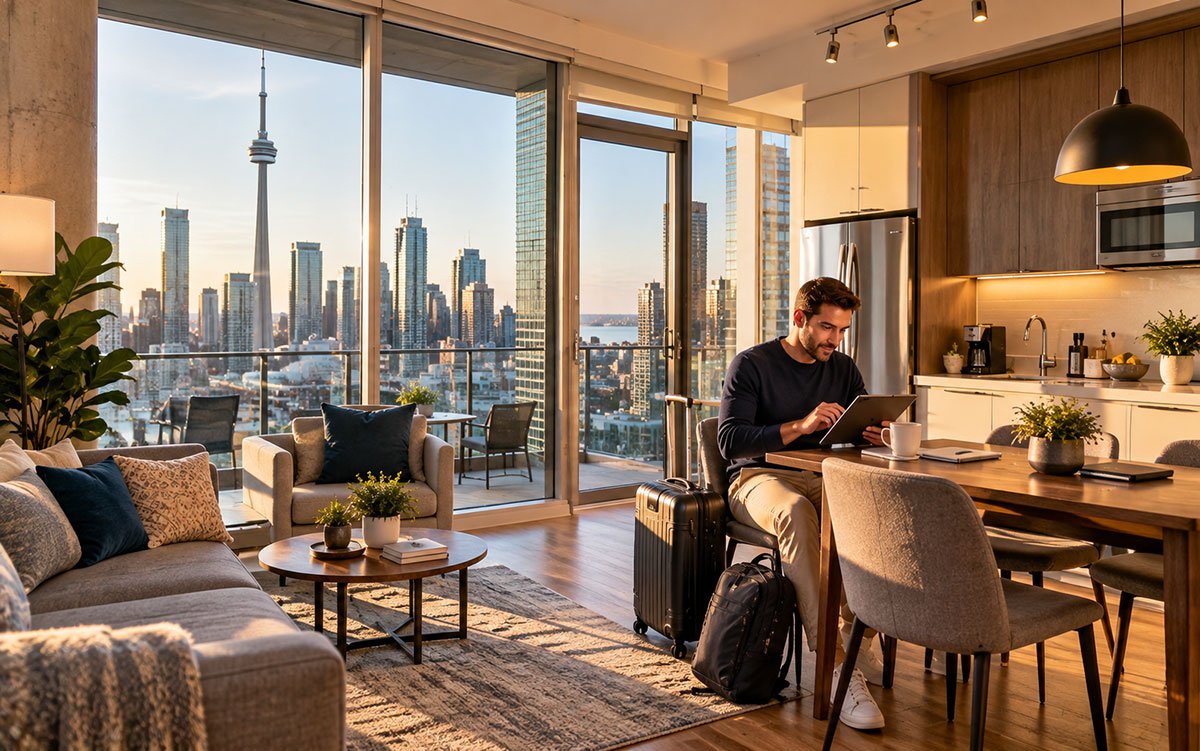
Furnished apartments provide an alternative to traditional hotels for travellers seeking space, convenience and home-style amenities during longer stays in Canada.
Furnished Apartment vs Hotel in Canada: Which Is Better for Extended Stays?
Choosing where to stay is one of the most important decisions when planning a longer trip to Canada. A full-service hotel offers convenience and professional guest services, while a furnished apartment can provide the space, privacy and everyday facilities of a temporary home.
But which option offers better value?
When comparing a furnished apartment vs hotel in Canada, the answer depends on how long you are staying, your budget and the amenities you actually need.
Business travellers may prioritise reliable internet, a comfortable workspace and flexible housekeeping. Families might prefer extra bedrooms and kitchen facilities. Meanwhile, holidaymakers who want restaurant dining and assistance on demand may find hotels more convenient.
There is also a third option worth considering: extended-stay hotels and serviced apartments that combine residential-style accommodation with selected hotel services.
This guide compares the main options, explains important Canadian accommodation regulations and helps you choose a comfortable, practical place to stay.
Furnished Apartment vs Hotel in Canada: Quick Comparison
Before exploring the differences in detail, here is how the accommodation types generally compare.
| Feature | Furnished Apartment | Full-Service Hotel |
|---|---|---|
| Living space | Often includes separate living and sleeping areas | Depends on room type; suites offer more space |
| Kitchen facilities | Frequently includes a kitchen | Usually limited, except in selected rooms or suites |
| Housekeeping | May be periodic or available for an additional charge | Often provided, but frequency varies |
| Laundry | May have in-unit or shared facilities | Often offers laundry services or guest facilities |
| Reception | May have limited or remote support | Typically provides staffed reception |
| Dining | Self-catering is the main option | May offer restaurants, breakfast or room service |
| Privacy | More residential-style living | Shared hotel facilities and staff access |
| Longer-stay pricing | May offer weekly or monthly rates | Extended-stay discounts may be available |
| Booking flexibility | Depends on rental agreement | Depends on the property’s rate conditions |
| Best suited for | Longer stays, families and independent travellers | Travellers who value convenience and on-site services |
These are general differences, not guaranteed features. Individual properties vary considerably, so always confirm facilities before booking.
1. What Is a Furnished Apartment?
A furnished apartment is accommodation supplied with essential furniture and living facilities for temporary or longer-term occupancy.
It may be a privately managed apartment, a corporate rental or a professionally operated serviced residence.
Depending on the property, facilities can include a separate bedroom, living room, dining area, kitchen, bathroom and laundry equipment.
Some providers include utilities and internet access in the rental price. Others charge separately or place limits on particular services.
Why furnished apartments appeal to extended-stay travellers
The main advantage is the opportunity to maintain a more familiar daily routine.
You can prepare meals, work from a dedicated space and relax without spending all your time in a single hotel room.
This can be especially valuable during a lengthy business assignment, family visit or temporary relocation.
However, a furnished apartment does not necessarily include the same support services as a hotel.
Maintenance requests may be handled by a property manager, while cleaning, linen changes and emergency assistance depend on the rental agreement.
Before booking, establish what is included and who is responsible if something goes wrong.
2. What Does a Full-Service Hotel Offer?
A full-service hotel is generally designed around guest convenience.
Depending on the property, services may include staffed reception, housekeeping, restaurants, luggage storage, concierge assistance and recreational facilities.
For visitors who prefer not to manage cooking or household tasks, these services can make travelling considerably easier.
Convenience and guest support
One advantage of a hotel is access to staff who can help with check-in, room-related problems and local information.
Larger full-service properties may have staff available around the clock.
However, not every hotel operates a 24-hour front desk, and some services may be unavailable at particular times.
Housekeeping arrangements also vary. Daily cleaning should not be assumed unless the property confirms it.
Similarly, breakfast, room service, gym access and laundry services may be included, optional or unavailable.
Why hotels remain attractive for longer trips
Hotels can suit business travellers with demanding schedules, visitors who require regular assistance and guests who prefer a straightforward booking arrangement.
They can also be convenient when the departure date is uncertain, provided the reservation conditions allow suitable changes.
The main drawback may be limited living space, particularly if you book a standard room for several weeks.
For a longer stay, compare larger hotel rooms, suites and properties offering extended-stay accommodation.
3. Are Furnished Apartments Cheaper Than Hotels in Canada?
A furnished apartment can offer better value for a longer stay, but it is not automatically the cheaper option.
Accommodation costs vary according to the city, neighbourhood, season, property type and length of stay.
A centrally located apartment in Toronto or Vancouver, for example, may cost more than a hotel in a less expensive area.
Hotels may also offer special rates for longer bookings, while apartment operators may provide weekly or monthly pricing.
The most reliable approach is to compare the complete cost of each suitable property.
Consider the total accommodation cost
When comparing quotations, include:
- The full accommodation charge for your intended dates.
- Applicable taxes and mandatory booking fees.
- Cleaning and housekeeping charges.
- Parking, where required.
- Laundry costs.
- Internet and utility charges, if not included.
- The cost of meals and groceries.
- Transportation between the property and your planned destinations.
- Cancellation conditions and any non-refundable payments.
For apartment rentals, also check security deposits and the conditions for their return. A refundable deposit is not necessarily a final expense, but it can affect your available travel funds.
Remember the cost of daily meals
A kitchen can provide an important financial advantage if you intend to cook regularly.
Preparing breakfast, storing groceries and cooking some evening meals may reduce your restaurant spending.
However, self-catering also requires shopping, preparation and cleaning.
If you expect to eat out every day, a kitchen may offer less financial benefit.
Some hotels include breakfast in particular rates, while others offer rooms with kitchenettes.
Travel tip: Compare the entire stay rather than the nightly rate alone. A property that appears cheaper initially may cost more after mandatory fees and everyday expenses.
4. Space and Comfort: Which Accommodation Feels More Like Home?
Space becomes increasingly important when you stay somewhere for more than a few nights.
A compact hotel room may be perfectly adequate for a weekend city break. However, it can become less practical when you need somewhere to work, prepare meals or spend time with family.
Furnished apartments for everyday living
Many furnished apartments offer separate areas for sleeping, relaxing and dining.
This arrangement can provide flexibility for couples with different schedules or families travelling with children.
A separate bedroom can also be useful when one person needs to rest while another works.
Nevertheless, the amount of space depends on the specific apartment.
A compact studio may be smaller than a hotel suite, so compare verified floor plans or property dimensions where available.
Hotels for comfortable, convenient stays
A hotel room can be appealing when you expect to spend most of your time sightseeing or attending meetings.
You may have fewer household responsibilities and easier access to organised services.
If comfort is important but you do not need a full kitchen, a hotel suite with a separate sitting area may provide a suitable compromise.
5. Kitchen and Laundry Facilities for Longer Stays
For many extended-stay travellers, access to kitchen and laundry facilities is one of the biggest reasons to choose an apartment.
These amenities can make everyday living more convenient, especially during family holidays or business assignments.
Cooking facilities
A furnished apartment may include a refrigerator, stove, microwave, basic cookware and dining equipment.
However, the term fully equipped kitchen can mean different things to different property operators.
Before booking, confirm what appliances, utensils and cooking facilities are actually provided.
Travellers with dietary requirements may particularly appreciate the ability to prepare their own meals.
Laundry facilities
Access to laundry can be equally useful.
Some furnished apartments provide an in-unit washer and dryer, while others offer shared laundry rooms.
Hotels may offer paid laundry services or guest-operated machines.
If you are travelling for several weeks, ask how often you can use these facilities and whether extra charges apply.
Do not assume that a furnished apartment includes in-unit laundry merely because the booking describes it as suitable for longer stays.
6. Housekeeping, Maintenance and Customer Service
Hotels and furnished apartments differ significantly in how they manage guest services.
Neither model is automatically better, but understanding the arrangements can prevent frustration.
Housekeeping in hotels
Hotels often provide regular housekeeping, fresh towels and room maintenance.
The exact cleaning schedule depends on the property and the rate you book.
Some hotels offer housekeeping on request or follow a reduced cleaning schedule for extended stays.
Ask about linen changes and cleaning frequency if these services are particularly important to you.
Housekeeping in furnished apartments
Apartment stays may include cleaning before arrival and after departure, with additional services available during the booking.
Professionally managed serviced apartments may offer scheduled housekeeping.
Other rentals place more responsibility on guests for routine cleaning.
Before confirming the reservation, ask:
- How frequently is the property cleaned?
- Are fresh towels and bed linen provided during the stay?
- Who handles maintenance problems?
- Is emergency assistance available outside normal office hours?
- Are cleaning supplies and basic household essentials included?
For a longer stay, reliable support can be just as important as the accommodation itself.
7. Privacy, Security and Accessibility
Privacy is a common reason travellers consider furnished apartments.
Having a separate living area, private kitchen and residential-style entrance can create a more independent experience.
However, privacy depends on the property’s layout, building rules and whether any facilities are shared.
A furnished apartment in a busy condominium building may not necessarily feel more private than a quiet hotel.
Security considerations
Hotels may provide staffed reception, controlled guest access and on-site assistance.
Furnished apartments may use building entry systems, digital locks or keys supplied by a property manager.
Before booking either option, investigate the security arrangements and emergency contact procedures.
Check whether the building has clear evacuation information and suitable safety equipment.
Accessibility and special requirements
Travellers with mobility needs should confirm the accessibility features of the actual room or apartment rather than relying only on a general property description.
Ask about step-free entry, lifts, bathroom arrangements, door widths and accessible parking where relevant.
A building with an elevator does not automatically provide a fully accessible apartment.
Similarly, guests travelling with children should check window safety, room layouts and any relevant property restrictions.
8. Consider Extended-Stay Hotels and Serviced Apartments
The choice does not have to be limited to a conventional apartment or a full-service hotel.
Extended-stay hotels and serviced apartments occupy the space between these accommodation styles.
Extended-stay hotels
These properties are designed for guests who need accommodation beyond a typical short hotel visit.
Depending on the property, rooms or suites may include kitchen facilities, additional storage, work areas and laundry access.
Guests may also benefit from hotel-style services such as reception, housekeeping and shared facilities.
Serviced apartments
Serviced apartments typically combine furnished residential accommodation with selected services.
They may provide a kitchen, separate living area and scheduled cleaning.
Some are operated within apartment buildings, while others form part of professionally managed hospitality properties.
The labels serviced apartment, aparthotel and extended-stay hotel do not guarantee identical facilities.
Compare the actual services included, not simply the name used in the advertisement.
For travellers who want cooking facilities without giving up regular guest support, these hybrid options deserve consideration.
9. Understand Canada’s Short-Term Rental Regulations
Booking a furnished apartment in Canada requires some additional research because short-term rental rules vary between provinces and municipalities.
A property that can legally operate as a tourist rental in one city may face different restrictions elsewhere.
Rules can also distinguish between ordinary residential rentals, licensed tourist accommodation and hotel-style properties.
Toronto: Short-term rental registration
The City of Toronto defines a short-term rental as all or part of a dwelling rented for fewer than 28 consecutive days.
Its regulations generally restrict eligible short-term rentals to the operator’s principal residence and require registration.
Hotels and certain other accommodation categories are treated separately.
When booking a Toronto apartment for a short visit, check that the listing complies with applicable local requirements.
Vancouver: Provincial and municipal requirements
Vancouver requires a short-term rental business licence for eligible home rentals of fewer than 90 consecutive days.
British Columbia also operates a provincial short-term rental registration system.
Hosts must comply with applicable provincial and local rules, and qualifying listings must display the required registration and licence information.
If you are considering a privately managed apartment in Vancouver, verify that the accommodation is legitimately offered for the intended length of stay.
Montréal: Additional tourist accommodation restrictions
Montréal has its own tourist accommodation requirements alongside Québec’s provincial framework.
For example, short-term rental arrangements involving principal residences are subject to location restrictions and permitted rental periods.
Other accommodation categories may operate under different authorisations.
These arrangements can affect the availability of furnished apartments for short visits.
Important: Always check the relevant municipal or provincial government website before booking. Longer residential leases, licensed hotels and professionally operated accommodation may be subject to different rules.
10. Consider Accommodation Taxes and Rental Conditions
Taxes can affect the total cost of accommodation in Canada.
The applicable treatment depends on the type of accommodation, the nature and length of the rental and the relevant federal, provincial and local requirements.
GST/HST on longer accommodation stays
Canada’s federal GST/HST rules generally distinguish short-term accommodation from qualifying residential accommodation supplied for a continuous period of one month or longer.
Certain longer residential lodging arrangements may be exempt from GST/HST when the applicable conditions are met.
However, travellers should not assume that every monthly hotel or apartment booking automatically qualifies for an exemption.
Other taxes or charges may also apply.
Ask the accommodation provider to explain the taxes included in the quoted total and how they apply to your particular stay.
Understand the rental agreement
For furnished apartments, carefully review the agreement before paying.
Check:
- The exact start and end dates.
- Payment schedules and deposit requirements.
- Whether utilities and internet are included.
- Guest and occupancy restrictions.
- Housekeeping responsibilities.
- Rules on pets, smoking and noise.
- Cancellation or early-departure conditions.
- Procedures for reporting damage or maintenance problems.
For longer residential arrangements, tenancy laws may become relevant depending on the province, the property and the nature of the agreement.
Do not assume hotel booking rules and residential lease conditions are interchangeable.
11. Choose the Right Location in Your Canadian Destination
Accommodation location matters regardless of whether you choose a hotel or apartment.
This is especially important in major Canadian cities, where the distance between neighbourhoods can affect commuting time and transportation costs.
Extended stays in Toronto
Toronto offers a variety of accommodation styles, from downtown hotels to residential apartments and professionally managed extended-stay properties.
If you are visiting for business, compare properties according to their proximity to your workplace or meeting locations.
If you are travelling for leisure, consider access to public transportation, grocery shops and the areas you intend to explore.
Being close to a suitable TTC subway or streetcar connection may be more useful than simply selecting a property described as centrally located.
Extended stays in Vancouver
In Vancouver, consider whether you need access to downtown business districts, residential neighbourhoods or destinations beyond the city centre.
Accommodation near suitable SkyTrain or bus connections can make daily journeys easier.
If you intend to rent an apartment, check the applicable short-term rental requirements as part of your research.
Extended stays in Montréal
Montréal offers different neighbourhood environments, including busy central districts and more residential areas.
When selecting accommodation, consider your workplace, planned attractions and access to the Montréal métro or other transportation.
For apartment rentals, ensure the booking complies with the relevant tourist accommodation rules.
Remember Canada’s seasonal conditions
Weather can influence accommodation comfort.
For winter stays, confirm the heating arrangements, building access and practical transportation options.
During warmer months, ask about air conditioning if it is important to you.
Do not assume that every property includes the same temperature-control facilities.
12. Which Accommodation Is Best for Your Type of Trip?
The most suitable option depends on why you are travelling and how you expect to spend your time.
For business travellers
A hotel may work well for short assignments that involve meetings, meals outside the property and limited time indoors.
For a longer assignment, a furnished apartment or extended-stay hotel may provide a more comfortable workspace, kitchen and laundry facilities.
Check internet reliability and whether the property offers a quiet area for video calls.
For families
A furnished apartment can be appealing when children need room to play, follow regular meal routines or sleep separately from adults.
However, some hotel suites can provide comparable benefits alongside convenient guest services.
Compare sleeping arrangements, kitchen facilities, safety features and total cost rather than assuming one accommodation type is always preferable.
For couples on holiday
A full-service hotel may appeal to couples who want minimal household responsibilities and convenient dining.
A furnished apartment can offer greater independence, particularly for a longer city stay.
The decision depends on whether you value hotel services or residential-style living more.
For remote workers
A dedicated work area, reliable internet and comfortable daily living arrangements can be important during a lengthy visit.
Ask the property manager about workspace facilities and any internet-related restrictions.
International travellers should also verify that their planned activities comply with Canada’s applicable immigration and work rules. Renting accommodation does not itself grant permission to work or remain in the country.
For travellers relocating to Canada
Temporary furnished accommodation can provide a practical base while you search for permanent housing.
A hotel or serviced apartment may offer greater convenience immediately after arrival, while a longer furnished rental may be more suitable once your plans become clearer.
Review the cancellation and extension conditions carefully if your relocation schedule is uncertain.
How to Compare Furnished Apartments and Hotels Before Booking
Once you have shortlisted suitable properties, compare them using the same criteria.
A simple five-step approach can help.
- Confirm your stay length. Establish the expected arrival and departure dates and whether they might change.
- Compare complete prices. Include all mandatory charges, applicable taxes and everyday expenses.
- Verify essential amenities. Check kitchen facilities, laundry, internet, housekeeping, accessibility and parking.
- Check location and legitimacy. Review the exact address, transportation connections, operator details and applicable rental registration requirements.
- Read the booking conditions. Understand payment deadlines, refunds, deposits and procedures for cancellations or extensions.
Look at recent, credible guest reviews, but do not rely on ratings alone.
Confirm important details directly with the property when the listing is unclear.
Be cautious of unusually cheap rental offers, pressure to pay immediately and requests to transfer money outside a trusted booking arrangement.
Frequently Asked Questions About Furnished Apartments and Hotels in Canada
Is a furnished apartment cheaper than a hotel for a month?
It can be, particularly when a monthly rate and kitchen facilities help reduce total expenses. However, hotels may offer competitive extended-stay packages. Compare complete quotations for the same dates and location.
Do furnished apartments in Canada include utilities and internet?
Some include electricity, heating, water and internet access in the rental price. Others charge separately or apply conditions. Confirm the details before booking.
Are furnished apartments suitable for short stays?
Yes, where the property is legally authorised and accepts bookings for the intended period. Availability depends on the operator and local short-term rental regulations.
What is the difference between a serviced apartment and a furnished apartment?
A furnished apartment provides furniture and residential facilities. A serviced apartment generally adds selected hospitality services, such as housekeeping or guest support. The exact service level varies.
Do hotels offer monthly accommodation rates?
Some hotels and extended-stay properties offer rates intended for longer bookings. Ask the provider directly and compare the conditions with standard nightly reservations.
Can tourists rent furnished apartments in Canada?
Tourists can book eligible accommodation, but the rental must comply with applicable local regulations. Travellers must also meet Canada’s entry and stay requirements, which depend on citizenship and circumstances.
Are furnished apartments safer than hotels?
Safety depends on the individual property. Hotels may provide staffed reception and on-site security, while apartments may have secure building access and professional management. Assess the specific arrangements rather than assuming either category is inherently safer.
Furnished Apartment or Hotel: Making the Right Choice
There is no universal winner in the furnished apartment versus hotel comparison.
A full-service hotel can be the better choice when you value on-site assistance, convenient dining and minimal household responsibilities.
A furnished apartment may be more appealing when you need additional living space, kitchen facilities, privacy and greater independence during a longer stay.
Extended-stay hotels and serviced apartments can provide a useful middle ground.
Whichever option you choose, compare the full cost, confirm the amenities and check the booking conditions and applicable rental rules.
The best accommodation for an extended stay in Canada is the one that suits your daily routine, supports your travel plans and delivers the services you actually need.
