
Chaka Salt Lake and the Wonders of the Qaidam Basin
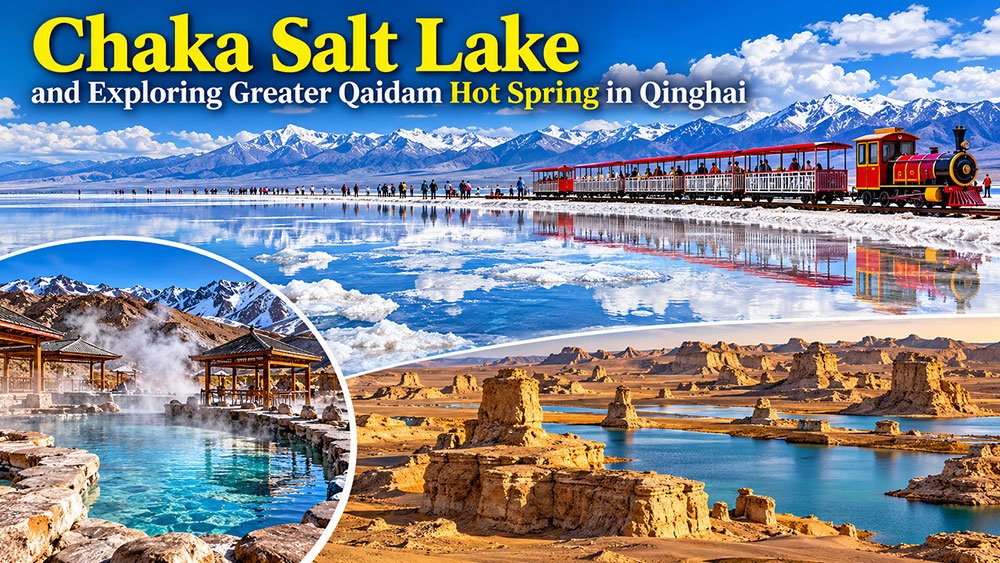
Qinghai’s Chaka Salt Lake is one of the most recognizable landscapes in the Qaidam region. Its broad salt surface, distant mountains and reflective water create the famous “Sky Mirror” effect that attracts photographers and road-trip travelers. The wider Qaidam Basin adds another layer of adventure with hot springs, desert landscapes and extraordinary Yadan rock formations.
Chaka Salt Lake sits in Chaka Town, Wulan County, in Haixi Mongolian and Tibetan Autonomous Prefecture. The official scenic-area website currently lists it as a national 4A-level tourist attraction and provides online ticketing, travel information and operating updates.
A journey through this part of Qinghai can combine salt-lake scenery with the hot springs around Dachaidan and the wind-carved landscapes of the Qaidam Basin. Because the region sits at high altitude and includes long stretches of remote terrain, travelers should plan carefully and check current weather, road and attraction information before setting out.
Chaka Salt Lake: The Sky Mirror of Qinghai
Chaka Salt Lake is a natural salt lake in the eastern part of the Qaidam Basin region. The Chinese name “Chaka” is widely used in English tourism information, although older travel articles often spell it as “Caka.”
The lake has become famous as the “Mirror of the Sky” because calm water can reflect the surrounding sky and mountains. Qinghai’s tourism authorities have also used the “Sky Mirror” description when promoting the province’s ecotourism attractions.
The contrast between brilliant white salt, blue water and snow-covered mountains creates a striking landscape.
A Long History of Salt Production
Salt production has shaped Chaka for centuries. Today, the destination combines its industrial salt heritage with tourism.
The scenic area has developed facilities that explain the history and culture of salt production. The official Chaka Salt Lake platform currently promotes a dedicated Salt Culture Museum and related attractions that explore salt formation, production history and the work of generations of salt workers.
Visitors can therefore experience more than the famous reflective lake. They can also learn about the resource that has shaped the local economy and landscape.
What to See at Chaka Salt Lake
The main scenic area now offers several attractions and visitor experiences.
The official site lists destinations including the Chaka Salt Special Tourist Area, Chaka Snow Special Tourist Area, Chaka Xia Special Tourist Area, Chaka Feng Special Tourist Area, Sky Mirror Station and outdoor salt sculptures.
Depending on the season and operating conditions, visitors may encounter:
- Salt flats and reflective water
- Snow-covered mountain views
- Salt sculptures
- Historic railway features
- Scenic viewpoints
- Tourist trains
- Boat experiences
- Salt-culture exhibitions
- Photography areas
The combination of natural scenery and tourism infrastructure gives travelers several ways to explore the lake.

Salt Sculptures at Chaka
The salt landscape has inspired the development of large outdoor salt sculptures.
The official scenic-area website describes the Chaka Salt Special Tourist Area as a large outdoor salt-sculpture complex. It contains themed sculpture groups based on myths, legends and stories connected with salt culture.
The white sculptures stand against the blue sky and surrounding mountains, creating another popular photography setting.
For visitors interested in photography, the salt sculptures can complement the more natural views of the lake.
The Famous Chaka Tourist Train
A tourist railway adds another way to experience the salt landscape.
The current Chaka scenic-area platform identifies Sky Mirror Station as the starting point for the narrow-gauge tourist train and provides information about the railway as one of the site’s visitor attractions.
Train operations can change according to the season and operating conditions, so confirm availability before planning your visit around a particular ride.
Chaka Salt Lake Opening Hours
The official Chaka Salt Lake website currently lists the following general operating hours:
May to October: 7:00 a.m. to 10:00 p.m.
November to April: 8:00 a.m. to 10:00 p.m.
However, travelers should treat these as general published hours rather than a guarantee for every day. The scenic area regularly publishes seasonal operating notices, and individual attractions can have different schedules.
Check the official website shortly before your visit, especially during shoulder seasons or periods of unusual weather.
Best Time to Visit Chaka Salt Lake
Summer and early autumn generally offer the most popular conditions for exploring the lake, particularly for visitors who want reflective-water photography and access to more seasonal facilities.
The official site identifies May through October as the busy season.
The weather, however, can change quickly in Qinghai. Strong sunshine, wind, clouds and temperature changes can all affect the appearance of the lake.
Early morning and late afternoon can produce particularly interesting light. At the same time, visitors should dress for changing temperatures rather than relying only on daytime forecasts.

Chaka Salt Lake Photography Tips
Chaka is one of the most photography-friendly landscapes in the Qaidam region.
For the classic “sky mirror” effect, look for calm, shallow water where the surface produces clear reflections.
A few practical tips can improve your experience:
Visit during good light
Sunrise and sunset can produce stronger colors than the middle of the day.
Protect your eyes
Bright salt surfaces can produce intense glare. Sunglasses and sun protection are useful at high altitude.
Check wind conditions
Wind can ripple the water and reduce the mirror effect.
Protect your camera
Salt and dust can be damaging to equipment. Keep lenses and camera bodies protected when conditions become windy.
High-Altitude Travel Considerations
Chaka Salt Lake sits at high elevation, so visitors should remember that the environment differs from lowland destinations.
The combination of altitude, strong sunlight, dry air and temperature changes can make a day outdoors more tiring than expected.
Take time to adjust if you have traveled rapidly from a lower elevation. Stay hydrated, avoid unnecessary exertion and pay attention to how you feel.
Travelers with medical concerns should obtain professional advice before traveling to high-altitude destinations.
Dachaidan Snow Mountain Hot Spring
The Dachaidan Snow Mountain Hot Spring adds a very different experience to a Qaidam Basin road trip.
The attraction lies about 8 kilometers north of Dachaidan Town in the Chaidamushan Hot Spring area. Current visitor information lists the site as a developed hot-spring tourism destination with indoor and outdoor bathing facilities.
The surrounding mountains create a dramatic setting, particularly when snow covers the higher peaks.
A Geothermal Landscape
The hot springs form part of a broader geothermal system in the northern Qaidam Basin.
Scientific research published in Water in 2024 analyzed groundwater and geothermal systems around the Da Qaidam area. Researchers identified hot-spring waters with distinctive chemical characteristics and found evidence that snow and ice melt contribute to groundwater recharge at high elevations.
This scientific perspective adds useful context to what visitors see on the surface: a hot geothermal system operating beneath a cold, high-altitude landscape.
How Hot Is the Spring?
Local visitor information reports temperatures around 80°C at some natural spring sources. That does not mean every bathing pool has that temperature. Developed facilities use controlled pools suitable for visitors.
Because natural geothermal water can become dangerously hot, visitors should never enter an undeveloped spring simply because it looks accessible.
Follow signs, staff instructions and designated bathing areas.
Avoid Unverified Medical Claims
Older versions of this article described the mineral-rich water as treating conditions such as skin disease and arthritis.
That wording does not belong in a responsible evergreen travel guide. Mineral content does not establish that a hot spring can treat or cure a medical condition.
Visitors can enjoy a hot spring as a recreational experience, but they should not regard it as medical treatment.
Amazing Yadan Landscapes of the Qaidam Basin
The Qaidam Basin is also famous for its Yadan, or yardang, landforms.
Yardangs are elongated, wind-eroded landforms that develop in arid environments. The Qaidam Basin contains one of the world’s major concentrations of these unusual geological formations. UNESCO’s tentative-list documentation describes extensive yardang landscapes in the Qaidam Basin and identifies the region as an important example of wind-driven geomorphic processes.
These formations can resemble castles, ridges, ships, animals and other shapes when viewed from different angles.
The landscape looks almost otherworldly.
How the Yadan Landforms Formed
Wind plays a major role in shaping the Yadan landscapes.
Over long geological periods, erosion has removed softer material while leaving more resistant ridges and rock formations behind. Persistent winds then sculpt these formations into elongated, streamlined shapes.
A major 2026 study published in Communications Earth & Environment used geological dating and other evidence to investigate the evolution of the Qaidam Basin’s yardangs. The study estimated that yardang development began around 0.8 million years ago and expanded southeastward over subsequent periods. Researchers also identified the Qaidam Basin as one of Earth’s most extensive and Mars-like yardang environments.
This research makes the Qaidam Basin especially interesting for travelers who enjoy geology as well as scenery.
Wusute Water Yadan Geological Park
One of the region’s best-known attractions is Wusute Yadan Geological Park, famous for formations rising from water.
The park’s official website describes it as part of the larger Nanbaxian Yadan region and says the distinctive water-covered landscape formed after flooding changed the course of the Nalenggele River.
Recent coverage from China News Service also highlighted the unusual combination of blue water and wind-carved Yadan formations at the park.
The scene provides a dramatic contrast to the white salt surface of Chaka Salt Lake.
A Major 2026 Update for Dachaidan Attractions
Travelers planning a current Qaidam itinerary should be aware of an important event from June 2026.
On June 16, a 6.3-magnitude earthquake struck the Dachaidan area. Local authorities temporarily closed tourism sites throughout the affected area, including Wusute Water Yadan, Dachaidan Snow Mountain Hot Spring and other attractions, while officials carried out safety inspections and emergency work.
The situation changed later that month. On June 27, 2026, the Haixi prefecture authorities announced that key Dachaidan attractions had completed geological-hazard checks, infrastructure inspections and related safety work and had reopened to visitors.
This illustrates why older travel articles should not provide permanent assumptions about access to remote Qinghai attractions.
Check local announcements immediately before traveling.
Chaka Salt Lake and Yadan: Two Very Different Landscapes
The combination of Chaka Salt Lake and the Qaidam Basin’s Yadan landscapes creates an unusually diverse travel experience.
At Chaka, the dominant colors can include white salt, blue water and bright sky.
In the Yadan region, the scenery shifts toward brown, red and ochre rock formations surrounded by vast desert.
The geological processes also differ. Salt lakes reflect the region’s mineral-rich closed-basin environment, while Yadan formations record long-term erosion and wind activity.
Together, they show why the Qaidam Basin attracts photographers, road trippers and travelers interested in geology.
How to Plan a Qaidam Basin Road Trip
The region works particularly well as part of a longer Qinghai road trip.
A common travel pattern connects destinations such as:
Xining → Qinghai Lake region → Chaka Salt Lake → Wulan → Dachaidan → Yadan landscapes → other western Qinghai attractions
The exact route depends on road conditions, available time and which attractions you want to visit.
Qinghai’s transport authorities continue to improve tourist routes and road infrastructure. In September 2026, the provincial transport department reported ongoing work to improve tourist road quality and create integrated scenic routes supporting major destinations including Chaka Salt Lake.
During peak tourism periods, roads leading toward Chaka and other popular destinations can become busy. In July 2026, Qinghai transport authorities specifically reported increased traffic pressure on major routes connecting Qinghai Lake and Chaka Salt Lake and carried out traffic-management measures during the tourism season.
Transport to Chaka Salt Lake
The Chaka Salt Lake official website provides route-planning information for visitors arriving by air, train, bus or private vehicle.
Because public transportation schedules can change, travelers should check current services before departure rather than relying on bus or train numbers from an older article.
A private vehicle or organized road trip can provide greater flexibility when combining Chaka with Wulan, Dachaidan and western Qinghai attractions.
Practical Tips for Visiting Chaka and the Qaidam Basin
Carry sun protection
The combination of high elevation and bright salt surfaces can make sunlight particularly intense. Carry sunglasses, sunscreen and a hat.
Prepare for changing temperatures
Do not assume that a sunny afternoon means warm conditions throughout the day. Temperatures can fall quickly after sunset.
Drink enough water
Dry, high-altitude conditions can increase your need for fluids.
Respect designated areas
Stay on marked paths and follow instructions around salt pools, railway tracks, geothermal springs and geological formations.
Avoid entering natural hot springs
Natural spring sources can reach extremely high temperatures. Use only designated bathing areas.
Protect fragile landscapes
Do not climb fragile rock formations, disturb salt features or leave litter behind.
Check road conditions
Remote sections of the Qaidam Basin can involve long driving distances and limited services. Check fuel, weather and road conditions before leaving a populated area.
Check attraction notices
Chaka Salt Lake and western Qinghai attractions publish seasonal announcements. Verify opening arrangements before setting out. The Chaka scenic area currently maintains an official notice system, while Wusute Yadan also publishes reopening and operating announcements through its official site.
When Should You Visit?
For a classic Chaka Salt Lake experience, the main tourist season offers broader access to facilities and visitor services.
The Chaka scenic area currently identifies May through October as its busy season, while November through April forms the low season.
However, each season provides something different.
Summer: Easier access to many attractions and generally strong tourism activity.
Early autumn: Cooler conditions and excellent opportunities for landscape photography.
Winter: Quieter scenery and a very different appearance, although cold weather and seasonal operations require more preparation.
For western Qaidam attractions such as Wusute Water Yadan and Dachaidan Snow Mountain Hot Spring, always check current operating notices and road conditions.
Chaka Salt Lake and the Qaidam Basin for Photographers
Photographers can find several distinct subjects within a single journey.
At Chaka Salt Lake, look for:
- Mountain reflections
- Salt textures
- White salt against blue sky
- Tourist railway scenes
- Salt sculptures
- Sunrise and sunset colors
Around Dachaidan, look for:
- Snow-covered mountain peaks
- Geothermal steam
- Desert landscapes
- Vast open horizons
In the Yadan region, look for:
- Wind-carved ridges
- Castle-like formations
- Desert textures
- Water-surrounded rock formations
- Long shadows at sunrise and sunset
The different environments make the Qaidam Basin particularly rewarding for landscape photography.
Final Thoughts
Chaka Salt Lake and the Qaidam Basin showcase some of Qinghai’s most unusual natural and cultural landscapes.
Chaka offers the reflective beauty of the “Sky Mirror,” while Dachaidan adds geothermal springs and access to the spectacular western Qaidam landscape. Farther west, Yadan formations reveal the power of wind and erosion across an immense desert basin. Scientific research continues to provide new insight into how these distinctive landforms developed.
The region has also changed considerably since this article first appeared in 2015. Chaka Salt Lake now offers a broader range of visitor facilities and experiences, while tourism infrastructure throughout Haixi continues to develop. The 2026 earthquake and subsequent reopening of major Dachaidan attractions also demonstrate why travelers should check official notices before every trip.
Rather than treating the journey as a quick stop at one famous lake, consider exploring the wider Qaidam landscape. The combination of salt flats, mountains, hot springs and Yadan formations creates a memorable journey through one of China’s most distinctive high-altitude environments.
