

Mount Huangshan in Anhui Province, China, offers breathtaking hiking trails, dramatic granite peaks and spectacular views above the clouds.
5 Best Mountains to Hike in China: Trails & Travel Tips
China offers extraordinary hiking experiences, from mist-covered granite peaks and dramatic mountain ridges to ancient pilgrimage paths lined with temples. Some mountains challenge experienced hikers, while others offer scenic walks and cable cars that make spectacular viewpoints easier to reach.
If you are looking for the best mountains to hike in China, five destinations deserve particular attention: Huangshan, Mount Tai, Mount Huashan, the Wudang Mountains and Mount Emei.
Each offers something different. Huangshan is famous for its sea of clouds, Mount Tai for its historic stone stairways and Huashan for its exposed cliffs. Meanwhile, Wudang combines mountain walking with Taoist heritage, and Emei offers forest trails, Buddhist temples and remarkable summit scenery.
This guide compares all five mountains, explains their hiking options and provides practical advice for planning a memorable trip.
Best Mountains to Hike in China at a Glance
| Mountain | Province | Best For | Hiking Experience |
|---|---|---|---|
| Huangshan (Yellow Mountain) | Anhui | Dramatic scenery and photography | Moderate to strenuous |
| Mount Tai (Taishan) | Shandong | Historic pilgrimage trails | Moderate to strenuous |
| Mount Huashan | Shaanxi | Steep climbs and exposed ridges | Strenuous on demanding routes |
| Wudang Mountains | Hubei | Taoist temples and cultural hiking | Easy to strenuous |
| Mount Emei (Emeishan) | Sichuan | Forest walks and Buddhist heritage | Easy to very strenuous |
Difficulty depends on the route, weather conditions and use of available mountain transport.
1. Huangshan: China’s Famous Yellow Mountains
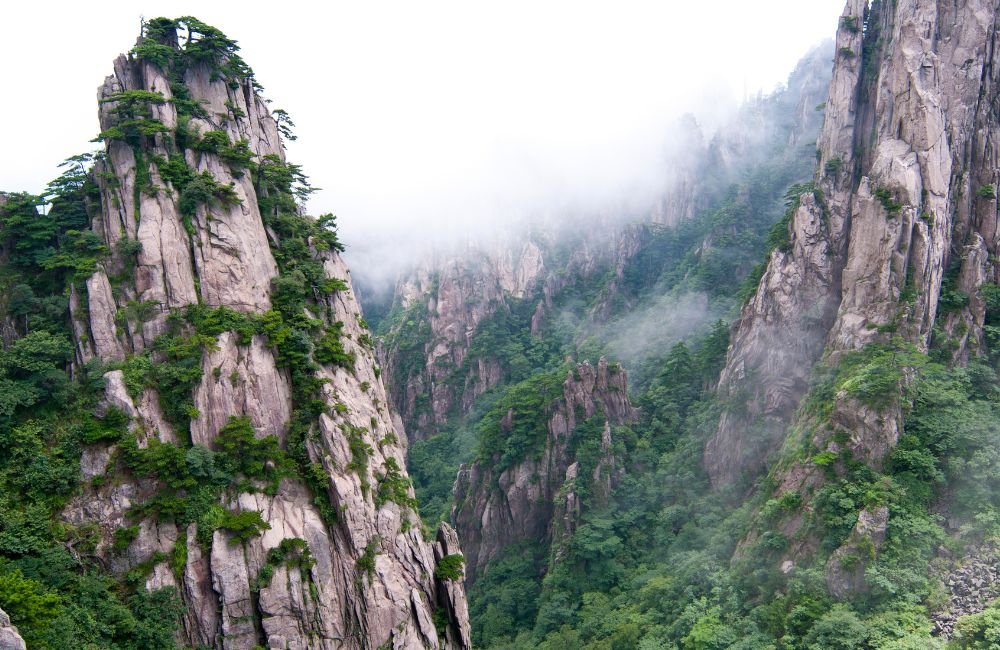
Mount Huangshan, also known as the Yellow Mountains, is famous for its towering granite peaks, distinctive pine trees and mystical cloud-covered landscapes in Anhui Province, China.
Huangshan (黄山), commonly called the Yellow Mountains, is among China’s most celebrated mountain landscapes. Located in southern Anhui Province, this UNESCO World Heritage Site is renowned for towering granite formations, windswept pine trees and valleys filled with drifting clouds.
The scenery has inspired Chinese painters, poets and photographers for centuries. On certain mornings, clouds gather below the summits, creating the impression of rocky islands floating above a white ocean.
Huangshan is particularly attractive because visitors can combine demanding climbs with relatively accessible scenic walks.
Best Hiking Trails and Viewpoints
Several established routes connect the mountain’s major scenic areas.
Bright Summit (Guangmingding) is a popular viewpoint that offers sweeping mountain panoramas. It is a rewarding stop on many summit-area walking itineraries.
Beginning-to-Believe Peak (Shixin Feng) provides classic Huangshan scenery, including unusual rock formations and pines growing from narrow granite crevices.
West Sea Grand Canyon (Xihai Grand Canyon) offers a more demanding experience when its designated walking sections are open. Its steep stairways and dramatic rock formations make it especially appealing to experienced walkers.
Jade Screen Scenic Area (Yuping) is another excellent choice, known for impressive mountain formations and iconic pine trees.
Some peaks and canyon sections close periodically for ecological recovery, maintenance or severe weather. Confirm the status of your intended route before setting off.
Hiking Difficulty and Access
Huangshan’s established hiking network includes extensive stone stairways, paved paths and steep climbs. Even when you use a cable car, expect considerable walking between viewpoints.
Visitors can access the mountains through designated scenic-area entrances, with cableways serving different sections. The East Gate and Donghai Cableway have also expanded access options.
For a first visit, consider spending two days exploring the mountain rather than attempting every viewpoint in one day.
Overnight accommodation is available within the scenic area, although reservations can be important during popular travel periods.
Getting there: Huangshan City is accessible by rail, including high-speed services. Travellers can continue towards the mountain’s designated visitor centres, with shuttle arrangements depending on their chosen entrance.
Travel tip: Reserve your scenic-area entry in advance through the official platform. Check the entrance direction, entry time and separate cableway arrangements carefully.
2. Mount Tai: Hike One of China’s Most Sacred Mountains
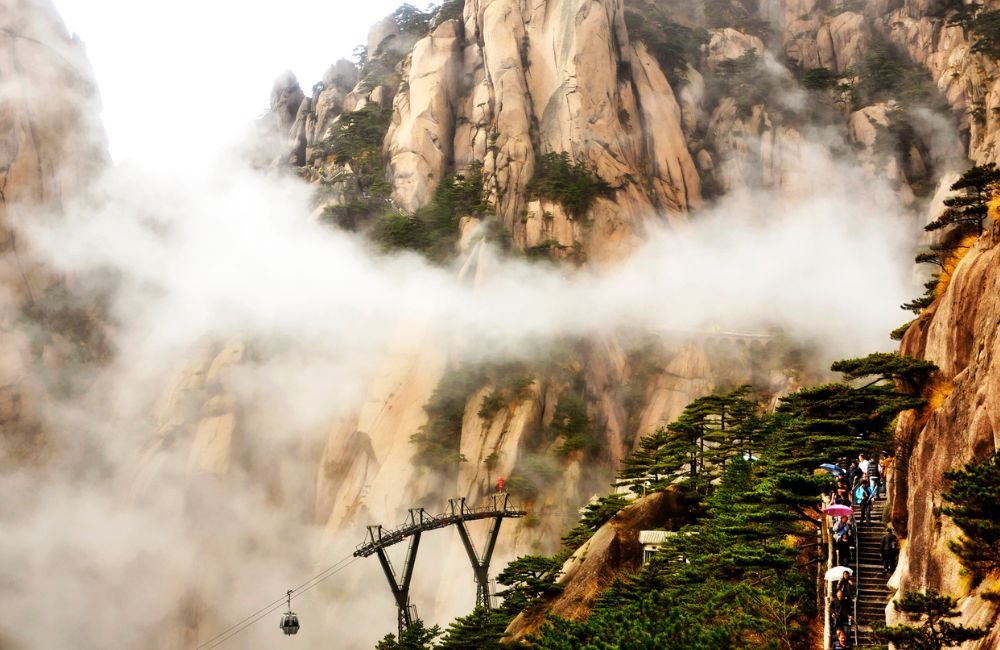
A dramatic Chinese mountain landscape featuring towering granite cliffs, mist-covered valleys, scenic hiking trails and cable-car access.
Mount Tai (泰山), also called Taishan, rises above the city of Tai’an in Shandong Province.
It is one of China’s Five Great Sacred Mountains and has played an important role in imperial ceremonies, religious traditions and Chinese literature.
Unlike mountains visited primarily for spectacular scenery, Mount Tai offers a journey through thousands of years of cultural history.
Stone inscriptions, traditional gates, ancient temples and steep stairways accompany hikers towards the summit.
The mountain’s highest point, Jade Emperor Peak, reaches approximately 1,545 metres above sea level.
The Classic Red Gate Hiking Route
The best-known hiking route begins at the Red Gate (Hongmen) entrance.
This historic route follows a long series of stone stairways past cultural landmarks, including:
- Red Gate Palace
- Doumu Palace
- Halfway Gate to Heaven (Zhongtianmen)
- Eighteen Bends (Shibapan)
- South Gate to Heaven (Nantianmen)
- Azure Cloud Temple (Bixia Temple)
- Jade Emperor Peak (Yuhuangding)
The Red Gate route extends for approximately 9.5 kilometres and contains thousands of steps.
The famous Eighteen Bends section is particularly steep. Although the route does not require technical climbing equipment, it demands stamina and careful pacing.
Official visitor guidance describes the complete ascent as a substantial hike that commonly takes several hours.
Easier Ways to Visit Mount Tai
Travellers who prefer less climbing can use the Tianwai Village route.
This option combines mountain transport to Zhongtianmen with a cableway towards the summit area, subject to operating conditions.
Alternatively, visitors can walk part of the historic trail and continue by cable car.
These alternatives make Mount Tai appealing to families and travellers with different fitness levels, although stairs and walking may still be necessary.
Getting there: Tai’an is connected to China’s railway network. From the city, visitors can travel to the appropriate mountain entrance.
Travel tip: Start early if attempting the full ascent. The combination of sustained climbing and steep stone steps can be tiring, especially in hot or wet weather.
3. Mount Huashan: Dramatic Cliffs and Challenging Mountain Trails
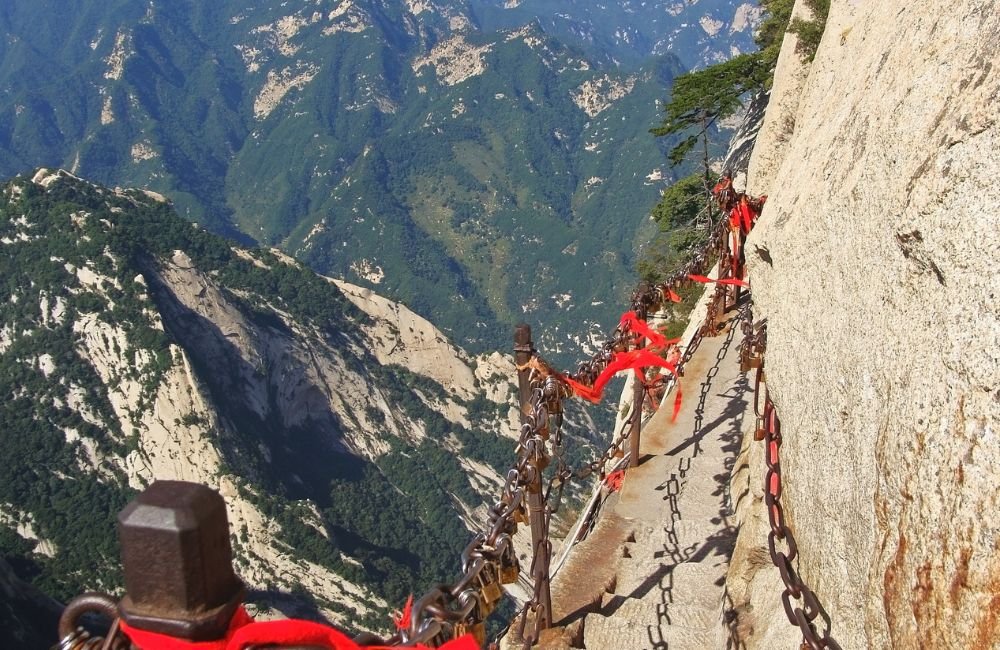
The famous cliffside plank walk on Mount Huashan in Shaanxi Province, China, features narrow wooden walkways, safety chains and dramatic views of the surrounding mountains.
Mount Huashan (华山), in Shaanxi Province, is one of China’s most dramatic mountain destinations.
Located near Huayin, it belongs to the Five Great Sacred Mountains and is traditionally associated with the western direction.
Its granite peaks, steep staircases and exposed ridges create a very different hiking experience from the forested paths of Wudang or Emei.
Huashan is famous for its striking terrain, where established walking routes sometimes follow narrow passages between steep rock faces.
Exploring Huashan’s Five Peaks
Huashan’s main scenic area contains five traditionally recognised peaks:
- North Peak
- East Peak
- South Peak
- West Peak
- Central Peak
South Peak is the highest, rising to approximately 2,155 metres.
The mountain offers a combination of summit walks, steep staircases and viewpoints overlooking dramatic valleys.
North Peak and West Peak are served by cableways, allowing visitors to explore selected higher sections without completing the entire ascent from the base.
However, cable-car access does not eliminate all physical challenges. Some summit connections involve significant stair climbing, exposed terrain and changing weather.
What About Huashan’s Famous Plank Walk?
Huashan became internationally famous for the Long Sky Plank Walk, a highly exposed attraction involving a narrow walkway attached to a cliff face.
Another well-known challenging attraction is Sparrowhawk Flip.
These specialised attractions are different from the mountain’s regular hiking routes and have additional safety requirements.
Important: Both attractions were temporarily closed for inspection and safety improvements in September 2026. Travellers should not assume they have reopened without checking official announcements.
The broader Huashan scenic area can still offer remarkable mountain walks independently of these attractions.
Visitors should never enter closed areas, cross safety barriers or attempt unofficial routes.
Who Should Hike Huashan?
Huashan is best suited to visitors who enjoy steep mountain walking and are comfortable with heights.
A cableway-assisted itinerary may be more appropriate for travellers who primarily want the scenery rather than the most physically demanding ascent.
Getting there: Huashan is commonly reached from Xi’an by rail towards Huashan North or by other regional transport services, followed by local transport to the scenic area.
Travel tip: Choose your route before purchasing tickets. Scenic-area admission, shuttle transport and cableway journeys may have separate booking requirements.
4. Wudang Mountains: Taoist Temples and Peaceful Mountain Walks
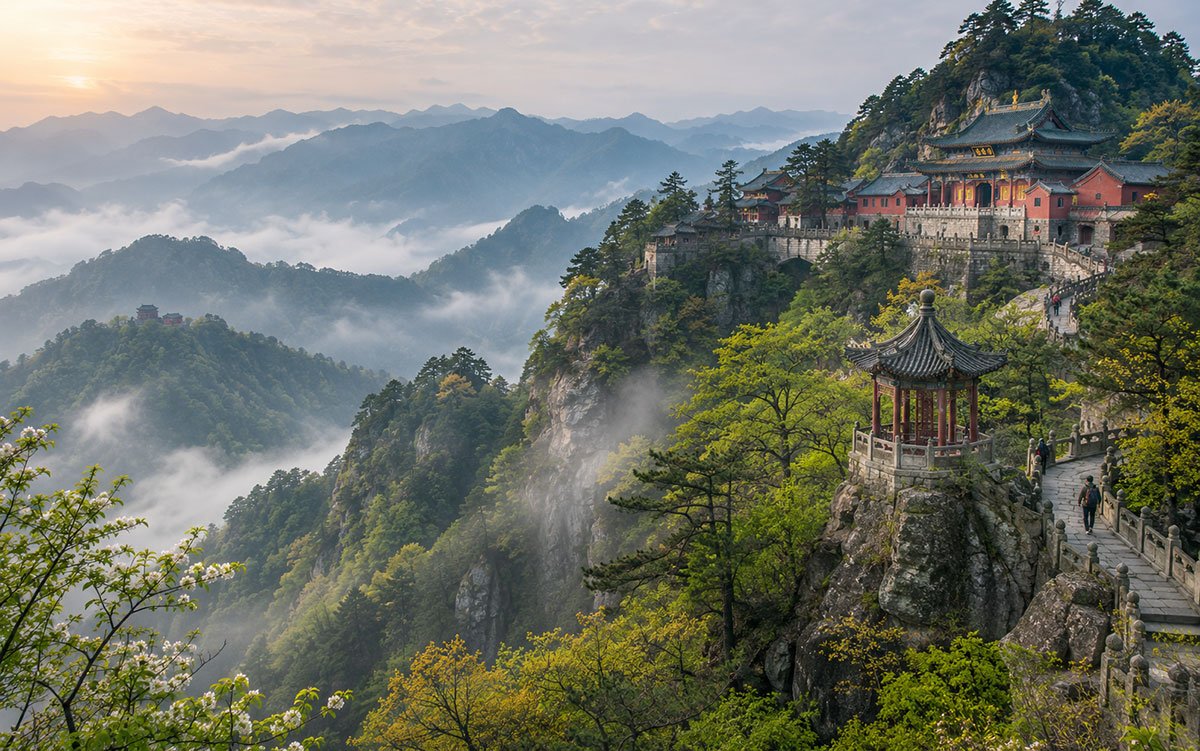
The Wudang Mountains in Hubei Province, China, are renowned for their ancient Taoist temples, beautiful forested peaks and peaceful mountain scenery.
The Wudang Mountains (武当山) in Hubei Province offer a distinctive combination of mountain scenery, ancient architecture and spiritual heritage.
The range is closely associated with Taoism and Chinese martial arts traditions.
Rather than focusing solely on reaching a summit, many visitors explore mountain paths connecting historic palaces, temples and forested viewpoints.
UNESCO recognises the Ancient Building Complex in the Wudang Mountains for its exceptional architectural and cultural significance.
The temples and palaces form an extraordinary mountain landscape, with structures carefully positioned on slopes, cliffs and within valleys.
Best Places to Explore in Wudang
Golden Summit (Jinding)
One of Wudang’s most important religious landmarks, the Golden Summit area offers panoramic mountain views and historic architecture.
Reaching the summit on foot involves climbing substantial sections of stone steps.
South Rock Palace (Nanyan Gong)
South Rock is especially impressive for the way traditional buildings integrate with steep mountain terrain.
The approach provides dramatic views of cliffs, valleys and historic structures.
Purple Cloud Palace (Zixiao Gong)
Purple Cloud Palace is one of Wudang’s most important surviving Taoist architectural complexes.
It offers visitors an opportunity to appreciate traditional Chinese building design within a peaceful mountain setting.
Hiking Difficulty and Access
Wudang offers a range of experiences, from relatively short walks around temple complexes to demanding stairway ascents towards the Golden Summit.
Scenic-area transport can reduce the amount of walking required.
Visitors should still prepare for uneven steps, steep sections and considerable distances between attractions.
Reservations may be required for the scenic area and particular Golden Summit entry periods.
Getting there: The Wudang Mountains are accessible through the Shiyan region of Hubei Province. Rail connections and local transport provide access to the scenic area.
Travel tip: Allow time to visit the temples rather than concentrating entirely on the summit. The cultural landscape is central to what makes Wudang special.
5. Mount Emei: Forest Trails and Buddhist Mountain Heritage
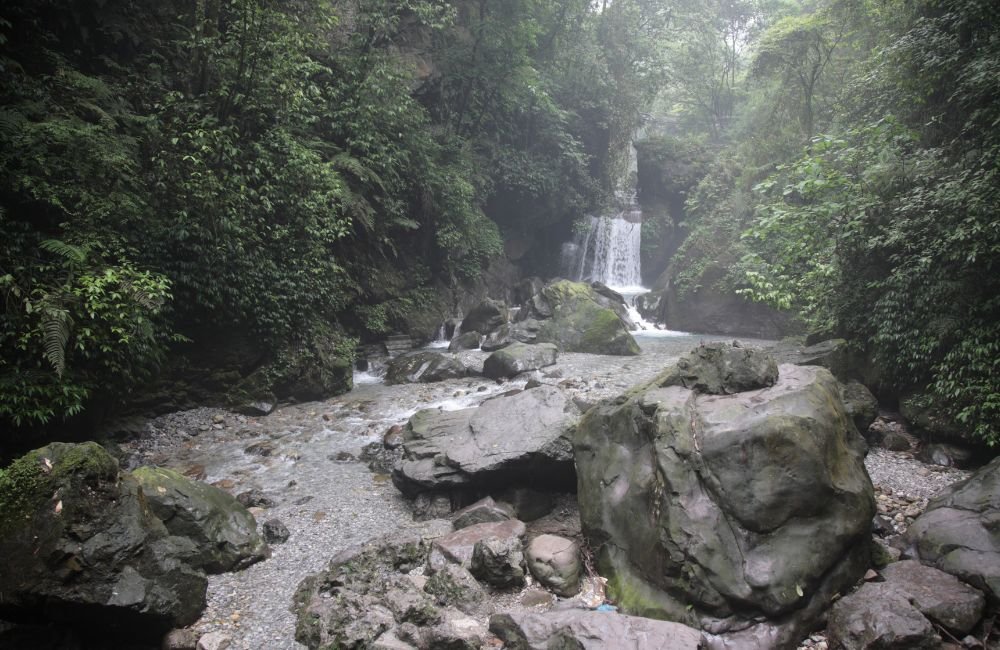
A peaceful waterfall and rocky forest stream on Mount Emei in Sichuan Province, China, surrounded by dense greenery and misty mountain scenery.
Mount Emei (峨眉山), or Emeishan, is a sacred Buddhist mountain in Sichuan Province.
Reaching approximately 3,099 metres above sea level, the mountain rises from lush lower forests to cooler high-altitude landscapes.
Its remarkable natural environment includes ancient trees, dense woodland and a variety of plant and animal species.
Mount Emei is also one of China’s Four Sacred Buddhist Mountains.
Together with the nearby Leshan Giant Buddha Scenic Area, it forms a UNESCO World Heritage Site.
Hiking here combines natural scenery with Buddhist temples, pilgrimage routes and mountain viewpoints.
Best Hiking Areas on Mount Emei
Qingyin Pavilion
This scenic area is ideal for visitors interested in forest walks, traditional architecture and the atmosphere of Emei’s lower mountain landscapes.
Wannian Temple
One of Mount Emei’s important Buddhist sites, Wannian Temple offers a combination of cultural sightseeing and walking through scenic mountain surroundings.
Golden Summit (Jinding)
Golden Summit is the mountain’s most famous high-altitude destination.
On favourable mornings, visitors may witness sunlight appearing above a broad layer of clouds.
However, views depend entirely on the weather. Fog can conceal the surrounding mountains even during otherwise pleasant conditions.
Choosing Between a Short Visit and a Longer Hike
Mount Emei offers different ways to explore.
Visitors with limited time can concentrate on the lower and middle mountain temples or use designated sightseeing transport to reach higher areas.
Experienced hikers may prefer longer sections of the traditional walking routes, where continuous stair climbing and large changes in elevation make the journey physically demanding.
The higher mountain area is significantly cooler than the base. Weather can also deteriorate rapidly.
Golden Summit access: Visitor numbers and sightseeing transport have been subject to restrictions while facilities at Leidongping and the Golden Summit cableway undergo improvement works. Advance reservations and a check of current transport arrangements are particularly important.
Wildlife Safety on Mount Emei
Wild macaques inhabit parts of the mountain, and visitors may encounter them along tourist routes.
Do not feed, touch or approach the animals. Keep food securely packed and follow the instructions displayed by park authorities.
Getting there: Travellers can reach Emeishan from Chengdu and other regional centres using available rail connections, then continue to the appropriate scenic-area visitor facilities.
Travel tip: If your priority is a relaxed cultural hike, explore the middle mountain trails rather than attempting to combine a long climb with a Golden Summit visit in a single day.
When Is the Best Time to Hike in China?
China’s mountain regions experience different climatic conditions, so the ideal hiking season varies by destination and elevation.
For many visitors, spring and autumn offer an appealing balance between comfortable temperatures and mountain scenery.
However, even during these seasons, rain, fog, strong winds and occasional snow can affect higher trails.
Spring: March to May
Spring brings fresh vegetation and attractive mountain landscapes.
Temperatures are often more comfortable for walking than during midsummer, although higher elevations can remain cold.
Rain and mist may reduce visibility, particularly in mountain areas with humid climates.
Summer: June to August
Summer brings green forests and active tourist seasons.
However, low-elevation approaches can be hot and humid. Heavy rainfall and thunderstorms may affect exposed ridges, stone steps and cableway operations.
Start early, monitor weather warnings and avoid exposed terrain during thunderstorms.
Autumn: September to November
Autumn is an excellent season to consider for mountain walking.
Many destinations experience cooler conditions, and changing foliage can enhance the scenery.
Nevertheless, the higher mountains may become cold well before winter begins.
Winter: December to February
Winter offers distinctive mountain landscapes, sometimes with snow, frost or ice-covered trees.
However, slippery stairs, freezing temperatures, reduced daylight and seasonal closures increase the challenges.
Winter hiking is best approached with suitable equipment, realistic expectations and careful attention to official route conditions.
Crowd planning: China’s major public holidays, especially the Labour Day holiday period and the National Day holiday around early October, can bring substantial visitor numbers. Booking ahead and choosing quieter dates may improve the experience.
How to Plan a Mountain Hiking Trip in China
Visiting China’s famous mountains requires slightly different preparation from hiking in an unrestricted wilderness area.
Many destinations operate as managed scenic areas with entrance gates, designated trails, visitor limits and separate transport services.
1. Choose a Mountain That Matches Your Experience
Consider what you want from your trip.
- Best for classic scenery: Huangshan
- Best for cultural pilgrimage: Mount Tai
- Best for challenging terrain: Huashan
- Best for Taoist heritage: Wudang Mountains
- Best for Buddhist temples and forests: Mount Emei
Do not judge a route solely by its distance. Thousands of steep stone steps can prove more exhausting than a longer but gentler woodland walk.
2. Check Entry Requirements Before Travelling
International visitors should confirm China’s entry requirements according to their nationality, passport and travel arrangements.
China offers different visa-free entry arrangements for eligible nationalities, as well as a visa-free transit programme for certain qualifying itineraries.
These policies have specific conditions and do not automatically apply to every traveller.
Check current requirements through official Chinese immigration or embassy channels before booking non-refundable travel.
3. Book Transport and Accommodation Carefully
China’s high-speed rail system makes many regional destinations accessible.
International travellers can purchase eligible railway tickets using valid passports through China Railway’s official 12306 booking services.
Where possible, arrange accommodation close to your intended hiking entrance.
For sunrise photography, check whether suitable accommodation is available inside the mountain scenic area. Never assume overnight access or camping is permitted without confirmation.
4. Reserve Scenic-Area Tickets
Popular Chinese mountain attractions increasingly use real-name ticketing and timed reservations.
Before visiting, confirm:
- Whether advance booking is mandatory
- Which passport or identification details are required
- Whether your selected entrance matches your hiking route
- Whether cableways and shuttle buses require separate tickets
- Whether specific peaks or attractions have additional reservations
- Whether any sections are closed for maintenance or weather
Keep your passport and booking confirmation accessible.
5. Prepare for Mobile Payments and Connectivity
Digital payments are common throughout China.
Visitors may be able to link international bank cards to supported payment services such as Alipay and WeChat Pay.
However, acceptance and payment limits can vary.
Carry a backup payment method and some local currency where practical.
It is also useful to download offline maps, save accommodation details in Chinese and prepare a translation app before travelling.
6. Pack for Mountain Conditions
A suitable hiking kit should include:
- Comfortable hiking shoes with reliable grip
- Layered clothing and a windproof or waterproof jacket
- Drinking water and lightweight snacks
- Sun protection and a hat
- A charged smartphone and portable power bank
- A small first-aid kit
- Essential medicines
- Passport and booking information
- Offline maps or an official trail guide
For longer or colder hikes, adjust your equipment to the forecast and route requirements.
7. Follow Mountain Safety Rules
Most established routes at these destinations involve stairways and maintained footpaths rather than technical mountaineering.
However, they can still present serious hazards.
Wet stone, fatigue, exposed cliffs and sudden weather changes all require caution.
Remain on authorised paths, obey closure notices and avoid attempting unfamiliar routes after dark.
Before departure, check whether your travel insurance covers hiking, the elevation involved and emergency medical evacuation.
Suggested Mountain Hiking Itineraries
You do not need to visit all five mountains on one journey.
They are spread across different parts of China, and travelling between them can require considerable time.
A more satisfying approach is to build an itinerary around one region.
A Two-Day Scenic Mountain Escape
Choose Huangshan for granite peaks, cloud formations and photography.
Spend your first day exploring accessible viewpoints and your second day following another open scenic trail before descending.
This itinerary is especially suitable for travellers who want time to appreciate the landscape without rushing.
A Cultural Hiking Trip Near Xi’an
Choose Huashan if you are already visiting Xi’an and would like to add a demanding mountain experience.
Plan a full mountain excursion, allowing for transport, cableway queues and weather-related changes.
Select summit paths that match your fitness and comfort with heights.
A Heritage and Nature Journey in Sichuan
Combine Mount Emei with the Leshan Giant Buddha area for a journey centred on Buddhist heritage and natural landscapes.
Allow separate sightseeing time for both destinations rather than attempting to cover everything in a rushed visit.
A Sacred Mountain Walking Experience
Choose Mount Tai or Wudang if you want to explore the relationship between Chinese religious traditions and mountain landscapes.
Both destinations reward visitors who slow down to appreciate temples, historic structures and cultural landmarks.
Frequently Asked Questions About Hiking in China
What Is the Best Mountain to Hike in China?
Huangshan is an excellent choice for visitors who prioritise spectacular mountain scenery and photography. Huashan is more suitable for experienced walkers seeking steep and dramatic terrain, while Mount Tai offers a historic pilgrimage experience.
The best option depends on your fitness, available time and interests.
Which Chinese Mountain Is Best for Beginners?
Visitors seeking a less strenuous experience may prefer selected walks at Wudang, Huangshan or Mount Emei using available scenic transport.
Mount Tai also offers cableway-assisted access.
However, beginners should choose individual routes rather than assuming an entire mountain is easy.
Is Mount Huashan Dangerous?
Huashan includes steep stairways, exposed mountain paths and challenging terrain.
Certain specialised attractions have additional risks and safety requirements.
Visitors who stay on authorised routes, follow official instructions and choose appropriate walking sections can reduce avoidable risks.
Do not attempt closed attractions or unofficial cliff paths.
Can You Hike China’s Mountains Without a Guide?
Many established visitor routes can be explored independently, subject to scenic-area regulations.
However, a reputable local guide may be helpful for visitors unfamiliar with local transport, language, trail arrangements or mountain conditions.
Specialised outdoor activities may require additional permissions or supervision.
Do Chinese Mountains Have Cable Cars?
Several popular mountain destinations, including Huangshan, Mount Tai, Huashan, Wudang and Emei, offer cableway or other scenic transport options.
Their availability varies by route, weather and operating arrangements.
Cable cars reduce the amount of climbing but do not always eliminate stairways or long walks.
Are These Mountains Suitable for Family Trips?
Some parts of these mountains can suit families, particularly where scenic transport and shorter walking routes are available.
Consider children’s stamina, older travellers’ mobility, steep stairs and the availability of rest facilities.
Huashan’s more exposed routes may be unsuitable for visitors who are uncomfortable with heights.
Discover China’s Mountains Beyond the Summit
The best mountains to hike in China offer far more than impressive views.
Huangshan’s granite peaks reveal landscapes celebrated in Chinese art. Mount Tai connects hikers with ancient pilgrimage traditions. Huashan provides dramatic mountain terrain, while Wudang and Emei combine beautiful natural surroundings with centuries of religious heritage.
Choose a mountain that matches your interests, fitness and available time. With appropriate preparation, confirmed trail access and respect for local conditions, a hiking journey through China’s mountains can become one of the most rewarding parts of your travels.
