
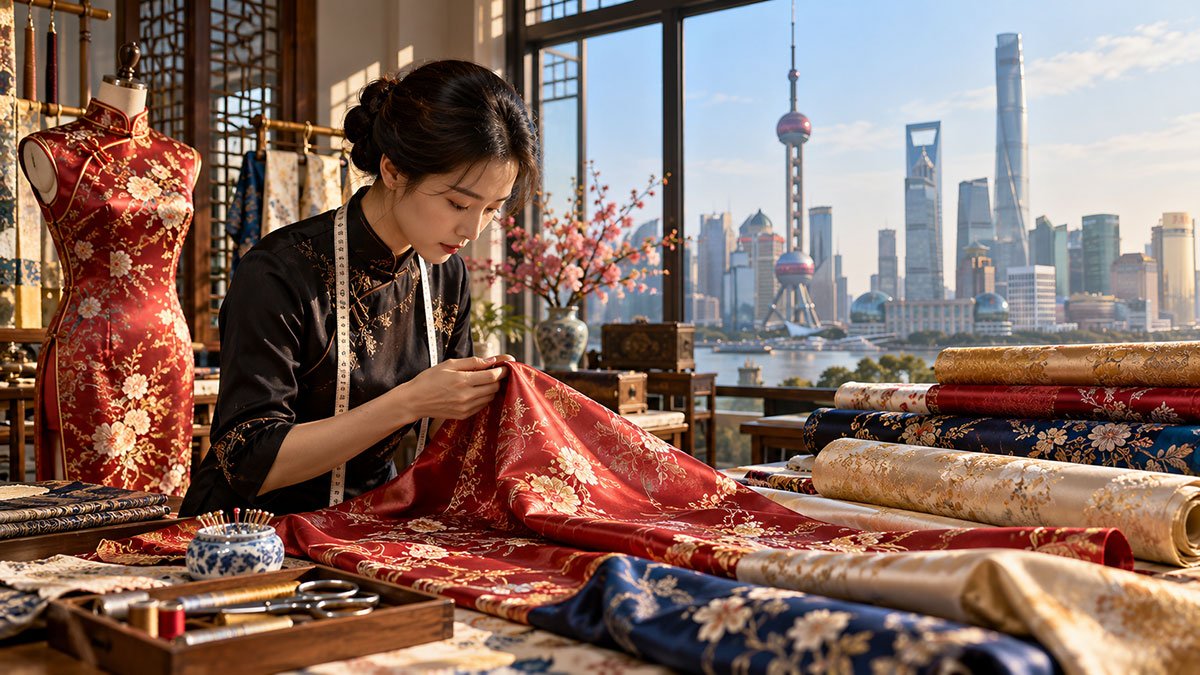
Shanghai brings China’s long silk tradition into contemporary fashion through museums, tailoring, textiles and traditional clothing.
The site commemorates Huang Daopo, an important historical figure associated with improvements in textile technology during the late Song and early Yuan periods.
Her story is significant because it demonstrates that China’s textile heritage is not limited to silk alone. Cotton production and weaving technologies also played a major role in the development of Chinese textile culture.
The memorial park can therefore add historical depth to a trip focused on traditional fabrics.
Shop for Custom Clothing at South Bund Fabric Market
For many international visitors, the most memorable hands-on textile experience in Shanghai is the South Bund Soft Spinning Material Market, commonly known as the South Bund Fabric Market.
Located at 399 Lujiabang Road in Huangpu District, the market has become well known for custom tailoring.
Visitors can browse fabrics and commission garments such as:
- Suits
- Shirts
- Coats
- Qipaos
- Chinese-style jackets
- Evening wear
- Wedding clothing
- Other made-to-measure garments
The experience is different from visiting a conventional shopping mall.
You can discuss a design, select fabric, provide measurements and arrange tailoring directly with the shop.
Many stores cater to international customers, and reference photographs can make it easier to explain the style you want.
Is It Really a Silk Market?
This distinction is important.
The South Bund market is primarily a fabric and tailoring market, not a museum or dedicated silk-production center.
Silk is among the materials available, but the market also sells many other fabrics.
For travelers specifically interested in silk, ask about the fabric composition, weight, weave and care requirements before purchasing.
Do not assume that a fabric is pure silk simply because it feels smooth or is described as silk-like.
Allow Enough Time for Tailoring
Custom clothing takes time.
The market is particularly suitable for travelers who have enough time in Shanghai for measurements, fittings and collection.
Some shops cater to tight schedules, but turnaround times depend on the garment, design and tailor.
For an important purchase, do not rely on the shortest advertised production time. Allow some flexibility for alterations and fitting.
The market has become increasingly popular with international visitors and remains one of Shanghai’s most distinctive shopping experiences.
Explore Shanghai’s Qipao Tradition
Silk becomes even more interesting when you see it as part of fashion rather than simply as a fabric.
The qipao, or cheongsam, is closely associated with Shanghai-style fashion.
Traditional and contemporary qipao designs can use silk, satin, brocade and other fabrics. Tailoring, embroidery, pattern placement and fit all influence the finished garment.
Today, Shanghai has specialist studios and established brands offering made-to-measure qipao.
A custom qipao can therefore become a more meaningful souvenir than a mass-produced textile item. You are not simply buying material. You are experiencing a living tradition of Chinese clothing design.
Travelers should also remember that contemporary Shanghai fashion is constantly evolving. Modern qipao designs may differ substantially from historic examples while retaining recognizable elements of the traditional garment.
Take a Silk-Focused Day Trip to Suzhou
Travelers with a strong interest in silk should seriously consider adding Suzhou to their itinerary.
Suzhou lies in Jiangsu Province and has a long association with silk production, embroidery and traditional weaving.
The city is also known for its classical gardens, canals and historic neighborhoods, making it a worthwhile destination even for travelers whose interests extend beyond textiles.
Visit the Suzhou Silk Museum
The Suzhou Silk Museum provides one of the clearest ways to understand Chinese silk heritage.
The museum opened in 1991 and explores the history of silk through exhibitions on ancient and modern textiles, sericulture, weaving machinery and traditional craftsmanship.
Its displays connect different stages of silk production, from mulberry cultivation and silkworm breeding to weaving and finished textiles.
Visitors can therefore see how silk functions not only as a finished luxury product but as an agricultural, technological and artistic tradition.
See Traditional Weaving
Suzhou is especially valuable for travelers who want to understand what happens after silk fiber has been produced.
Traditional weaving techniques can involve highly specialized looms and intricate patterns.
Some forms of Suzhou textile craftsmanship have also been recognized as intangible cultural heritage.
This is one reason a Suzhou visit complements the more commercial shopping experience in Shanghai.
Suzhou Silk Factory Heritage
Suzhou’s textile history is also visible outside museums.
The Suzhou No. 1 Silk Factory dates back to 1926 and has been redeveloped as a cultural and industrial heritage destination.
The site now includes exhibitions related to industrial history, silk fabrics and silk patterns.
This provides an alternative perspective on the industry by showing how silk production evolved within a modern industrial setting.
For travelers interested in the transition from traditional handcraft to industrial production, this can make an especially interesting addition to a Suzhou itinerary.
Consider Hangzhou for a Deeper Silk Experience
Another useful addition is Hangzhou, the capital of Zhejiang Province.
The city is home to the China National Silk Museum, one of the most important institutions devoted to Chinese silk history.
The museum’s collections and exhibitions cover silk culture, textile history, sericulture, weaving and the Silk Roads.
This makes Hangzhou particularly useful for travelers who want a museum-led understanding of the subject.
A Shanghai–Suzhou–Hangzhou itinerary can therefore provide three complementary perspectives:
Shanghai: Contemporary fashion, shopping and custom tailoring.
Suzhou: Traditional silk production, weaving and textile heritage.
Hangzhou: Museum collections, research and the broader history of Chinese silk.
This combination is much more informative than treating silk shopping as the main experience.
What Should You Look for When Buying Silk?
Buying silk in Shanghai can be enjoyable, but travelers should shop carefully.
Check the Fabric Composition
Ask whether the item is:
- 100% silk
- A silk blend
- Synthetic
- Another natural fiber
- A combination of different materials
A silk-blend garment can still be attractive and well made, but it should not be sold to you as pure silk.
Examine the Weave
Look closely at the fabric under good lighting.
Fine silk should have a natural appearance and a complex surface rather than looking completely uniform and synthetic.
However, appearance alone is not enough to establish authenticity.
Ask About Care
Silk can require more careful cleaning and storage than many everyday fabrics.
Ask the seller how the garment should be washed, dried and stored.
Consider the Finished Garment
For clothing, examine:
- Stitching
- Seams
- Lining
- Buttons
- Closures
- Embroidery
- Pattern matching
- Overall fit
A beautiful piece of fabric does not automatically mean that the finished garment is well made.
How to Make the Most of a Silk Shopping Trip
A little preparation can significantly improve the experience.
Bring Reference Images
If you are ordering custom clothing, bring photographs or examples of the style you like.
This can help with:
- Collar design
- Sleeve length
- Fit
- Embroidery
- Color
- Overall silhouette
Know Your Measurements
A professional tailor will take your measurements, but having your basic measurements available can be useful when comparing options.
Leave Time for Fittings
A first fitting can reveal changes that are difficult to identify during the initial measurement.
For an expensive custom garment, allow enough time for adjustments.
Keep Receipts and Order Details
When ordering custom clothing, keep information about the fabric, measurements, agreed design and collection arrangements.
This becomes especially important when ordering multiple pieces.
Be Careful With Claims About Age or Origin
A seller may describe a textile as traditional, antique or historically inspired.
Ask questions and distinguish between a genuinely historic textile, a modern reproduction and a contemporary design using traditional techniques.
How to Get Around for a Silk-Focused Trip
Shanghai has an extensive urban transport system, making it practical to combine museums, shopping districts and cultural attractions.
The South Bund Fabric Market is accessible by Shanghai Metro, with Nanpu Bridge Station on Line 4 among the options listed in current municipal tourism information.
For Suzhou, high-speed rail makes the city practical as part of a broader eastern China itinerary.
However, rail services, entry procedures and local transport arrangements can change. Check official transport and attraction information shortly before your journey.
For travelers visiting several museums or markets in one day, group destinations by neighborhood rather than crossing the entire city repeatedly.
When Is the Best Time to Explore Silk Culture in Shanghai?
Silk-related attractions can be visited throughout the year, so there is no single season that is essential for a silk-focused trip.
Spring and autumn are often comfortable periods for walking around Shanghai and Suzhou, while summer can be hot and humid.
Winter offers a different experience and can be useful for travelers more interested in museums, shopping and indoor cultural attractions.
The bigger consideration is your overall China itinerary.
If you are planning a wider trip, check seasonal weather, public holidays, major festivals and attraction reservation requirements before deciding your dates.
Entry and Travel Planning for International Visitors
Foreign travelers should check China’s current immigration requirements before booking their trip.
Visa-free entry and visa-free transit arrangements depend on nationality, passport type, travel purpose, routing and length of stay.
China currently operates visa-free transit arrangements for eligible nationalities, including a 240-hour transit policy covering designated ports and areas. Shanghai is among the permitted entry locations for eligible travelers.
These policies are subject to official conditions and can change, so travelers should confirm their individual eligibility through China’s National Immigration Administration or the appropriate Chinese diplomatic mission before departure.
This is particularly important if Shanghai is only one stop on a larger multi-country itinerary.
A Suggested Silk-Themed Shanghai Itinerary
Travelers with two or three days can explore the subject without turning the entire trip into a shopping expedition.
Day 1: Shanghai Textile Culture
Begin with the Shanghai Museum of Textile and Costume.
Continue with other Shanghai cultural attractions and explore the city’s traditional fashion scene.
Finish the day around one of Shanghai’s major shopping and dining districts.
Day 2: South Bund and Traditional Fashion
Visit the South Bund Fabric Market.
Browse fabrics, speak with tailors and consider ordering a custom garment.
Leave enough time for measurements and discussion rather than treating the market as a quick shopping stop.
Day 3: Suzhou
Take a day trip to Suzhou.
Visit the Suzhou Silk Museum and explore some of the city’s historic areas and gardens.
Travelers with more time can stay overnight and explore additional textile and cultural attractions.
Longer Trip: Add Hangzhou
Travelers with several additional days can continue to Hangzhou and visit the China National Silk Museum.
This creates a much broader understanding of Chinese silk, from its historical development to modern craft and design.
Why Shanghai Is Worth Visiting for Silk
The greatest strength of Shanghai is not that it is China’s only silk destination. It is the way the city connects traditional textile culture with contemporary life.
You can study the history of Chinese textiles in a museum, examine traditional clothing, watch tailoring take place and order a garment designed specifically for you.
Then, within a relatively manageable journey, Suzhou and Hangzhou reveal the deeper regional history behind those traditions.
That combination turns a simple shopping trip into a cultural experience.
Discover Chinese Silk Beyond the Souvenir
Chinese silk is best understood as a living tradition rather than an old-fashioned craft preserved only in museums.
The same cultural heritage that produced elaborate historical textiles continues to influence contemporary fashion, tailoring, embroidery and design.
Shanghai provides the modern setting.
Suzhou adds centuries of weaving and silk-making traditions.
Hangzhou provides a deeper museum and research perspective.
Together, they offer travelers a more complete way to discover the history, craftsmanship and continuing appeal of Chinese silk.
