
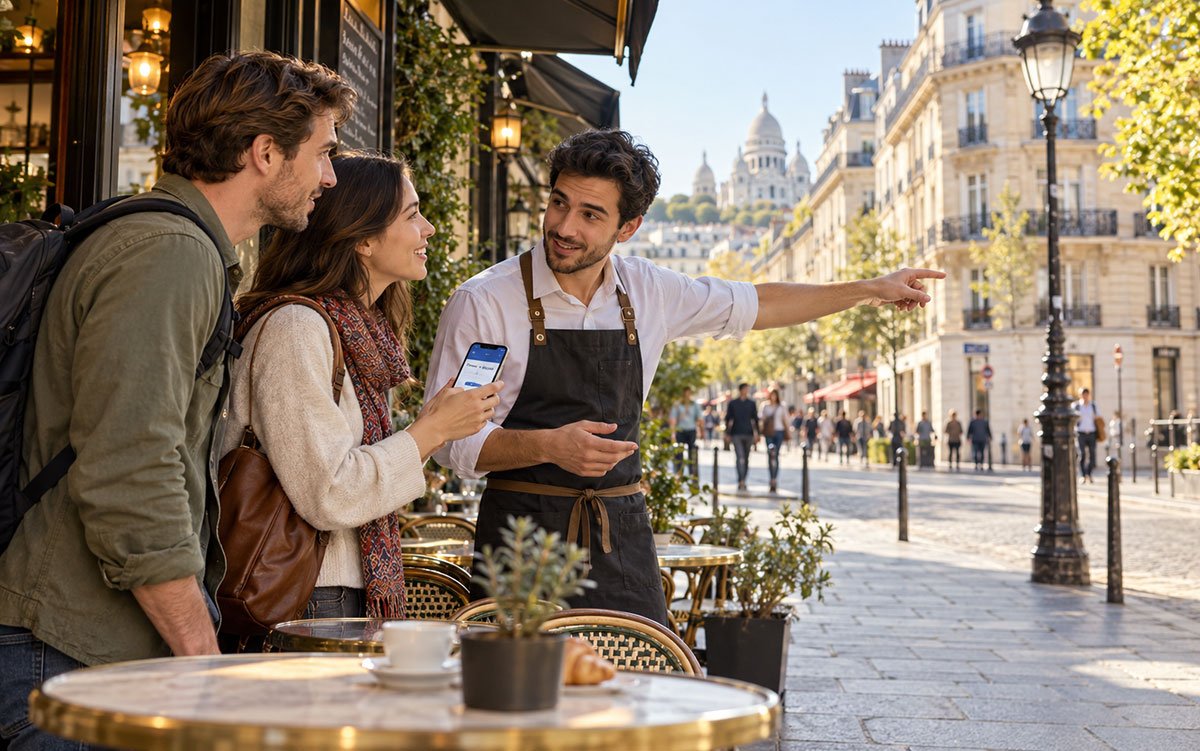
International travelers use a translation app and friendly conversation to overcome language barriers while exploring Paris.
Overcoming Language Barriers While Traveling: 12 Practical Tips
Traveling to a foreign country is an opportunity to discover new cultures, meet interesting people, and experience everyday life from a different perspective. However, communicating in an unfamiliar language can sometimes turn simple activities into unexpected challenges.
Overcoming language barriers while traveling does not require fluency in every language you encounter. Learning a handful of useful phrases, speaking clearly, preparing essential information, and using reliable translation tools can make an enormous difference.
Whether you are ordering a meal in Paris, asking for directions in Tokyo, or checking into accommodation in Rome, a little preparation can help you navigate unfamiliar situations.
The most effective approach combines technology with patience, cultural awareness, and a willingness to communicate creatively.
Here are 12 practical ways to make international travel easier when you do not speak the local language.
1. Learn Essential Local Phrases Before Your Trip
One of the simplest ways to overcome a language barrier is to learn a few common expressions before leaving home.
You do not need an extensive vocabulary. Instead, concentrate on phrases that help you manage everyday travel situations.
Start with:
- Hello and goodbye.
- Please and thank you.
- Excuse me and sorry.
- Do you speak English?
- Where is the train station?
- How much does this cost?
- Can you help me?
- Where is the bathroom?
- I do not understand.
- Could you please repeat that?
Learning the correct pronunciation is just as useful as remembering the words themselves.
Language-learning apps, pronunciation recordings, and online dictionaries can help you practise before departure.
Focus on the Language Spoken at Your Destination
Europe offers a particularly interesting example of linguistic diversity.
The European Union recognises 24 official languages, while additional regional, minority, and local languages are spoken across the continent.
A traveler visiting several European countries may encounter different languages within a relatively short journey.
Research the main language of each destination rather than assuming that English will always be understood.
Even a basic greeting in the local language can help establish a friendly connection.
2. Speak Clearly and at a Natural Pace
When communicating with someone who has limited English, the way you speak can matter as much as the words you choose.
Speaking too quickly makes it harder for the other person to recognise individual words. However, speaking excessively slowly can also feel unnatural.
Aim for a calm, measured pace.
Use short sentences and allow the other person time to respond.
For example, instead of saying:
“Would you happen to know whether there’s any chance of catching a bus heading towards the city centre?”
Try:
“Is there a bus to the city centre?”
The second question communicates the same request with fewer words.
Avoid Raising Your Voice
Speaking louder does not solve a language barrier.
Unless the environment is noisy or someone has difficulty hearing, raising your voice rarely improves understanding.
Instead, repeat your message more clearly, simplify the vocabulary, or try another communication method.
A polite expression and patient attitude usually accomplish more than repeating an unfamiliar phrase at increasing volume.
3. Avoid Slang, Idioms, and Complicated Expressions
Every language contains expressions that make perfect sense to native speakers but sound confusing when translated literally.
English is no exception.
Phrases such as “hit the road,” “grab a bite,” or “it’s raining cats and dogs” may create misunderstandings when someone interprets their literal meaning.
Use straightforward words when communicating across languages.
For example:
| Avoid saying | Say instead |
|---|---|
| Let’s grab a bite. | Let’s find a restaurant. |
| How far is it down the road? | How far is this place? |
| I’m running late. | I will arrive late. |
| Does this cost an arm and a leg? | Is this expensive? |
| Can you give me a hand? | Can you help me? |
Simple vocabulary also produces clearer results when using automated translation tools.
Do Not Imitate Local Accents
Trying to exaggerate another person’s accent is not an effective communication technique.
It can sound unnatural or disrespectful, even when the intention is friendly.
Instead, pronounce words clearly in your own accent and practise authentic local phrases when possible.
The goal is mutual understanding, not performing an imitation of another language or culture.
4. Use Translation Apps for Everyday Communication
Smartphones have transformed the way travelers communicate abroad.
Modern translation applications can translate written text, spoken conversations, photographs, and everyday expressions.
Two useful options are Google Translate and Apple Translate, depending on your device and the languages you need.
Google Translate
Google Translate offers several features that can help international travelers.
Text translation: Type a question or phrase and display the translation to another person.
Camera translation: Use your phone’s camera to understand signs, menus, notices, and other written information.
Conversation translation: Translate spoken exchanges between supported languages.
Saved phrases: Keep frequently used expressions available for future reference.
Offline translation: Download supported languages before your trip so certain translation functions remain available without internet access.
These features are particularly useful when communicating at restaurants, railway stations, accommodation reception desks, and shops.
Apple Translate
Apple’s Translate app also supports text and voice translation across selected languages.
On compatible iPhones, travelers can download supported languages for on-device translation, including certain conversation features without an internet connection.
Language availability and functionality vary, so confirm that your destination’s language is supported before relying on the app.
Remember That Translation Apps Can Make Mistakes
Automatic translation is useful, but it cannot always interpret context, humour, regional expressions, or technical terminology accurately.
Keep your messages short and check important details.
For legal documents, serious medical concerns, or other situations requiring precise communication, seek qualified interpretation rather than relying entirely on automated tools.
5. Download Translation Tools Before Traveling
An internet connection is not guaranteed throughout an international journey.
Mobile roaming may be unavailable, expensive, or unreliable. Wi-Fi access can also be limited in some locations.
Preparing offline communication tools reduces your dependence on mobile connectivity.
Before leaving home:
- Install your preferred translation application.
- Download the languages you expect to use.
- Save important phrases and addresses.
- Download available offline maps for your destination.
- Test essential translation features without internet access.
- Carry a charged power bank if you rely on your phone for navigation and communication.
Why Offline Maps Are Useful
Offline maps can help you locate accommodation, identify nearby streets, and understand your surroundings without continuously using mobile data.
Google Maps supports downloadable map areas in many destinations.
However, its offline functionality has limitations. Public transport, walking, and cycling directions are not available through its offline navigation feature.
Download the relevant area before departure and check what works on your device.
Keep a written address as a backup, particularly when arriving somewhere unfamiliar.
6. Use Gestures, Maps, and Visual Communication
Words are not the only way to communicate.
A map, photograph, written address, or simple drawing can sometimes explain your needs faster than a complicated conversation.
Imagine trying to locate your hotel in an unfamiliar city.
Instead of repeatedly pronouncing the street name, show the address on your phone or point to its location on a map.
Other useful methods include:
- Showing a photograph of a landmark.
- Pointing to a destination on a transport map.
- Writing down a price or quantity.
- Showing your booking confirmation.
- Using a simple drawing to explain an object.
- Displaying a translated sentence on your phone.
These methods can be especially helpful when communicating in noisy environments.
Be Careful With Cultural Gestures
Body language is not completely universal.
A gesture that appears friendly or harmless in one country may carry a different meaning elsewhere.
Avoid exaggerated gestures or physical contact with strangers.
When uncertain, choose simple visual explanations and maintain a respectful distance.
7. Carry a Small Notebook or Digital Phrasebook
Technology is convenient, but a notebook remains a valuable travel accessory.
A small notebook and pen can help you communicate when your phone battery runs out or a translation application cannot interpret what someone is saying.
Write down essential information before leaving your accommodation.
Useful details include:
- Your accommodation name and address.
- The nearest railway or metro station.
- Important destination names.
- Booking references.
- Emergency contact information.
- Useful phrases in the local language.
If you visit a country that uses an unfamiliar writing system, save important names in the local script.
This can be particularly useful when communicating with drivers or asking for directions.
Make a Personal Travel Phrasebook
Create a small collection of phrases relevant to your itinerary.
For example, a traveler planning a train journey might prepare questions about platforms, departure times, and ticket validity.
Someone visiting restaurants frequently might save questions about ingredients, payment methods, and dietary requirements.
Personalising your phrasebook makes it more useful than memorising vocabulary you may never need.
8. Prepare for Public Transport Communication
Navigating public transport can be challenging when signs, announcements, and ticket instructions appear in an unfamiliar language.
This is particularly relevant when traveling independently between European cities.
Before leaving for a station, identify:
- The official name of your destination.
- Your departure station and arrival station.
- The scheduled departure time.
- Your service number, where applicable.
- Any required connections.
- The location of your station or bus terminal.
Keep your ticket available offline whenever possible.
Check More Than the Destination Name
Some railway stations serve multiple routes and platforms.
A train may also display its final destination rather than every intermediate stop.
Compare the service information on your ticket with the official departure board or transport operator’s information.
If you need assistance, show a member of staff the relevant booking details.
For example, a simple question such as “Does this train stop at Lyon?” is easier to understand than a lengthy explanation of your itinerary.
Allow additional time for unfamiliar stations and connections rather than expecting every journey to proceed exactly as planned.
9. Communicate Carefully When Ordering Food
Eating local food is one of the pleasures of international travel.
However, unfamiliar menus and ingredients can create communication difficulties, especially when travelers have dietary restrictions.
Translation apps can help explain menu descriptions, but they may not identify every ingredient or preparation method accurately.
If you have a food allergy, take additional precautions.
Prepare an Allergy Translation Card
Before departure, arrange a reliable translation explaining your allergies in the local language.
The US Centers for Disease Control and Prevention recommends carrying translated food-allergy cards and emergency response information when traveling.
Your card should clearly identify the relevant allergens and any important information about avoiding them.
Show the card to restaurant staff before ordering and confirm that they understand your requirements.
In the European Union, food businesses must provide information about certain allergens, including for food served in restaurants and cafés. However, communication and preparation practices can still vary.
Do not assume that a dish is safe simply because an automated translation does not mention an allergen.
If staff cannot establish whether food meets your medical or dietary needs, choose a safer alternative.
10. Keep Accommodation Information Ready
Hotel check-in, apartment access, and guesthouse arrangements are easier when important details are organised beforehand.
Save your reservation confirmation, property address, contact information, and arrival instructions somewhere accessible offline.
If you expect to arrive late, contact the accommodation in advance and ask about the check-in procedure.
Use Written Messages for Complicated Requests
A written message can be more reliable than a hurried telephone conversation when neither person speaks the other’s language confidently.
For example, you might need to ask:
“Will someone be available when I arrive at 10 p.m.?”
Or:
“Where should I collect the apartment keys?”
Use a translation tool to prepare the question, but keep the original message short and straightforward.
Request written confirmation of important arrangements.
This creates a reference you can consult later if any misunderstanding occurs.
11. Know How to Ask for Help in an Emergency
A language barrier becomes more serious when someone needs urgent medical, police, or other emergency assistance.
Before traveling, identify the appropriate emergency number for your destination.
Across the European Union, 112 is available free of charge for emergency services, including police, fire, and ambulance assistance.
Emergency operators in some countries can assist callers in English or other languages. However, language support varies by location and should not be assumed.
Outside the European Union, emergency contact arrangements differ between countries.
Prepare Important Information in Advance
Keep a record of:
- Your current accommodation address.
- Local emergency numbers.
- Your embassy or consulate’s contact information.
- Your travel insurer’s emergency assistance number.
- Relevant medical information and allergies.
- Contact details for someone you trust.
If you have a medical condition that may require emergency assistance, discuss communication preparations with an appropriate healthcare professional before departure.
For serious medical situations, request professional language assistance where available.
A translation app can help explain basic information, but it should not replace qualified medical interpretation when accuracy is essential.
12. Be Patient, Respectful, and Willing to Learn
Perhaps the most valuable travel communication skill is patience.
Not every interaction will go smoothly, even with careful preparation and sophisticated translation technology.
Mispronounced words, unfamiliar expressions, and misunderstandings are normal parts of communicating across languages.
When someone does not understand you, avoid repeating the same sentence without changing anything.
Try a simpler explanation, write the question down, or show a photograph.
If the other person still cannot assist, thank them politely and seek information from an official tourist information centre, transport employee, accommodation host, or another suitable source.
Let Local People Guide the Conversation
Some people are comfortable communicating in English, while others prefer their own language.
Begin with a polite greeting and ask whether they speak a language you both understand.
Give them time to respond and avoid assuming that they are obliged to speak English.
A friendly conversation does not need perfect grammar.
Sometimes, exchanging a few simple words or receiving directions from someone willing to help becomes a memorable part of the journey.
Common Mistakes to Avoid When Communicating Abroad
Even experienced travelers sometimes make communication more difficult than necessary.
Avoid these common mistakes:
- Assuming everyone understands English: Learn about the languages spoken in your destination before departure.
- Speaking louder instead of more clearly: Use shorter sentences and a natural speaking volume.
- Using slang and complex expressions: Choose direct vocabulary that translates more reliably.
- Depending entirely on your smartphone: Keep offline information and a written backup.
- Trusting every automated translation: Verify important information, particularly medical and safety details.
- Imitating local accents: Speak naturally and learn authentic local pronunciation.
- Ignoring cultural differences: Research basic etiquette and avoid gestures that may be misunderstood.
- Pretending to understand instructions: Ask for clarification whenever important details remain uncertain.
Small changes in your communication habits can prevent unnecessary confusion.
Frequently Asked Questions About Language Barriers While Traveling
Can I travel internationally without speaking the local language?
Yes. Many international travelers visit destinations without speaking the local language fluently. Learning basic phrases, carrying important information, and using translation tools can make everyday communication easier.
The level of preparation you need will depend on your destination, itinerary, and personal circumstances.
What is the best way to overcome a language barrier when traveling?
Combine simple language, patience, basic local phrases, and reliable translation tools.
When words are insufficient, use maps, written addresses, photographs, or other visual information.
For important matters, confirm that both parties understand the same details.
Are translation apps reliable for international travel?
Translation apps can be useful for everyday interactions, including ordering food, understanding signs, and asking straightforward questions.
However, their accuracy varies by language and context. They should not be the only source of information for important medical, legal, or safety decisions.
Can I use translation apps without internet access?
Some applications support offline translation after you download the required languages.
Google Translate and Apple Translate offer offline functionality for supported languages and devices.
Check the available features before departure, because offline translation capabilities may differ from online services.
What should I do if someone does not understand me?
Try expressing your request in fewer words.
You can also write the information down, show a translation, point to a map, or ask an appropriate staff member for assistance.
Remain polite and avoid raising your voice.
How can I overcome language barriers while traveling alone?
Solo travelers can prepare by saving accommodation addresses, transport details, emergency contacts, and useful local phrases before leaving home.
Offline maps, translation applications, and written booking confirmations provide additional support when navigating unfamiliar places independently.
Final Thoughts: Communication Is Part of the Travel Experience
Overcoming language barriers while traveling is less about speaking perfectly and more about finding practical ways to understand one another.
A few local phrases, clear speech, dependable translation tools, and an open-minded attitude can help you manage unfamiliar situations with greater confidence.
Prepare for the important moments, especially transport connections, accommodation arrangements, food allergies, and emergencies. Then allow yourself to enjoy the less predictable conversations that make travel interesting.
You may not understand every word spoken around you, but that does not have to prevent you from exploring a destination, appreciating its culture, or connecting with the people who live there.
