
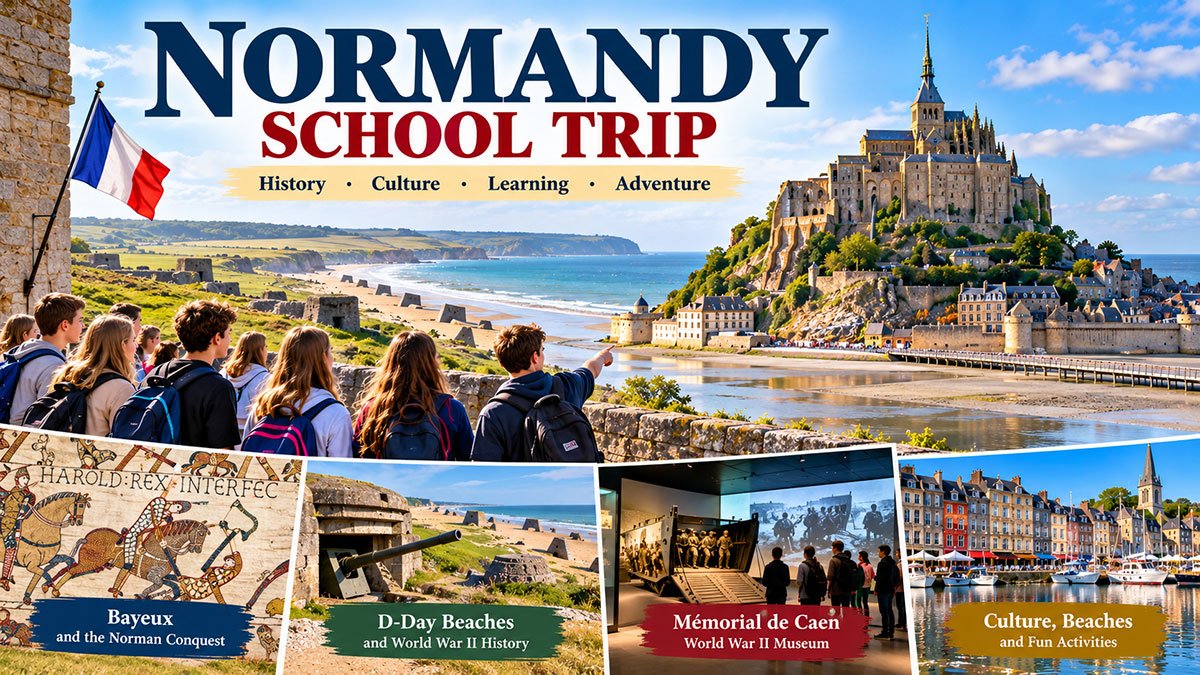
Normandy School Trip: A Journey Through History, Culture and Learning
Choosing the right destination for a school trip can be challenging. Teachers need somewhere educational, engaging, safe, and enjoyable. A Normandy school trip can meet all those requirements.
Normandy lies in northwestern France and is easily connected with the United Kingdom. The region combines medieval history, World War II heritage, French culture, architecture, art, food, coastal landscapes, and outdoor activities.
Official Normandy Tourism specifically promotes the region as a strong destination for school groups. Its educational travel programme includes historical sites, museums, outdoor activities, and interactive experiences. Normandy Tourism, France
The region also offers opportunities to connect several subjects. History, geography, art, French, citizenship, environmental studies, and literature can all become part of the same trip.
Why Choose Normandy for a School Trip?
A successful school trip should extend classroom learning rather than simply provide sightseeing.
Normandy makes that possible because its attractions cover different periods and subjects. Students can examine medieval society in the morning, study twentieth-century history in the afternoon, and practise French during dinner.
The region also provides an unusually strong connection between Britain and France. The Norman Conquest of 1066 gives history students a direct link between the two countries.
Bayeux, Caen, Rouen, Honfleur, and Mont-Saint-Michel also provide opportunities to study architecture, religion, art, trade, geography, and local culture.
Explore the History of 1066 in Bayeux
Bayeux is one of the most important historical destinations in Normandy.
The city is closely associated with the Bayeux Tapestry, the famous medieval embroidery that depicts events surrounding the Norman Conquest of England in 1066. The tapestry is particularly valuable for school groups because it connects history, visual storytelling, art, politics, warfare, and medieval daily life.
There is an important current change for teachers planning a trip.
The original Bayeux Tapestry is currently being displayed at the British Museum in London from September 2026 to July 2027 as part of an historic loan. Meanwhile, the Bayeux Tapestry Museum is closed for renovation, with its new museum scheduled to reopen in October 2027. British Museum
Therefore, schools visiting Normandy during this period should not plan their itinerary around seeing the original tapestry in Bayeux.
The town itself remains highly worthwhile. Bayeux has preserved much of its historic character, including its cathedral and medieval street network. Students can also visit other museums and heritage attractions in the city. Normandie Tourisme
Study the D-Day Beaches
For many schools, the most powerful part of a Normandy school trip will be visiting the D-Day sites.
On 6 June 1944, Allied forces landed along the Normandy coast during Operation Overlord. The beaches became the setting for one of the most important military operations of the Second World War.
Students can visit Utah, Omaha, Gold, Juno, and Sword Beaches, along with Pointe du Hoc. Museums, memorials, bunkers, batteries, and cemeteries help explain what happened before, during, and after the landings. UNESCO World Heritage Centre
There is also significant new recognition for these sites.
In 2026, the Beaches of the D-Day Landings, Normandy, 1944 were inscribed on the UNESCO World Heritage List. The UNESCO property covers approximately 80 kilometres of coastline and includes six component areas associated with the Normandy landings. UNESCO World Heritage Centre
This provides another useful teaching opportunity. Students can explore not only the military history but also the preservation of historical landscapes and the way societies remember conflict.
The area remains a place of remembrance. School groups should therefore approach cemetery and memorial visits with appropriate preparation and respect.
Visit the Mémorial de Caen
The Mémorial de Caen is another excellent educational stop.
The museum covers major developments in twentieth-century European history, including the Second World War and the D-Day landings. Its location also makes it practical for groups combining museum study with visits to the nearby beaches.
The museum currently provides dedicated school-group programmes, including guided visits, educational workshops, and guided circuits of the D-Day beaches. Separate arrangements are available for primary and secondary school groups. Memorial Caen
That structure makes the museum particularly useful for teachers. A visit can be planned around specific curriculum objectives rather than treated as a general sightseeing activity.
Teachers preparing a group can also check the latest school booking conditions directly with the museum.
Discover Mont-Saint-Michel
A trip to Normandy does not need to focus entirely on war history.
Mont-Saint-Michel provides an excellent contrast. The spectacular medieval abbey sits above a tidal bay and combines architecture, religion, geography, and environmental study.
Mont-Saint-Michel and its bay have been a UNESCO World Heritage Site since 1979. The area also experiences some of the largest tidal ranges in continental Europe. Normandy Tourism, France
For students, this creates several opportunities.
History groups can study the medieval abbey and pilgrimage. Geography students can investigate tides, coastal processes, and the changing landscape. Art students can sketch the architecture and surrounding scenery.
Teachers should plan carefully around tide times. Visitors are strongly advised not to enter the bay without a qualified guide because of the area’s powerful tides and changing conditions. Normandy Tourism, France
The region also promotes educational activities connected with the bay, including nature, heritage, and environmental learning.
Add French Language and Culture
One of the strongest advantages of taking students abroad is the chance to use their language skills in everyday situations.
Normandy provides many natural opportunities for French practice. Students can order food, greet local residents, read signs, identify regional products, and use basic French while shopping or travelling.
The experience goes beyond vocabulary.
Students can observe French customs, regional architecture, food traditions, public spaces, and everyday life. They can also compare French and British approaches to history, education, food, transport, and cultural heritage.
A teacher can make this even more effective by preparing short language tasks before departure.
For example, students might receive a vocabulary sheet covering food, directions, numbers, transport, and common questions.
Explore Normandy’s Art and Cultural Heritage
Normandy has strong connections with European art and culture.
The region is particularly associated with Impressionism and Claude Monet. Giverny, where Monet lived and worked, can provide an interesting excursion for art students and anyone studying landscape painting.
Normandy Tourism also promotes themes such as Impressionism, medieval heritage, culture, parks and gardens, arts, crafts, and local products. Normandy Tourism, France
This makes it possible to design a school trip around more than one academic subject.
An art-focused itinerary might combine Giverny with Rouen. A history programme could focus on Bayeux, Caen, and the D-Day beaches.
Make Room for Fun
Educational travel works best when students have time to relax.
Fortunately, Normandy offers plenty of leisure opportunities between museum visits and historical sites.
Students can enjoy beaches, parks, sports, local attractions, and entertainment venues. A particularly practical option for school groups is Festyland near Caen.
The amusement park currently accepts groups of at least 20 people, including school groups. It offers access to attractions and additional group meal packages. Festyland
Adding one leisure activity can help create a better balance between structured learning and recreation.
The coast also provides opportunities for supervised beach activities. Schools should always assess conditions and use appropriate safeguarding arrangements for any outdoor activity.
Explore the Natural Side of Normandy
Normandy offers more than historic buildings and museums.
The coastline, countryside, rivers, gardens, cliffs, and wetlands can provide useful material for geography and environmental studies.
Students can examine coastal erosion, tidal systems, agriculture, biodiversity, and sustainable tourism.
The Bay of Mont-Saint-Michel is particularly suitable for this type of learning. The nearby Ecomuseum of the Bay offers educational activities connected with the bay’s landscapes, history, traditional occupations, and natural environment. Normandy Tourism, France
This can turn a sightseeing day into a practical geography or environmental science lesson.
Sample Five-Day Normandy School Trip
A well-planned itinerary does not have to be overloaded. Giving students time to absorb what they see is more valuable than rushing between attractions.
Day 1: Arrival and Local Orientation
Begin with arrival in Normandy and a short orientation walk. Introduce students to the local geography, architecture, and French vocabulary.
Day 2: Bayeux and 1066
Explore Bayeux and its historic centre. Use the city’s medieval heritage to examine the Norman Conquest and the relationship between Normandy and England.
During the current 2026–2027 tapestry loan period, substitute a local heritage programme rather than expecting to see the original Bayeux Tapestry.
Day 3: Caen and D-Day History
Visit the Mémorial de Caen and combine it with a guided excursion to selected D-Day sites.
Students can examine military strategy, personal experiences, memorialisation, and the wider political context of the war. Memorial Caen
Day 4: Mont-Saint-Michel
Travel to Mont-Saint-Michel for a day combining medieval history, architecture, geography, and coastal studies.
Check tide conditions before the visit and arrange any bay activity through a qualified provider. Normandy Tourism, France
Day 5: Culture and Recreation
Finish with a cultural activity, nature visit, or leisure attraction. A group visit to an attraction such as Festyland can provide a relaxed conclusion to the trip. Festyland
Practical Planning Tips for Teachers
A Normandy school trip requires more planning than an ordinary holiday. Good preparation will make the experience safer and more educational.
Set Clear Learning Objectives
Decide what students should learn before choosing attractions.
A history group might focus on 1066 and the Second World War. Geography students could study tides and coastal landscapes. French students can focus on communication and cultural immersion.
Book Group Visits Early
Popular museums and heritage sites can become busy during school holidays. Group reservations may also have different procedures from individual visits.
The Mémorial de Caen, for example, has dedicated school-group arrangements. Memorial Caen
Build in Travel Time
Normandy may look compact on a map, but coach journeys can take longer than expected.
Avoid creating an itinerary with too many distant attractions on the same day.
Check Current Entry Requirements
Travel documentation depends on nationality.
For British citizens visiting France, current Schengen rules generally allow visa-free short stays of up to 90 days in a 180-day period. Passports must meet the applicable validity requirements. The EU’s Entry/Exit System (EES) is also being implemented for non-EU nationals entering the Schengen area. GOV.UK
School leaders should check the latest French, UK, and EU requirements for every pupil and adult in the group. Requirements can differ by nationality and residence status.
Arrange Appropriate Insurance
School groups should have suitable travel insurance that covers the planned itinerary and relevant activities.
Teachers should also keep emergency contacts, medical information, consent documentation, and accommodation details accessible throughout the trip.
Respecting Normandy’s History
The educational value of a Normandy school trip comes partly from confronting difficult aspects of history.
D-Day sites are not simply tourist attractions. They are places connected with enormous loss of life, military sacrifice, civilian suffering, and the liberation of Western Europe.
The recent UNESCO inscription reinforces the importance of preserving these landscapes and their memories. UNESCO specifically identifies their continuing role in education, youth engagement, and multinational remembrance. UNESCO World Heritage Centre
Teachers can prepare students beforehand by discussing appropriate behaviour at cemeteries, memorials, and former battle sites.
That preparation can make the visit more meaningful and respectful.
Why Normandy Works So Well for School Travel
Very few destinations offer such a broad combination of educational subjects within a relatively manageable area.
History students can investigate 1066 and the Second World War. Geography groups can study coastlines, tides, and landscapes. Art students can explore medieval design and Impressionism.
French students gain real-world language practice. Science groups can examine ecosystems and environmental change.
Students also develop independence. They experience another culture, navigate unfamiliar places, and learn outside the traditional classroom.
That is the real value of educational travel.
Final Thoughts on a Normandy School Trip
A Normandy school trip can combine learning, culture, history, nature, and recreation in one memorable experience.
Bayeux provides a remarkable connection with the Norman Conquest. Caen and the D-Day beaches offer powerful lessons about the Second World War. Mont-Saint-Michel introduces medieval architecture, pilgrimage, tides, and coastal geography. Museums, nature sites, art destinations, and leisure attractions add further variety. Normandie Tourisme
The destination has also gained renewed significance in 2026. The D-Day Landing Beaches are now UNESCO World Heritage, while the Bayeux Tapestry is making its historic temporary journey to London. UNESCO World Heritage Centre
With sensible planning, clear academic objectives, and a balanced itinerary, Normandy can provide students with experiences that are difficult to recreate in a classroom.
For teachers looking for a destination that combines education with genuine adventure, Normandy remains an outstanding choice for a school trip to France.
