
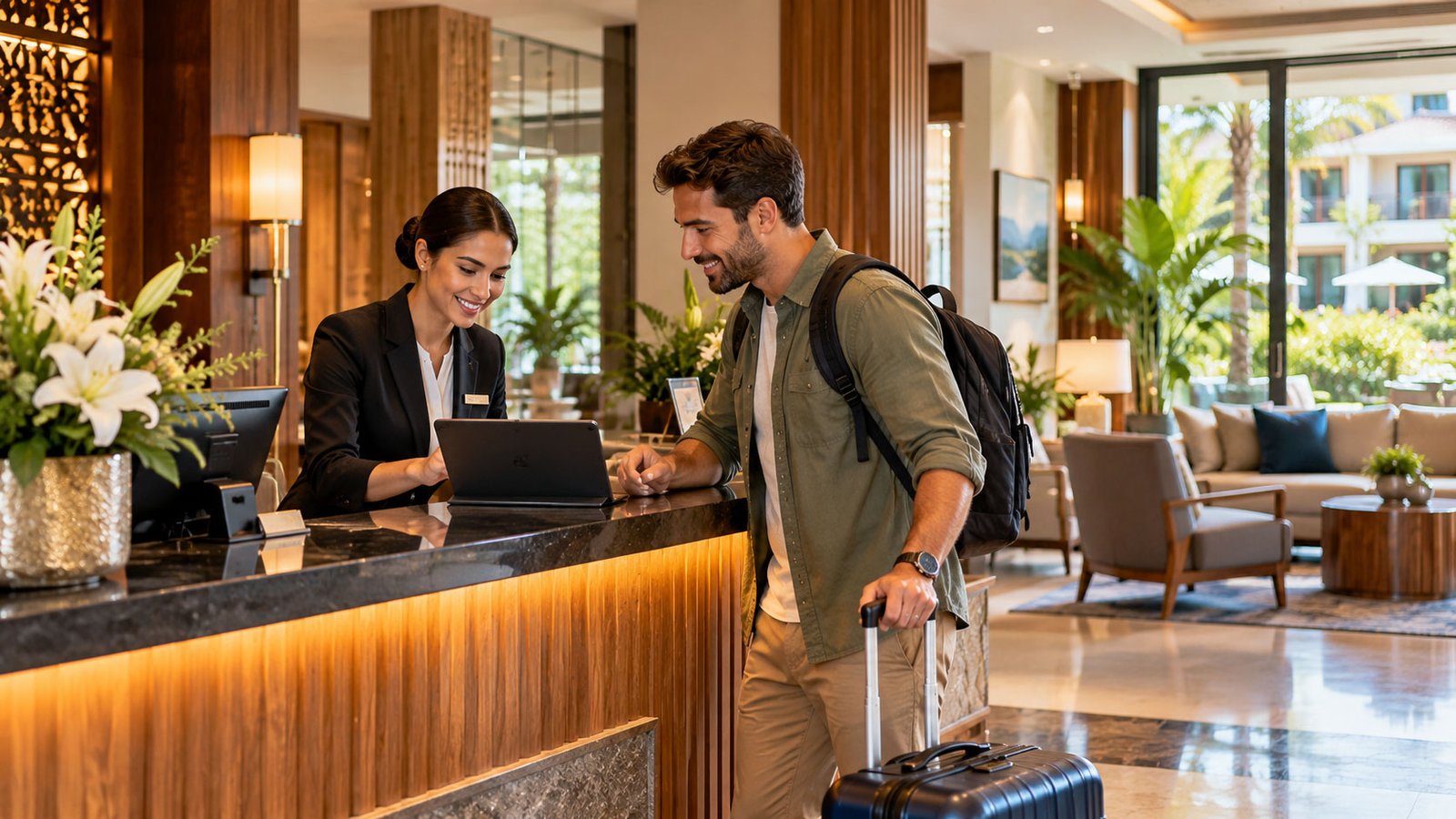
A welcoming guest experience is central to successful hotel marketing, helping properties build trust, strengthen their reputation and encourage repeat bookings.
Hotel Marketing Strategies to Attract More Guests
Attracting guests takes more than offering comfortable rooms and good service. Hotels also need to reach travellers while they are researching destinations, comparing accommodation and deciding where to stay. The most effective hotel marketing strategies bring together a clear brand identity, accurate online listings, a useful website, genuine guest reviews and targeted promotions.
However, hotels do not need to spend heavily on every available marketing channel. Independent hotels, boutique properties, resorts and guesthouses can often make better progress by understanding their ideal customers, choosing a few suitable channels and measuring which activities lead to profitable reservations.
Here are practical ways to increase your property’s visibility, strengthen its reputation and attract more bookings.
1. Identify Your Target Guests and What Makes Your Hotel Different
Before investing in advertising, define the guests you want to attract. A hotel that serves business travellers has different priorities from a family resort, a romantic countryside retreat or accommodation near an airport.
Consider the main reasons guests might choose your property. These could include:
- A convenient location near business districts, transport hubs or popular attractions.
- Family-friendly rooms, facilities or services.
- Meeting rooms, event spaces or wedding facilities.
- A distinctive setting, local character or scenic views.
- Competitive rates, flexible booking conditions or longer-stay options.
- Reliable Wi-Fi, accessible facilities or services for particular guest needs.
Use these strengths to develop a clear marketing message. Rather than describing your property only as comfortable and affordable, explain what it offers and who benefits most from staying there.
Keep that message consistent across your website, booking platforms, business listings and social media profiles. Make sure every claim accurately reflects the facilities and services available.
2. Build a Website That Converts Visitors into Guests
Your website should do more than display your hotel’s name and contact details. It should help prospective guests answer their questions, compare options and complete a reservation with confidence.
Make the booking process straightforward
A hotel website should work well on mobile phones as well as desktop computers. Visitors should be able to find room information, check availability, understand the total price and book without unnecessary steps.
Include the following wherever relevant:
- Clear photographs of guest rooms, bathrooms, dining areas and shared facilities.
- Descriptions of room types, bed arrangements and occupancy limits.
- Accurate information about amenities, location and transport access.
- Rates, applicable taxes and mandatory fees, along with relevant booking conditions.
- Check-in and check-out arrangements, cancellation policies and contact details.
- A visible booking option and a straightforward way to ask questions.
Use current photographs that represent the property honestly. Avoid relying entirely on generic stock images that could leave guests with an inaccurate impression.
Make your property’s strengths easy to understand
Think about the questions guests ask before booking. Business travellers may want to know about Wi-Fi, transport and meeting facilities. Families may prioritise room capacity, dining arrangements and nearby activities. Leisure travellers may want information about attractions, local experiences and transport options.
Address these questions directly. Clear information can reduce repetitive enquiries and help guests make informed decisions.
Balance direct bookings with online travel agencies
Online travel agencies such as Booking.com and Expedia can introduce your property to people who may not otherwise find it. They can be valuable acquisition channels, particularly for independent hotels without a large existing audience.
A direct booking through your own website may reduce distribution costs, depending on your arrangements. However, building and maintaining a direct booking channel also involves costs, including website development, payment processing, software and marketing.
Compare the net contribution from each channel rather than assuming that one source is always better. Consider commissions, advertising expenses, discounts, cancellation rates and the number of bookings each channel generates.
The objective is to build a balanced distribution strategy that reaches enough potential guests without allowing avoidable costs to undermine profitability.
3. Improve Local Search Visibility
Travellers frequently search for accommodation by destination, neighbourhood, landmark or type of property. A hotel that appears prominently in relevant local searches has another opportunity to attract potential guests.
Keep your Google Business Profile accurate
Claim and verify your hotel’s Google Business Profile if you are eligible. Review the details regularly, including the property name, address, telephone number, website, amenities and other information available for your hotel.
Add high-quality photographs that show the rooms, exterior, reception, dining areas and other facilities. Use descriptions that help travellers understand the property rather than filling them with repetitive keywords.
Google also provides hotel-specific guidance and booking visibility options. Eligible hotels can appear through free hotel booking links, subject to the relevant connectivity, rate-data and landing-page requirements. These links are not the same as simply adding a website address to a business listing, so check whether your booking system or provider supports the necessary integration.
Keep published rates and availability accurate wherever your hotel supplies them. Discrepancies between an advertised price and the booking page can frustrate guests and undermine trust.
Optimise your website for relevant searches
Use natural language that reflects how prospective guests search. Depending on your property’s location and services, relevant phrases may include:
- Hotels in a particular city or neighbourhood.
- Family accommodation near a local attraction.
- Business hotels close to a commercial district.
- Boutique hotels with specific facilities.
- Guesthouses near an airport or transport station.
Include relevant wording in page titles, headings, descriptions and content where it fits naturally. Avoid repeating the same phrase in every paragraph.
If you serve several distinct areas or guest types, create genuinely useful pages for them instead of publishing near-identical pages that merely replace one location name with another.
Local search visibility takes time. Clear information, helpful website content and a good user experience are more sustainable priorities than shortcuts that promise instant rankings.
4. Use Social Media to Show the Guest Experience
Social media gives hotels a way to demonstrate their atmosphere, communicate with prospective guests and remain visible between booking periods. The right approach depends on your audience, location, resources and the platforms your potential customers actually use.
Facebook and Instagram may be useful for visual storytelling and local promotions. Short-form video can also help a property communicate its character quickly. Other platforms may suit hotels targeting particular markets or professional audiences.
Share content that helps people imagine their stay
Useful content ideas include:
- Short room tours that show the layout and available facilities.
- Videos of breakfast, dining, gardens, pools or other genuine amenities.
- Staff introductions that give the business a human identity.
- Guides to nearby attractions, restaurants and local experiences.
- Seasonal information, event announcements and practical travel tips.
- Guest photographs shared with appropriate permission.
A simple, well-lit video filmed with a phone can be more useful than a highly polished promotion that does not answer a traveller’s questions.
Keep the information accurate. Do not advertise facilities that are unavailable, present an occasional seasonal feature as a permanent amenity or use imagery that materially misrepresents the property.
Treat social media as a conversation
Respond to genuine questions about availability, location, facilities and booking conditions. Establish a process for handling enquiries so that potential guests do not wait unnecessarily for answers.
Useful content can build familiarity, but social engagement alone does not prove that a campaign is generating bookings. Where possible, direct prospective customers to a clear booking page and use trackable links to assess the results.
5. Manage Guest Reviews and Online Reputation
Travellers often read reviews before making a hotel reservation. Reviews can help them evaluate cleanliness, service, location, value and whether a property matches their expectations.
Start by providing an experience that gives guests good reasons to recommend your hotel. Consistent housekeeping, accurate room descriptions, courteous service and prompt handling of problems are all part of reputation management.
After a stay, invite guests to share an honest review on relevant platforms. You can include a review link in a post-stay message or provide a QR code at an appropriate point in the guest journey.
Google prohibits offering discounts, gifts or other incentives in exchange for reviews, as well as selectively soliciting only positive feedback. Ask for genuine feedback without pressuring guests about what they should write.
Respond professionally to feedback
Thank guests for useful feedback and address legitimate concerns with specific, constructive responses. Avoid sharing private reservation details or personal information in a public reply.
When a review highlights a recurring issue, look beyond the response itself. If several guests report slow check-in, confusing directions or maintenance problems, treat the pattern as an operational signal.
Do not ignore negative reviews, but do not let a single comment dictate your entire strategy either. Look for repeated themes across feedback and use them to improve the guest experience.
Platforms such as Google and Tripadvisor provide business-management resources for maintaining property details, adding photographs and engaging with guest feedback. Keep your information consistent across the platforms that matter to your audience.
6. Publish Useful Travel Content
Travel content can help a hotel reach people before they have decided where to stay. Someone researching a destination’s attractions, restaurants or transport may not yet know which property to book.
A hotel blog or destination guide can introduce your property while answering practical questions about the area. Good topics depend on the destination, but might include:
- Things to do during a weekend in the area.
- Local attractions and how to reach them.
- Suggested itineraries for families, couples or business visitors.
- Seasonal events and activities.
- Transport options from the nearest airport or railway station.
- Advice on choosing accommodation for a particular type of trip.
Focus on information you can verify and keep it useful after publication. Where opening arrangements, transport services, prices or event dates may change, link to authoritative sources and review the details regularly.
Connect relevant articles naturally to room pages, facilities and booking information. A visitor reading about nearby attractions should be able to find suitable accommodation without searching through the entire website.
Search-friendly content should serve the reader first. It needs a clear purpose, a useful structure and accurate information—not merely repeated keywords or pages created to capture small variations of the same search.
7. Use Email Marketing to Encourage Repeat Bookings
Past guests and people who have chosen to receive your communications may provide a valuable audience for future offers. Email can help a hotel maintain relationships without relying exclusively on paid advertising or third-party platforms.
Build your mailing list responsibly. Explain what people are signing up for, obtain permission where required and make it easy for recipients to unsubscribe. Follow applicable privacy and electronic marketing laws for the markets in which you operate.
Useful messages might include:
- Seasonal packages relevant to the guest’s interests.
- Updates about events or experiences at the destination.
- Offers for dates with weaker expected demand.
- Information about new facilities or services.
- Relevant reminders or information before an upcoming stay.
- Invitations to book again where the communication is appropriate.
Avoid sending the same promotion to every contact. A business traveller, a family that previously stayed during school holidays and a couple who booked a weekend break may respond to different messages.
Personalisation should be helpful rather than intrusive. Use the information guests have reasonably provided, protect their data and avoid making assumptions that could feel unwelcome.
Measure email performance in terms of meaningful actions, such as enquiries and completed bookings, rather than opens or clicks alone.
8. Build Local Partnerships and Attend Relevant Business Events
Hotel marketing does not need to take place entirely online. Relationships with businesses and tourism organisations can connect a property with people who need accommodation for a specific purpose.
Potential partners include:
- Local tourism boards and destination-marketing organisations.
- Tour operators, guides and attraction operators.
- Wedding planners and event organisers.
- Conference venues and professional associations.
- Nearby companies with visiting employees or clients.
- Transport providers and businesses serving the same visitor market.
A small hotel near an industrial area, for example, might develop relationships with businesses that regularly host visiting staff. A countryside property could work with local activity providers to create relevant stay packages.
Business expos and tourism trade events can also be useful when they attract the audiences a hotel wants to reach. They offer opportunities to meet potential partners, present the property and learn about local market demand.
However, attendance is not automatically cost-effective. Before committing, consider registration fees, travel, staff time, promotional materials and the likelihood of reaching suitable prospects. Set a clear goal, collect enquiries appropriately and follow up after the event.
Partnerships work best when each party understands what the arrangement offers and when any fees, referral terms or customer responsibilities are clear.
9. Create Promotions Without Undermining Profitability
Discounts can help stimulate demand, but frequent price cuts are not a complete marketing strategy. A promotion that generates reservations at an unsustainable net rate may increase workload without improving the hotel’s financial performance.
Begin with a specific objective. For example, you might want to attract bookings for a particular low-demand period, encourage longer stays or increase reservations for a package that includes an experience guests value.
Possible approaches include:
- A value-added package with a clearly defined inclusion.
- A longer-stay offer where the economics justify it.
- A seasonal package tied to an event or local experience.
- A targeted promotion for a suitable audience or market.
- A flexible booking option that addresses a particular guest concern.
Define the dates, room types, restrictions, cancellation terms and total costs before launching the offer. Make the conditions easy to understand.
Deal and discount platforms can provide exposure, but examine their commercial terms carefully. Assess commissions or fees, discount depth, booking restrictions and whether the promotion is likely to attract new customers or mainly reduce revenue from people who would have booked anyway.
Measure results after accounting for distribution costs and the value of the reservations generated. A campaign should have a reason to exist beyond producing a temporary rise in booking numbers.
10. Use Paid Advertising Selectively
Paid search and social advertising can help a hotel reach people who are actively researching a destination or who match a relevant audience profile. The most suitable campaign depends on the property’s location, target guests, available budget and booking infrastructure.
Search advertising may be worth testing when travellers use specific location or accommodation searches. Social advertising can work well for visual packages, seasonal experiences or destination-based promotions. Retargeting may be appropriate where privacy requirements, platform rules and the website setup allow it.
Before launching a campaign, make sure the landing page answers the advertisement’s main promise. An ad promoting a family package should lead to clear package information, not a generic homepage where visitors must search for the offer.
Start with a defined objective and a controlled budget. Track enquiries and completed reservations where practical, and account for cancellations before judging the outcome.
A useful measure is the acquisition cost per completed booking. Compare it with the booking’s net value after relevant distribution and operating costs. Pause or revise campaigns that attract clicks but fail to generate worthwhile results.
11. Measure Results and Improve Your Marketing Plan
Effective hotel marketing involves testing, learning and reallocating resources. Different properties have different demand patterns, so the most useful channels will depend on factors such as location, seasonality, room rates, competition and guest type.
Track a manageable set of performance measures:
| Metric | What it helps you understand |
|---|---|
| Website booking conversion rate | How effectively website visits turn into reservations |
| Direct booking share | How much business comes through direct channels |
| Cost per acquisition | How much marketing and distribution cost to generate a booking |
| Average daily rate (ADR) | The average room revenue earned per occupied room |
| Occupancy rate | The proportion of available rooms that are occupied |
| Revenue per available room (RevPAR) | Room revenue in relation to available room capacity |
| Cancellation rate | How many reservations are cancelled |
| Repeat-guest rate | How effectively your property encourages guests to return |
Use your booking engine, property management system, channel manager, advertising reports and website analytics to understand performance. Tools such as Google Analytics and Google Search Console can help assess website behaviour and search visibility when configured appropriately.
Do not judge a campaign solely by its number of impressions, followers, enquiries or bookings. Consider the quality of the guests attracted, the revenue retained and the operational effort required to serve them.
Review performance regularly and change one or two things at a time where possible. This makes it easier to identify which adjustments are helping.
12. A Practical 30-Day Hotel Marketing Plan
If your hotel has limited marketing resources, begin with the basics rather than launching several campaigns at once.
Week 1: Review your online presence. Check your website, Google Business Profile and major booking-platform listings. Correct inaccurate details and replace outdated photographs.
Week 2: Improve the booking journey. Test the website on a mobile phone, review room descriptions and booking conditions, and make sure prospective guests can find the information they need.
Week 3: Strengthen trust and visibility. Set up a consistent process for requesting genuine guest feedback. Publish useful social content and contact a small number of relevant local partners.
Week 4: Test and measure. Run one focused promotion or advertising test if the budget allows. Track enquiries, confirmed bookings, cancellations and net results, then decide what to continue.
At the end of the month, prioritise the improvements with the clearest evidence of value. Continue refining the plan as booking patterns and guest needs change.
Conclusion
The best hotel marketing strategies combine visibility with trust and commercial discipline. A clear website, accurate online listings, useful destination content, professional review management and carefully chosen partnerships can help a property reach more suitable guests.
Not every hotel needs every marketing channel. Start with the actions most likely to improve your property’s discovery and booking experience, measure the results and invest further in the approaches that deliver sustainable returns. Strong marketing works best when it reflects the real guest experience—and when the hotel consistently delivers on the promises it makes.
