
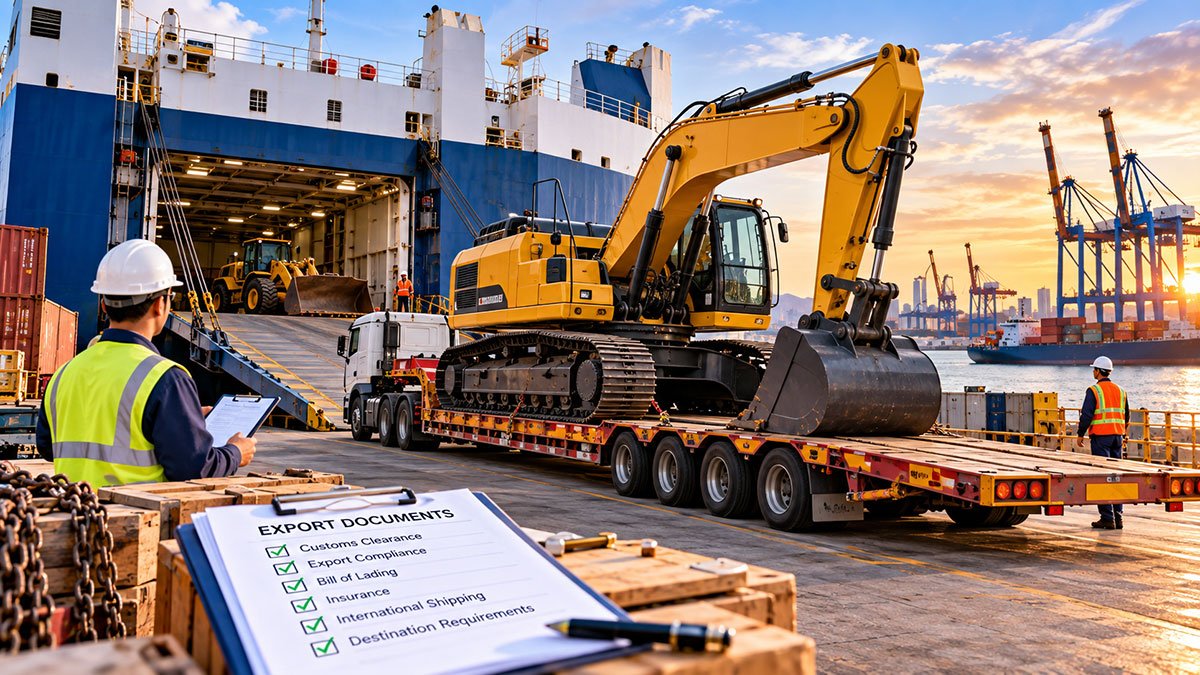
How to Ship Heavy Construction Machinery Internationally
Construction companies increasingly operate across international markets. Contractors, infrastructure developers, mining companies and equipment distributors may need excavators, bulldozers, cranes, loaders, graders and other heavy machinery that they cannot source locally.
However, shipping heavy construction machinery internationally requires considerably more planning than shipping ordinary commercial goods. The equipment may be oversized or overweight, require specialized transport, and involve export controls, customs documentation, import permits, insurance and destination-specific technical requirements.
The good news is that careful planning can make the process much more predictable.
Whether you are exporting new equipment from the United States or sending used construction machinery to an overseas buyer, the following steps can help you prepare for an international shipment.
-
Research the Destination Market First
Before you arrange transportation, confirm that the destination country allows the equipment to enter.
Import requirements vary significantly between countries. They can include customs duties, import licenses, technical standards, conformity assessments, inspections and restrictions on used equipment.
The U.S. International Trade Administration recommends reviewing country-specific import requirements, tariffs, standards and documentation before entering a new market. Its Country Commercial Guides provide information about customs authorities, import requirements, labeling, standards and restricted goods.
Research the following before committing to a sale:
- Import duties and taxes
- Import permits
- Equipment age restrictions
- Emissions requirements
- Safety standards
- Technical certifications
- Inspection requirements
- Used-equipment regulations
- Environmental requirements
- Port and inland transportation restrictions
- Local registration requirements
Do not assume that another country will apply the same rules that apply in the United States.
-
Confirm the Correct Equipment Classification
Correct classification is an important part of international trade compliance.
Your machinery may require a Schedule B classification for U.S. export reporting and an appropriate tariff classification for the destination country’s customs process. The buyer or customs broker may also need the relevant Harmonized System (HS) code.
For U.S. exports subject to the Export Administration Regulations, you should also determine whether the equipment has an Export Control Classification Number (ECCN) or qualifies as EAR99.
The Bureau of Industry and Security explains that exporters must determine whether an item is subject to the EAR and, when applicable, determine its ECCN. EAR99 does not automatically mean that an export is unrestricted; licensing requirements can still apply based on the destination, end user or end use.
For complicated equipment or unusual transactions, consider obtaining professional export-compliance advice before shipment.
-
Check U.S. Export Controls
Heavy construction machinery may appear straightforward from an export-control perspective, but you should not assume that every transaction is automatically exempt.
The Bureau of Industry and Security’s current Export Administration Regulations provide the framework for determining whether an item requires an export license. License requirements can depend on the item’s classification, destination, end user and intended use.
Before shipping, check:
- Whether the equipment is subject to the EAR
- The appropriate ECCN or EAR99 status
- The destination country’s requirements
- The end user
- The intended end use
- Applicable license exceptions
- Any required export license
The BIS Commerce Control List and Country Chart can help exporters determine whether a particular transaction requires authorization.
-
Screen the Buyer and Other Parties
Knowing your buyer is an important part of export compliance.
Do not rely solely on a buyer’s website, email address or sales representative. Conduct appropriate due diligence on the company, ownership, business activities and transaction.
The U.S. Commercial Service recommends performing due diligence on foreign markets and business partners. Its resources include Country Commercial Guides, International Company Profiles and the U.S. Government’s Consolidated Screening List.
Screen relevant parties against applicable U.S. government restrictions before completing the transaction.
Also check the current sanctions rules administered by the U.S. Department of the Treasury’s Office of Foreign Assets Control (OFAC). Sanctions can apply to particular countries, entities, individuals, activities or transactions.
-
Choose an Experienced Freight Forwarder
A heavy-equipment shipment requires more than simply booking space on a vessel.
An experienced international freight forwarder can help coordinate transportation, documentation, cargo space, inland delivery and other logistics.
The U.S. Commercial Service explains that freight forwarders can arrange and track international and inland transportation, prepare shipping documents, book cargo space, negotiate freight charges and arrange cargo insurance.
When comparing freight forwarders, ask:
- How much heavy equipment do you handle?
- Do you regularly ship oversized machinery?
- Which countries do you serve?
- Can you arrange inland transportation?
- Can you coordinate port handling?
- Can you arrange specialized loading?
- Can you assist with export documentation?
- Do you work with destination-country customs brokers?
- Can you provide cargo insurance?
- Can you provide shipment tracking?
A forwarder with relevant experience can help identify potential problems before the machinery reaches the port.
-
Compare Shipping Methods
The right shipping method depends on the equipment’s dimensions, weight, value, destination and handling requirements.
Common options include:
Roll-On/Roll-Off Shipping
RoRo shipping allows suitable self-propelled equipment to drive onto and off the vessel.
It can work well for:
- Excavators
- Wheel loaders
- Bulldozers
- Tractors
- Construction vehicles
- Other mobile equipment
However, availability depends on the route, vessel and equipment specifications.
Flat-Rack Containers
Some oversized machinery can travel on flat-rack equipment rather than inside a conventional enclosed container.
Your freight forwarder should confirm the maximum dimensions, weight, securing requirements and vessel availability before booking.
Breakbulk Shipping
Very large or heavy equipment may require breakbulk or other specialized cargo handling.
This can be appropriate when machinery cannot fit within normal container dimensions or when the shipment requires specialized lifting arrangements.
Container Shipping
Smaller machinery or disassembled equipment may fit inside standard containers.
The equipment must still meet the applicable weight, dimensional, loading and securing requirements.
The U.S. Commercial Service recommends comparing transportation modes and planning packing, labeling, documentation and insurance requirements as part of the export process.
-
Measure the Machinery Accurately
Never estimate the dimensions or weight of heavy equipment.
Record:
- Overall length
- Overall width
- Overall height
- Operating weight
- Shipping weight
- Wheelbase or track dimensions
- Center of gravity where relevant
- Attachment dimensions
- Ground clearance
- Fuel and fluid levels
- Manufacturer specifications
Include attachments such as buckets, blades, booms and other components in your measurements if they will travel with the machinery.
Incorrect dimensions can result in unsuitable equipment bookings, additional handling costs, port delays or transportation problems.
-
Prepare Used Machinery Carefully
Used machinery needs additional preparation.
Clean the equipment thoroughly before export. Remove soil, plant material, mud, debris and other contamination.
This is particularly important for equipment that has operated on farms, construction sites or other locations where soil and biological material can accumulate.
For example, the U.S. Department of Agriculture’s APHIS notes that dirty or contaminated used farm machinery can face restrictions because of soil and contamination risks.
Destination countries may impose their own cleaning, inspection or biosecurity requirements.
Therefore, check the destination country’s rules before preparing the machinery for shipment.
-
Protect the Machinery During Transit
Heavy equipment can face exposure to rain, saltwater, humidity, dust and temperature changes during international transportation.
Ask your logistics provider how they will protect the machinery during transit.
Depending on the equipment and shipping method, preparation may include:
- Weather-resistant covers
- Corrosion protection
- Drainage precautions
- Battery protection
- Secure tie-downs
- Wheel or track restraints
- Protective wrapping
- Removal or securing of detachable components
- Appropriate blocking and bracing
Follow the manufacturer’s transportation instructions wherever applicable.
Do not assume that simply covering the machinery provides adequate protection.
-
Follow Container Weight Requirements
If your machinery travels inside a packed container, weight documentation becomes particularly important.
Under the International Maritime Organization’s SOLAS requirements, the shipper must provide the verified gross mass (VGM) of a packed container before loading. The verified weight can come from weighing the packed container or using an approved calculation method.
An inaccurate weight declaration can create serious safety and operational problems.
Your freight forwarder should tell you which weighing method and documentation the relevant terminal and carrier require.
-
Prepare the Export Documentation
International machinery shipments can involve numerous documents.
Depending on the transaction and destination, documentation may include:
- Commercial invoice
- Packing list
- Bill of lading
- Export declaration
- Electronic Export Information (EEI)
- Certificate of origin
- Insurance documents
- Import permit
- Inspection certificate
- Conformity certificate
- Export license, if required
- Equipment specifications
- Serial-number records
- Other destination-specific documents
The U.S. Commercial Service emphasizes that proper shipping documentation is essential to avoid customs problems and shipment delays.
-
Understand AES and EEI Filing
For many U.S. exports, the Electronic Export Information (EEI) must be filed through the Automated Export System (AES).
The filing contains information such as the parties involved, item description, value, quantity, Schedule B or HTS classification and, where applicable, the ECCN and license authority.
Do not assume that every export requires the same filing.
The requirements and exemptions depend on the specific transaction, so confirm the applicable rules with the U.S. Census Bureau, BIS or an experienced export professional.
-
Check Destination-Country Customs Requirements
The importing country controls what it will accept and what documentation it requires.
Some countries require:
- Import licenses
- Customs registration
- Certificates of origin
- Pre-shipment inspections
- Conformity certificates
- Technical certificates
- Special permits for used machinery
- Environmental or emissions documentation
- Customs valuation documents
The U.S. Commercial Service’s Country Commercial Guides provide country-specific information that can help exporters identify these requirements.
For example, current country guidance shows that machinery import requirements can vary significantly. Some markets require special licenses or registrations for industrial machinery, while others impose additional standards or conformity requirements.
Always confirm requirements for the specific destination country, not merely the region.
-
Work With a Destination-Country Customs Broker
Your overseas buyer may need a local customs broker to handle import clearance.
A local broker can help with:
- Import declarations
- Customs classification
- Duty and tax calculations
- Customs documentation
- Inspections
- Import permits
- Release procedures
- Port clearance
The buyer should confirm the broker’s responsibilities before shipment.
Do not wait until the machinery arrives at the destination port to determine who will handle customs clearance.
-
Choose the Right Incoterm
Your sales contract should clearly establish which party handles transportation, insurance, customs clearance, duties and other responsibilities.
Incoterms® 2020 provide internationally recognised rules for allocating responsibilities, costs and risks between buyers and sellers.
The International Chamber of Commerce’s guidance explains how different Incoterms allocate responsibilities for transportation, export and import clearance, insurance and risk.
For example, depending on the transaction, parties may consider terms such as:
- FCA
- FOB
- CIF
- CPT
- CIP
- DAP
- DPU
- DDP
The appropriate term depends on the shipment and commercial arrangement.
Do not select an Incoterm simply because it appears familiar. Make sure the term matches your actual logistics responsibilities and the capabilities of both parties.
-
Calculate the Full Landed Cost
International shipping costs involve much more than the ocean freight rate.
Your budget may need to include:
- Inland transportation
- Loading
- Export handling
- Port charges
- Ocean freight
- Destination handling
- Customs brokerage
- Import duties
- Taxes
- Inspection fees
- Storage
- Demurrage
- Insurance
- Documentation
- Special equipment
- Final-mile transportation
Ask the freight forwarder for a detailed quotation and identify which charges are included and excluded.
The U.S. Commercial Service notes that freight forwarders can help estimate freight costs, port charges, documentation costs, insurance and handling fees.
A detailed quote makes it easier to compare competing logistics providers.
-
Protect the Shipment With Appropriate Insurance
Heavy construction equipment can represent a substantial financial investment.
Consider appropriate cargo insurance for the shipment.
Your policy should clearly explain:
- Covered risks
- Exclusions
- Deductibles
- Coverage limits
- Valuation method
- Loading and unloading coverage
- Inland transportation coverage
- Transit duration
- Claims procedures
Do not assume that the carrier’s liability automatically covers the full value of your machinery.
Discuss the appropriate level of coverage with your insurer or logistics provider before shipment.
-
Check the Buyer’s Infrastructure
The destination port is only one part of the journey.
A large excavator may still need to travel hundreds of kilometres after customs clearance.
Before shipping, determine:
- Road restrictions
- Bridge weight limits
- Maximum vehicle dimensions
- Port access
- Available heavy-haul trucks
- Crane availability
- Storage facilities
- Site access
- Local unloading equipment
The U.S. Commercial Service recommends considering infrastructure and logistical factors when selecting international markets.
A shipment that reaches the port successfully can still encounter problems if the final destination cannot accommodate the machinery.
-
Research the Buyer and Local Partner
A reliable local partner can make international expansion much easier.
Research potential buyers, distributors, agents and contractors before signing major agreements.
Consider checking:
- Company registration
- Ownership
- Trading history
- References
- Financial information
- Physical business location
- Existing customers
- Industry reputation
- Litigation or regulatory issues where available
The U.S. Commercial Service recommends due diligence on foreign partners and provides tools for evaluating potential buyers and business partners.
Avoid making decisions based solely on a low freight quote or an attractive purchase order.
-
Create a Shipment Timeline
Heavy machinery exports can take time.
Build a schedule covering:
- Buyer confirmation
- Equipment inspection
- Export-control review
- Destination-country compliance review
- Documentation
- Equipment preparation
- Inland transportation
- Port delivery
- Vessel booking
- Customs clearance
- Ocean transportation
- Destination port handling
- Import clearance
- Final delivery
Allow additional time for inspections, documentation corrections and customs issues.
-
Compare International Shipping Companies
Do not select a logistics provider based solely on price.
Ask several companies for detailed quotations and compare their services.
Look for experience with:
- Heavy machinery
- Oversized cargo
- Project cargo
- RoRo shipments
- Breakbulk cargo
- Flat-rack containers
- Heavy-haul transportation
- Export documentation
- Destination customs
- Cargo insurance
The U.S. Commercial Service recommends comparing international shipping companies and considering their shipping expertise, documentation services and available transportation options.
-
Ask for References
Before signing a large contract, request relevant references.
Ideally, speak with businesses that have shipped similar machinery to the same or similar destinations.
Ask:
- Was the shipment delivered on schedule?
- Were there unexpected charges?
- Did customs clearance proceed smoothly?
- Did the equipment arrive in good condition?
- How did the company handle problems?
- Was communication consistent?
Independent references can provide useful information that a sales presentation may not reveal.
-
Do Not Rely on Informal Customs Advice
International trade rules can be complicated, but the solution is not to rely on unofficial payments or informal arrangements.
If someone claims that you need an undocumented payment to clear machinery, ask for the legal basis and supporting documentation. Use licensed customs brokers and official government channels whenever possible.
The U.S. Commercial Service recommends using reputable partners and conducting due diligence when entering international markets.
A clear compliance process can reduce the risk of penalties, shipment delays and commercial disputes.
Heavy Construction Machinery Export Checklist
Before shipping, confirm the following:
Equipment
- Accurate dimensions recorded
- Accurate weight confirmed
- Serial numbers documented
- Attachments listed
- Machinery inspected
- Used equipment cleaned
- Equipment prepared for weather exposure
- Loading and securing plan completed
Export Compliance
- Equipment classification confirmed
- ECCN/EAR99 status reviewed where applicable
- Destination checked
- End user screened
- End use reviewed
- Sanctions checked
- Export license obtained if required
- EEI/AES filing requirements confirmed
Shipping
- Freight forwarder selected
- Shipping method selected
- Vessel or carrier booked
- Insurance arranged
- Incoterm agreed
- Inland transportation arranged
- Container/VGM requirements confirmed
Destination
- Import requirements checked
- Import permits obtained
- Customs broker appointed
- Duties and taxes estimated
- Inspection requirements confirmed
- Final delivery route checked
- Unloading equipment arranged
Final Thoughts
Shipping heavy construction machinery internationally requires careful coordination between the exporter, buyer, freight forwarder, customs brokers, carriers and government authorities.
The most important step is to begin planning before the machinery reaches the port.
Research the destination market, classify the equipment correctly, check U.S. export controls, screen the transaction, prepare accurate documentation and choose a logistics provider with relevant heavy-cargo experience.
You should also calculate the complete landed cost rather than comparing ocean freight rates alone. Import duties, taxes, port handling, inland transportation, insurance and customs fees can significantly affect the final cost.
Current U.S. export guidance emphasizes proper shipping documentation, transportation planning, compliance with both U.S. and foreign regulations, and careful selection of logistics partners.
With the right preparation, exporters can reduce avoidable delays and make international machinery shipments more predictable.
