
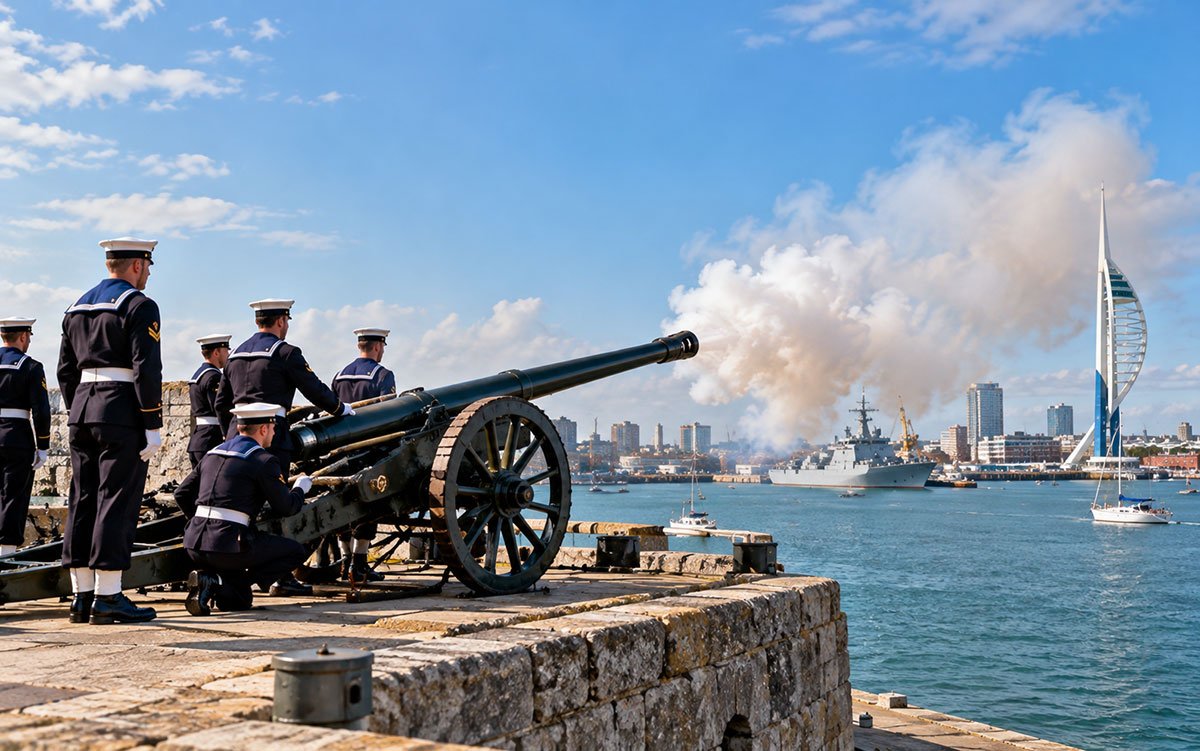
The Royal Navy’s ceremonial gun salutes honour significant royal occasions and preserve Britain’s long naval tradition.
21-Gun Salute in Portsmouth: The Royal Navy Tradition Explained
The sound of ceremonial gunfire over Portsmouth Harbour is a reminder of Britain’s long maritime history and its continuing royal traditions. A 21-gun salute is one of the most recognisable forms of military honour, marking significant national and royal occasions.
On 6 February 2013, the Royal Navy marked the 61st anniversary of Queen Elizabeth II’s accession to the throne with a 21-gun salute at Fort Blockhouse, near the entrance to Portsmouth Harbour. The ceremony honoured the day Princess Elizabeth became Queen following the death of her father, King George VI, in 1952.
The event formed part of a wider tradition of ceremonial salutes held across the United Kingdom. Although the monarchy has since changed, the Royal Navy continues to use gun salutes to mark important occasions. Understanding the history behind the ceremony offers a fascinating glimpse into Britain’s naval heritage.
Why Was a 21-Gun Salute Fired for Queen Elizabeth II?
Queen Elizabeth II became monarch on 6 February 1952, when King George VI died. She was in Kenya during an official Commonwealth tour when she received the news of her father’s death and her accession to the throne.
Her coronation took place later, on 2 June 1953, at Westminster Abbey.
These dates mark two different events. Accession is the moment a person becomes monarch, while the coronation is the formal religious and ceremonial occasion that follows.
The 21-gun salute in Portsmouth on 6 February 2013 marked the 61st anniversary of the Queen’s accession. The Royal Navy joined the long-standing practice of recognising significant royal anniversaries through ceremonial gunfire.
The ceremony also reflected the close relationship between the Crown and the Armed Forces. As monarch, Queen Elizabeth II was Head of the Armed Forces and maintained a longstanding association with the Royal Navy throughout her reign.
During her 70-year reign, she became the longest-reigning monarch in British history.
Where Was the Portsmouth Gun Salute Fired?
The 2013 salute took place at Fort Blockhouse, on the Gosport side of the entrance to Portsmouth Harbour. The site has a long military history and is closely associated with the development of Britain’s coastal defences and naval activity in the area.
Portsmouth Harbour has been an important base for the Royal Navy for centuries. Its waterfront continues to combine working naval facilities, historic vessels and landmarks that reflect the city’s maritime identity.
Fort Blockhouse provided a fitting location for a ceremonial event connected with the Navy’s heritage.
The saluting team fired 21 rounds, while naval ships in the harbour displayed colourful flags in the tradition known as dressing overall. The sound of the guns carried across Portsmouth, Gosport and the surrounding waterfront.
The location used for a salute can vary between events. In 2017, the Royal Navy fired a 21-gun salute for the Queen’s Sapphire Jubilee from South Railway Jetty. More recent official naval notices have also identified South Railway Jetty as the location for royal anniversary salutes.
Visitors should therefore check the details of each ceremony, as the Royal Navy may fire Portsmouth salutes from locations other than Fort Blockhouse.
What Is the History Behind the 21-Gun Salute?
The origins of naval gun salutes lie in the practices of sailing ships. When ships arrived in foreign ports, they could discharge their guns to demonstrate that they were unloaded and that their visit was intended to be peaceful.
Over time, the practice developed into a formal ceremonial tradition. Gun salutes came to represent respect, welcome and recognition rather than a practical requirement for entering a port.
Today, military personnel conduct these salutes according to established ceremonial procedures. They are used to mark selected royal occasions, significant national events and formal visits.
The traditional Royal Salute consists of 21 rounds. However, the number of rounds may vary according to the location and occasion.
For example, salutes in certain royal parks include additional rounds, while the ceremony at the Tower of London has its own established arrangement. The distinction reflects different ceremonial traditions and the significance attached to particular locations.
Although the gunfire may sound dramatic, military personnel carefully plan and conduct a ceremonial salute to mark an important occasion, not to engage in combat.
Why Are Royal Ships Decorated with Flags?
During important royal and national occasions, naval ships may display colourful flags along their length in a practice known as dressing overall.
The display is a visual expression of celebration and ceremonial respect. It can accompany gun salutes and other formal naval observances.
For an event such as the Queen’s accession anniversary, dressing overall provided a fitting complement to the ceremonial gunfire. The flags also made the occasion visible across the harbour, creating a distinctive scene for those watching from suitable public viewpoints.
The exact arrangements depend on the occasion and the instructions issued to the relevant ships and naval establishments.
What Has Changed Since Queen Elizabeth II’s Reign?
Queen Elizabeth II died on 8 September 2022, after 70 years on the throne. Her eldest son became King Charles III immediately upon her death.
Queen Elizabeth II’s accession anniversary falls on 6 February, while King Charles III marks his accession anniversary on 8 September.
The Royal Navy continues to mark selected royal occasions with ceremonial salutes. For example, an official notice scheduled a 21-gun salute at His Majesty’s Naval Base Portsmouth for King Charles III’s accession anniversary on 8 September 2026.
The ceremony was scheduled for noon at the southern point of South Railway Jetty. The notice also specified a temporary exclusion zone for marine traffic to maintain safety during the firing.
These arrangements demonstrate that the gun-salute tradition continues, even as the monarch and the dates associated with royal ceremonies change.
The location, timing and nature of each salute depend on official arrangements. Anyone interested in witnessing a future ceremony should consult current Royal Navy announcements rather than rely on a previous year’s schedule.
Can Visitors Watch a Royal Gun Salute in Portsmouth?
A royal gun salute can be an interesting sight for visitors exploring Portsmouth’s naval heritage. However, the opportunity to watch depends on the location, public access and safety arrangements for the particular event.
Naval bases and some waterfront facilities are restricted areas. A ceremonial salute taking place within or beside a naval establishment does not automatically mean the public can approach the guns.
If you are planning a visit, consider these practical steps:
- Check official announcements. The Royal Navy or King’s Harbour Master Portsmouth may publish details about the timing and location of a scheduled salute.
- Confirm public access. Do not assume that Fort Blockhouse, South Railway Jetty or other naval facilities are open to visitors.
- Follow safety instructions. Gun salutes can involve restrictions on harbour traffic and access to nearby areas.
- Plan a wider Portsmouth visit. The city has a rich maritime heritage, with historic ships, museums and waterfront attractions to explore independently of a ceremonial event.
Visitors interested in the city’s naval history can research Portsmouth Historic Dockyard and its attractions, checking current admission arrangements and opening times before travelling.
Portsmouth’s Enduring Naval Heritage
The 21-gun salute for Queen Elizabeth II’s accession anniversary reflected more than a royal milestone. It connected the modern Royal Navy with traditions shaped by centuries of maritime history.
Fort Blockhouse and Portsmouth Harbour provided a setting closely tied to that history, while the ceremony demonstrated how established customs continue to mark important national occasions.
Today, royal gun salutes remain part of the United Kingdom’s ceremonial calendar. Their locations and dates may change, but their purpose remains recognisable: to honour significant events through a tradition that links the country’s naval past with its present.
For those interested in British history, the Portsmouth salute is a reminder that even a brief ceremony can carry a story spanning generations.
