
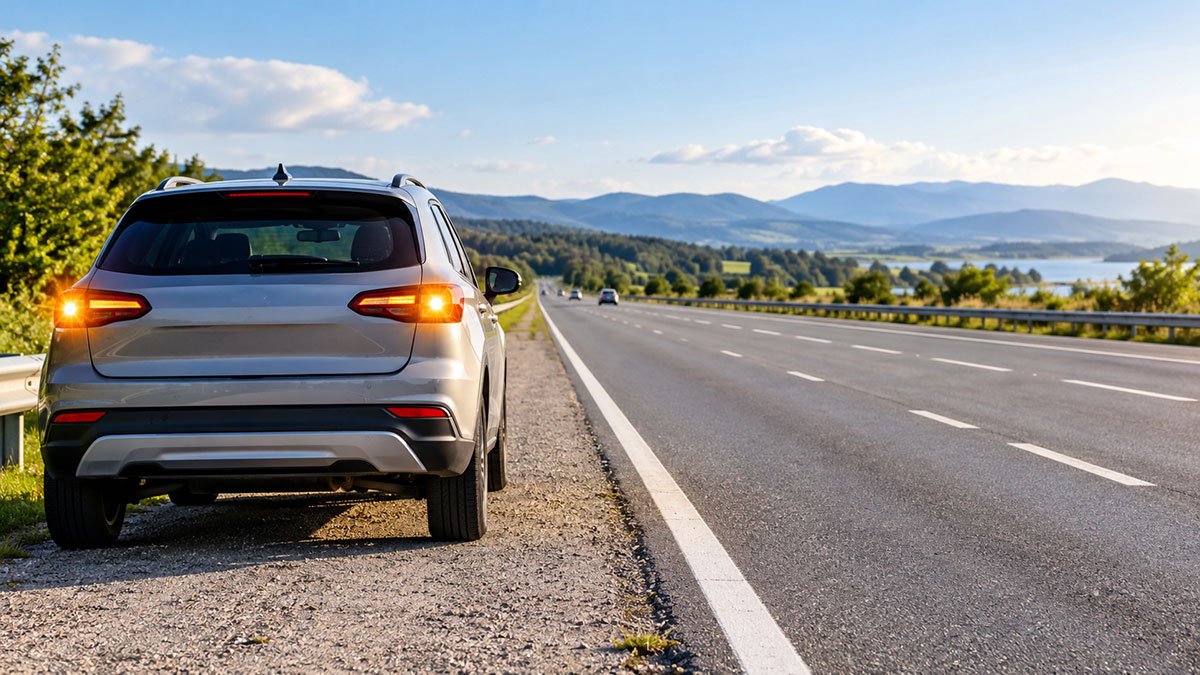
Move to a safe location, switch on your hazard lights and call for roadside assistance if your car breaks down on the highway.
What to Do When Your Car Breaks Down on the Highway: 7 Essential Safety Steps
A car breakdown on the highway can happen without warning. An engine may overheat, a tyre may blow out, a warning light may appear, or the vehicle may suddenly lose power. Knowing what to do when your car breaks down on the highway can help you protect yourself, keep your passengers safe and get professional assistance without making the situation worse.
The first priority is always safety. Avoid sudden braking or sharp steering, move away from moving traffic if you can do so safely, and switch on your hazard warning lights. If your vehicle stops in a live lane or you cannot safely exit it, call emergency services rather than attempting a repair.
Whether you are commuting, travelling between cities or planning a long road trip, these seven steps will help you handle a breakdown more confidently.
1. Move Your Car to a Safe Location
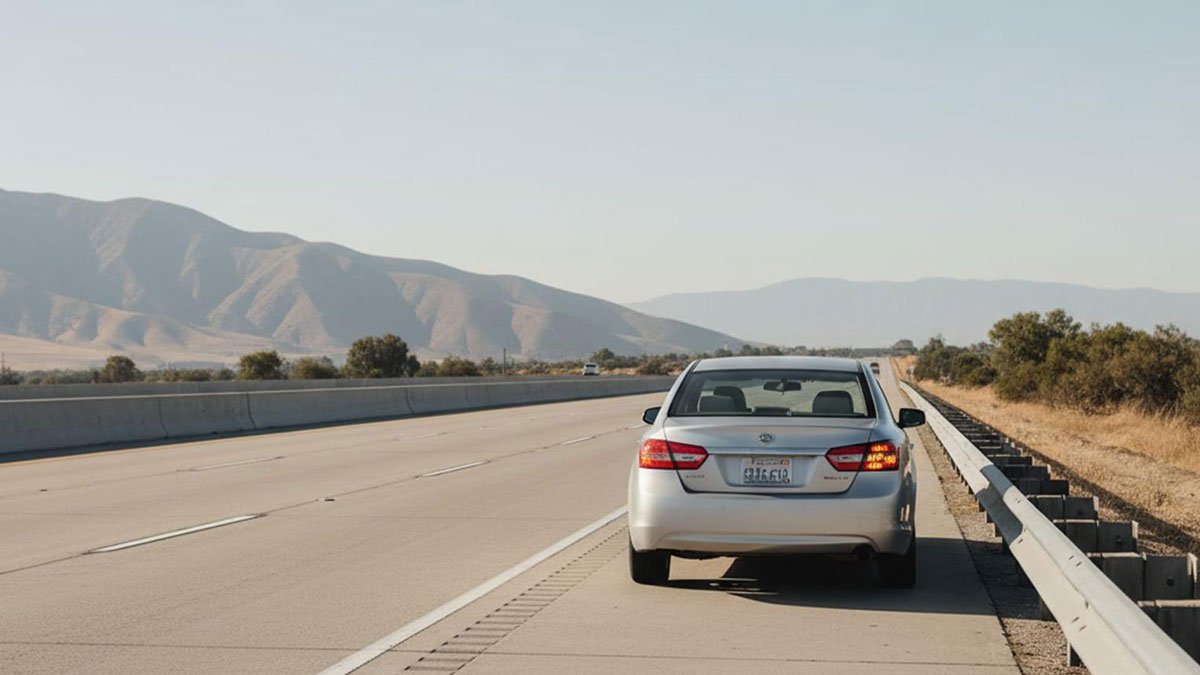
As soon as you notice signs of trouble, assess whether the car can still be controlled. Warning signs include unusual engine noise, smoke, a sudden loss of power, steering difficulties, a flat tyre or a temperature warning.
If the vehicle remains controllable, ease off the accelerator, signal your intention to move and steer gradually towards a safer location. Avoid sudden braking, abrupt lane changes or unnecessary manoeuvres.
Whenever possible, aim for a designated parking area, service area or the next exit. If you cannot reach one safely, pull as far away from moving traffic as the road layout permits.
Keep these precautions in mind:
- Do not force the car to keep moving. A serious mechanical problem can make driving unsafe.
- Avoid stopping in a live traffic lane unless the vehicle cannot move any farther.
- Do not assume a road shoulder is completely safe. Fast-moving traffic may pass close to your vehicle.
- On a motorway or expressway, follow the road’s specific emergency procedures. Hard shoulders, emergency refuge areas and permitted stopping locations vary by country and road design.
If the engine fails or the car becomes difficult to control, concentrate on maintaining control and reaching the safest attainable stopping point. Do not risk a collision to reach a particular exit or shoulder.
2. Switch On Your Hazard Lights and Assess the Danger
Once the vehicle stops, switch on the hazard warning lights. They alert approaching drivers that your car is stationary or experiencing a problem.
If visibility is poor, use the vehicle’s other appropriate lights when safe and permitted. At night, in heavy rain or in fog, other drivers may have less time to recognise a stopped vehicle.
Next, assess your surroundings before deciding whether to leave the car.
If the vehicle is safely away from moving traffic: You may be able to exit through the side furthest from the road and move to a safer waiting area.
If the vehicle is in a live lane or exposed to immediate traffic danger: Do not step into moving traffic. Keep your seat belt fastened, leave the hazard lights on and contact emergency services.
Do not stand behind or directly in front of a stopped vehicle. If another vehicle strikes it, these positions can leave you exposed to serious injury.
Avoid placing reflective triangles, flares or other warning devices in a live lane or on a motorway where their use is prohibited. Only deploy a warning device when local rules permit it and you can do so without entering a dangerous area.
3. Get Yourself and Your Passengers to Safety
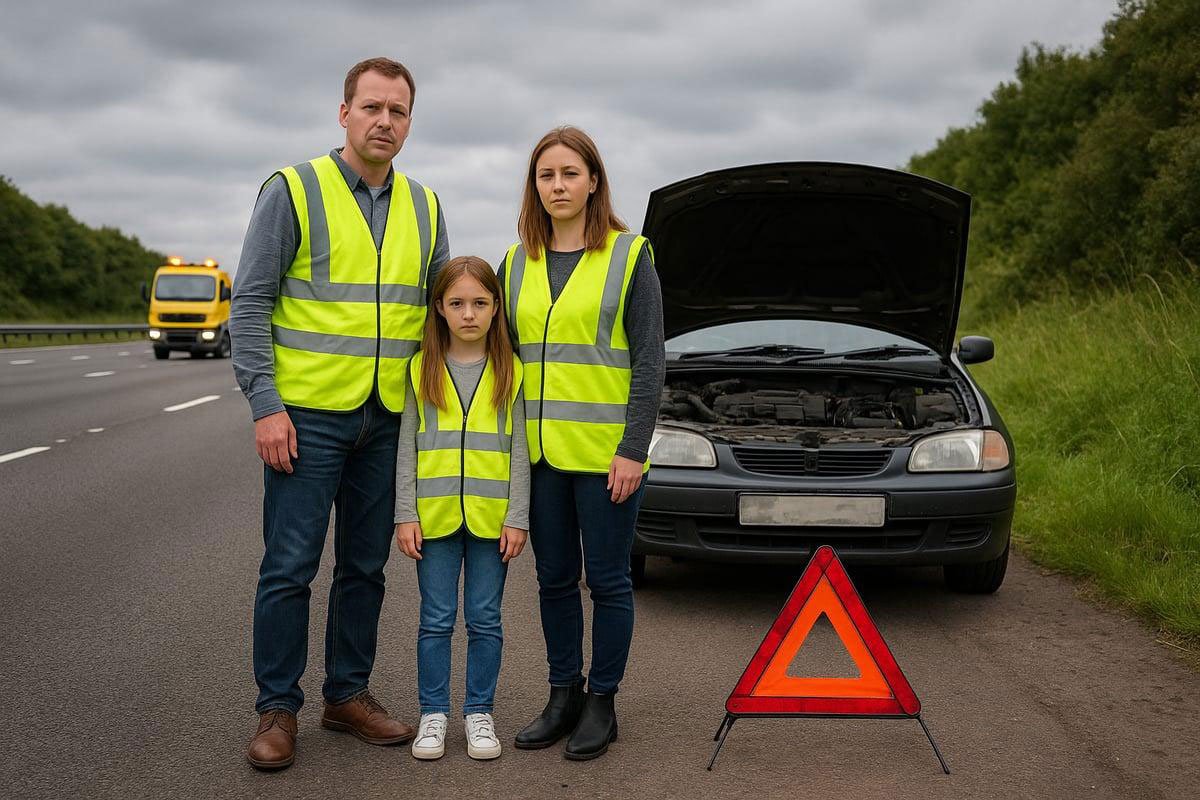
Leaving the car is not always the safest option. Your decision should depend on where the vehicle has stopped and whether you can reach a protected area without crossing traffic.
If you can exit safely, use the door away from moving vehicles. Move well away from the carriageway and get behind a safety barrier where one is available and accessible. Keep children close and under control.
Remember these important rules:
- Never stand between your car and approaching traffic.
- Do not attempt to cross a highway to reach a phone, shop or nearby building.
- Do not walk along a high-speed road unless emergency personnel direct you to do so.
- Keep pets secured and under control without exposing yourself to traffic.
- In darkness, rain or poor visibility, remain alert to approaching vehicles and road debris.
If you cannot safely leave the vehicle, remain inside with your seat belt fastened and call for help. Follow the instructions given by emergency services.
Avoid opening the bonnet simply to investigate smoke or a possible engine fault while you are beside moving traffic. A roadside inspection can wait until you are in a safe location.
4. Call Roadside Assistance or Emergency Services
Once you are in the safest available position, arrange professional help. Do not wait for another motorist to notice your vehicle or assume that a highway patrol team will arrive automatically.
Depending on the situation, contact:
- Your roadside assistance provider or vehicle manufacturer’s breakdown service.
- The relevant highway authority or motorway assistance service.
- Police or emergency services if the vehicle is obstructing traffic, there is an immediate danger, or someone is injured.
- An authorised towing service if the vehicle cannot be driven safely.
In India, 1033 is the National Highways Authority of India’s highway helpline for reporting highway-related problems, including vehicle breakdowns. For police, fire, medical or other urgent emergencies, 112 is India’s pan-India emergency number.
The correct service and available roadside support can depend on the road and location. In other countries, use the local emergency number and the relevant highway authority’s official contact details.
What information should you provide?
When calling for assistance, explain:
- Your location: Give the highway or road name, direction of travel, nearest exit, kilometre marker, toll plaza or other recognisable landmark.
- The problem: Describe the symptoms, such as an overheated engine, flat tyre, electrical failure or a vehicle that will not start.
- The safety risk: State whether the car is in a traffic lane, on the shoulder or in a designated emergency area.
- The number of passengers: Mention any children, older passengers, people with disabilities or anyone needing medical attention.
- Your contact details: Provide a working phone number and follow the operator’s instructions.
If possible, use your phone’s mapping application to identify your location. Share a location pin with the assistance provider or a trusted contact when it is safe to do so.
If you are on a road with an official emergency phone, use it only when you can reach it safely and follow the road authority’s instructions.
5. Avoid Risky Repairs on the Roadside
A breakdown can make even a minor mechanical problem feel urgent. However, attempting a repair beside fast-moving traffic can be more dangerous than waiting for professional help.
Do not crawl under the car, inspect the underside, change a tyre or work in an exposed traffic-side position. Never attempt a repair in a live lane.
Some warning signs also require special caution.
If the engine overheats
Stop driving as soon as you can safely do so and switch off the engine. Keep clear of steam or escaping coolant. Never remove a hot radiator cap because pressurised coolant can cause severe burns.
If you see smoke or smell burning
Stop in the safest attainable location. If there are signs of fire, evacuate only if you can do so safely, move away from the vehicle and contact emergency services. Do not open the bonnet if doing so could expose you to flames or smoke.
If you have a flat tyre
Maintain control, reduce speed gradually and stop somewhere safe. Avoid driving on a damaged tyre if doing so could cause loss of control or further damage. Arrange professional help if you cannot change it safely.
If the battery fails
Do not attempt a jump-start unless the vehicle manufacturer’s instructions permit it, you understand the correct procedure and the location is safe. Modern vehicles may have specific requirements for battery assistance.
If the car loses power or displays a serious warning
Do not repeatedly restart the engine or continue driving in the hope that the warning will disappear. Consult the owner’s manual and arrange inspection or towing when necessary.
The safest decision is to wait for trained assistance whenever the vehicle’s condition or roadside environment makes a repair hazardous.
6. Stay Safe While Waiting for Help
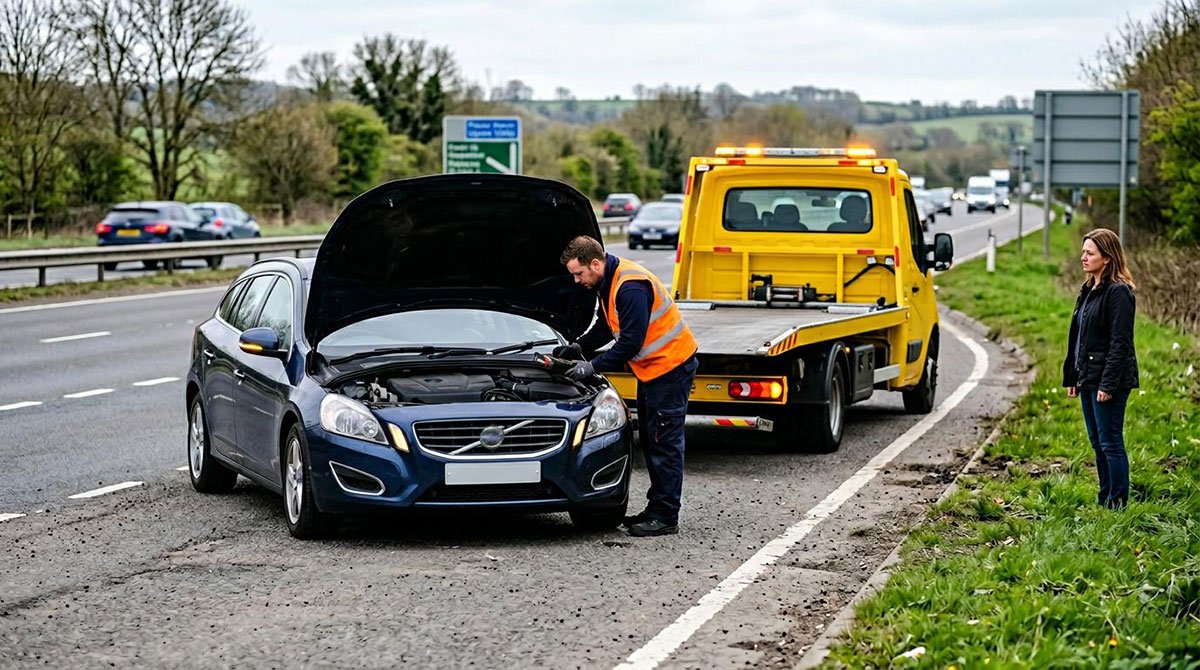
Once assistance has been requested, remain in a safe position and keep your phone available.
If you are waiting outside the car, stay behind a suitable safety barrier where possible. Avoid standing near the vehicle, facing the carriageway from an exposed position or returning to the car to retrieve belongings when traffic conditions are dangerous.
If you must remain inside because exiting is unsafe, keep your seat belt fastened and your hazard lights on. Tell the emergency operator that you cannot safely leave the vehicle.
While waiting:
- Keep your phone charged and answer calls from the recovery provider.
- Monitor your surroundings rather than concentrating entirely on your phone.
- Follow instructions from authorised roadside personnel.
- Keep passengers together in a safe location.
- If your location changes or the vehicle is moved, update the assistance provider.
- Do not accept an unfamiliar towing offer without checking who is providing the service and where the vehicle will be taken, provided you can make that check safely.
If the situation becomes more dangerous, such as a vehicle fire, a collision or a person experiencing a medical emergency, contact emergency services immediately.
Wait for the recovery team to assess the vehicle. Once it is safe, arrange a repair, tyre replacement or tow to a suitable workshop.
7. Prepare for Future Breakdowns Before Your Next Journey
The best time to prepare for a breakdown is before you set off. A few simple checks can reduce the likelihood of mechanical problems and make an unexpected stop easier to manage.
Check your vehicle before departure
Inspect the following items before a long drive:
- Tyres: Check pressure, tread condition and visible damage, including the spare tyre if your vehicle has one.
- Engine oil and coolant: Check the levels according to the manufacturer’s instructions.
- Battery: Look for signs of deterioration and have a weak battery tested.
- Brakes and lights: Make sure the braking system and exterior lights work correctly.
- Fuel or charge: Ensure you have enough fuel or battery charge for the planned journey, including a sensible reserve.
- Warning lights: Address important dashboard warnings before travelling.
- Maintenance: Follow the manufacturer’s service schedule and have unusual noises or vibrations checked.
Do not rely on a basic pre-trip inspection to identify every possible fault. If the vehicle has a serious warning, visible damage or a known mechanical issue, seek professional advice before travelling.
Keep an emergency kit in your vehicle
A useful car emergency kit can include:
Roadside emergency checklist
- Copy checklist
Choose equipment that suits your vehicle and the roads you travel. For example, electric vehicles may require different recovery arrangements from conventional petrol or diesel cars. Warning devices must also comply with local road rules.
Before leaving, save the relevant emergency numbers, check your roadside assistance coverage and download offline maps if your route passes through areas with unreliable mobile reception.
What Should You Do if Your Car Breaks Down at Night?
A nighttime breakdown requires extra caution because approaching drivers may have less time to spot a stationary vehicle, and roadside surroundings may be difficult to see.
Follow these precautions:
- Switch on your hazard warning lights as soon as you stop.
- Move to a safe stopping area if you can do so without risking a collision.
- Decide whether exiting the car is safer than remaining inside, based on traffic exposure and the availability of a protected area.
- Use a torch or reflective clothing if you can access them safely.
- Contact roadside assistance and provide precise location details.
- Never stand in the road or attempt repairs in darkness beside moving traffic.
Do not assume that turning on the interior light or hanging a cloth outside the window makes your vehicle safe. These measures do not replace proper hazard lights, a safe stopping position and professional assistance.
What If Your Car Breaks Down in an Isolated Area?
A remote road can present additional challenges, particularly when mobile coverage is weak or help is far away.
Before travelling through an isolated area, tell a trusted person your planned route and expected arrival time. Carry sufficient water, suitable clothing, essential medication and a charged phone.
If your car breaks down:
- Move to a safe stopping point if possible.
- Try to contact roadside assistance or the relevant emergency service.
- Share your exact location and direction of travel.
- Conserve your phone battery and keep it available for important calls.
- Avoid walking long distances along an unfamiliar road to find assistance.
- Do not accept help that makes you feel unsafe; contact your assistance provider or emergency services if you need guidance.
If you cannot obtain a mobile signal, look for an official emergency communication point only if you can reach it safely. Otherwise, remain in the safest available location and use any available emergency communication system.
Common Mistakes to Avoid During a Highway Breakdown
Even experienced drivers can make poor decisions under stress. Avoid these common mistakes:
- Braking sharply: Sudden braking can cause a loss of control or a collision with following traffic.
- Standing behind the car: A stopped vehicle can be struck and pushed into anyone standing nearby.
- Trying to fix the problem immediately: A roadside repair is not worth risking your life.
- Using a warning triangle without assessing the danger: Never enter a live lane to place one.
- Ignoring smoke or serious warning lights: Continuing to drive can worsen the fault or create a fire risk.
- Assuming help will arrive automatically: Contact the relevant assistance service and explain the danger.
- Leaving passengers unsupervised: Keep children and vulnerable passengers safe and accounted for.
- Giving vague location details: Road names, direction of travel, nearby signs and location pins help responders find you.
Frequently Asked Questions
What is the first thing to do when your car breaks down on the highway?
Stay calm, maintain control of the vehicle and move towards a safe stopping place if possible. Switch on your hazard lights once stopped. Your next decision should be whether you and your passengers can safely exit the vehicle or should remain inside while contacting emergency services.
Should you stay inside your car when it breaks down?
It depends on where the vehicle has stopped. If it is exposed to moving traffic and you cannot safely reach a protected area, remaining inside with your seat belt fastened may be the safer option. If you can exit safely away from traffic and move behind a barrier, doing so may reduce the risk of injury. Follow local highway guidance and emergency operator instructions.
Should you put a warning triangle behind your car?
Only if local regulations permit it and you can place it without exposing yourself to traffic. Never place a warning triangle on a motorway or in a live lane where it is prohibited. Your safety takes priority over deploying warning equipment.
Can you repair your car on the highway shoulder?
Only consider minor work when you are in a genuinely safe location, local rules permit it and you are competent to carry it out. Avoid repairs beside high-speed traffic, under the vehicle or in a live lane. On motorways and expressways, professional assistance is generally the safer choice.
Who should you call if your car breaks down on an Indian national highway?
For highway-related assistance in India, you can call the National Highways Authority of India’s 1033 helpline. For urgent emergencies involving police, fire, medical assistance or immediate danger, dial 112. Explain your exact location and whether the vehicle is obstructing traffic.
How can you reduce the chances of a highway breakdown?
Maintain your vehicle according to the manufacturer’s schedule, check tyres and fluid levels, address warning lights promptly and ensure you have sufficient fuel or battery charge. Keep emergency supplies in the car and know how to contact roadside assistance before beginning a long journey.
Final Thoughts
A highway breakdown can disrupt your plans, but the right decisions can prevent a mechanical problem from becoming a serious emergency. Move to safety when possible, make your vehicle visible, protect your passengers and contact the appropriate assistance service.
Avoid unnecessary repairs beside traffic and never risk your safety to save time or money. A little preparation before departure can make a significant difference when something goes wrong on the road.
