
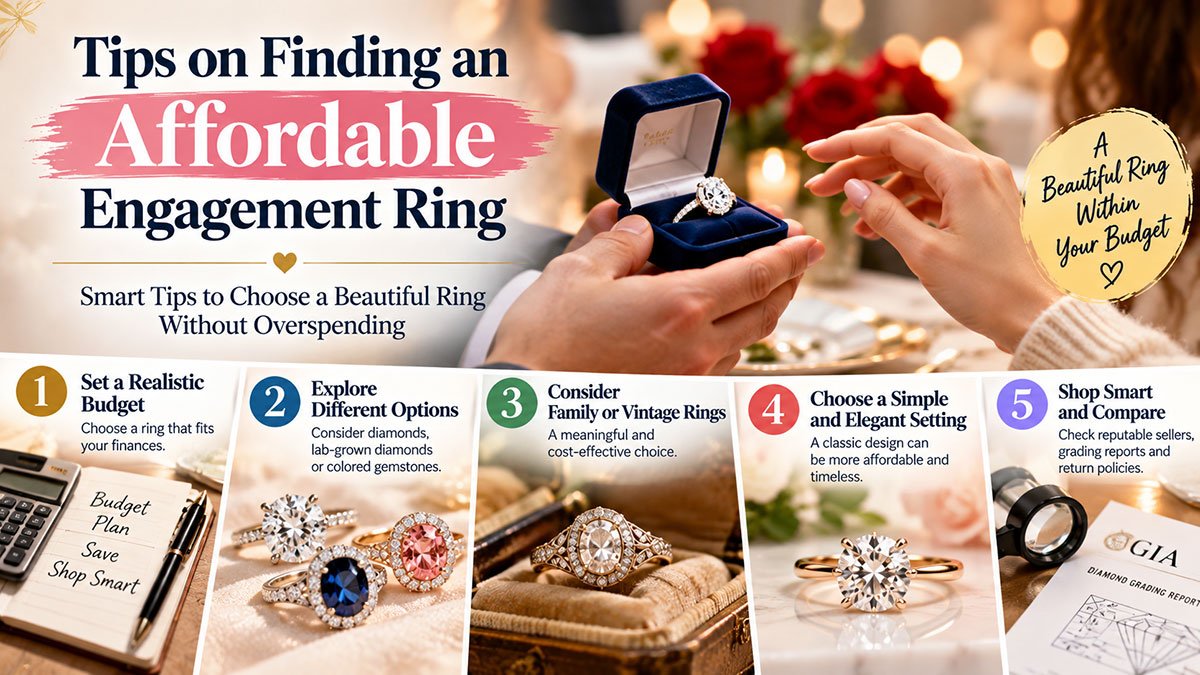
Tips for Finding an Affordable Engagement Ring
Subtitle: Learn how to choose a beautiful engagement ring without overspending, using practical tips on diamonds, gemstones, metals, sizing, secondhand rings, and financing.
Buying an engagement ring can feel like a major financial decision. However, you do not need to spend your life savings to choose a meaningful and beautiful ring.
The best affordable engagement ring is one that fits your budget, suits your partner’s style, and offers reliable quality. A sensible approach starts with setting a firm budget before you begin browsing.
You can then compare different gemstones, metals, designs, and sellers. Modern buyers also have more choices than they did when this article was first published in 2013. Lab-grown diamonds, colored gemstones, vintage rings, and simpler settings can all provide alternatives to a traditional high-carat natural diamond.
Here are practical ways to find the right ring without unnecessary expense.
Set Your Budget Before You Shop
The first step is simple: decide what you can comfortably afford.
Avoid choosing a ring first and trying to justify the price afterward. Your engagement ring is important, but it should not create long-term financial stress.
Start by reviewing your available savings and monthly budget. Consider other upcoming expenses, such as the wedding, honeymoon, housing, or family commitments.
There is no universally correct amount to spend on an engagement ring.
The old idea that buyers should spend a specific number of months’ salary is a marketing myth rather than a financial rule. Your budget should reflect your circumstances and priorities.
Once you have a maximum amount in mind, stick to it.
Consider a Family Heirloom
A family ring can be one of the most meaningful ways to save money.
A vintage engagement ring passed down from a parent or grandparent may have enormous sentimental value. Its financial cost can also be much lower than buying a comparable new ring.
The ring may need professional cleaning, polishing, repair, or resizing. Even with those additional costs, restoration can be less expensive than purchasing an entirely new piece.
You can also redesign an inherited ring.
A jeweler may be able to reset the existing gemstone into a new setting or modify the band while preserving the original stone. The possibilities depend on the ring’s condition, construction, gemstone, and metal.
Before making changes, ask a qualified jeweler to inspect the ring. They can identify structural weaknesses, damaged prongs, worn settings, or stones that require special care.
Consider Lab-Grown Diamonds
One of the biggest changes in the engagement-ring market since 2013 is the wider availability of laboratory-grown diamonds.
Laboratory-grown diamonds are manufactured rather than mined. The FTC distinguishes them from imitation stones and requires jewelry marketers to describe products accurately so consumers understand what they are buying. (ftc.gov)
GIA also recognizes laboratory-grown diamonds and provides identification and grading services for them. (gia.edu)
For budget-conscious buyers, a lab-grown diamond can be worth considering because it may provide the look and physical properties of diamond without the same price as a comparable natural stone.
However, compare products carefully.
Make sure the listing clearly states whether the stone is natural, laboratory-grown, or an imitation. The FTC specifically advises consumers not to assume that a stone is a natural diamond simply because it looks like one. (consumer.ftc.gov)
Explore Colored Gemstones
Diamonds are not the only option for an engagement ring.
Colored gemstones such as sapphire, ruby, spinel, garnet, tourmaline, and morganite can create a distinctive look. Some can also offer more visual size for the budget.
GIA notes that colored gemstones can be a good-value alternative to diamonds, although durability should be considered carefully when selecting a stone for daily wear. (4cs.gia.edu)
Sapphire and ruby are particularly durable choices, ranking 9 on the Mohs hardness scale. GIA also identifies several other gemstones as suitable for everyday wear when properly cared for. (4cs.gia.edu)
Some softer or less-tough gemstones require more caution.
For example, emerald can be vulnerable to breaking and may receive treatments that affect how it should be cleaned and maintained. (4cs.gia.edu)
The best gemstone is therefore not necessarily the cheapest one. Choose one that can handle the intended lifestyle.
Understand the 4Cs Before Buying a Diamond
For a traditional diamond engagement ring, learn the 4Cs: cut, color, clarity, and carat weight.
GIA created the 4Cs as a standard for describing diamond quality. (4cs.gia.edu)
Cut
Cut affects how effectively a diamond interacts with light. A well-cut diamond can look bright and lively without requiring a very high carat weight. GIA’s recent guidance continues to emphasize cut as one of the most important considerations for a round brilliant diamond. (4cs.gia.edu)
For a budget-conscious buyer, prioritizing cut can sometimes provide better visual impact than simply increasing carat weight.
Color
Diamond color is graded from D to Z within the standard GIA scale. The closer a stone is to colorless, the higher its rarity and, generally, its market value. (4cs.gia.edu)
You may not need the highest grade to achieve a beautiful appearance.
Metal choice also affects how diamond color appears. GIA notes that yellow or rose gold can complement warmer diamond colors, while white metals can emphasize a diamond’s lack of color. (4cs.gia.edu)
Clarity
Clarity describes the internal and external characteristics of a diamond.
A higher clarity grade does not automatically mean a better-looking ring. Some lower-clarity diamonds can appear clean to the unaided eye.
The important consideration is whether the stone has visible characteristics that affect its appearance or durability.
Carat Weight
Carat refers to weight, not exactly visual size.
A larger carat weight normally costs more when other quality factors are comparable. Choosing a slightly smaller stone can therefore free up money for a better cut or setting.
You do not have to choose a round diamond, either.
Different diamond shapes can create a larger-looking appearance for the same budget, depending on their proportions and design.
Compare the Grading Report
When buying a significant diamond, ask whether it has a grading report from a respected gemological laboratory.
A grading report can provide independent information about the diamond’s 4Cs and whether the stone is natural, laboratory-grown, or treated. GIA specifically recommends using grading reports when comparing diamonds. (4cs.gia.edu)
Compare like with like.
GIA notes that different laboratories can use different grading standards, so comparing diamonds graded by the same laboratory can make price and quality comparisons more meaningful. (4cs.gia.edu)
The report does not replace seeing the ring or stone in person. It simply gives you independent information about the gemstone.
Choose a Simple Ring Setting
The setting can have a major impact on the total price.
A complicated halo, elaborate pavé work, multiple gemstones, or highly detailed metalwork can increase both the purchase price and future maintenance costs.
A simpler solitaire setting may provide a clean, timeless appearance while putting more of your budget toward the center stone.
That does not mean simple is better.
Choose the design your partner would actually wear. A less expensive ring is only a good value if its style, comfort, and construction meet your needs.
Choose the Right Metal
Gold and platinum remain popular engagement-ring materials.
GIA explains that gold is commonly alloyed with other metals because pure gold is relatively soft. Common choices include 14K and 18K gold, along with platinum. (4cs.gia.edu)
A lower-karat gold may be more affordable and can be somewhat more resistant to dents than higher-purity gold. Platinum offers a different combination of durability, density, and appearance.
Compare the complete ring rather than focusing only on the metal’s name.
The thickness of the band, setting design, workmanship, and gemstone requirements all affect the final price.
Do Not Assume Silver Cannot Be Resized
The original article advised shoppers to avoid silver because silver rings cannot be resized.
That statement is too broad.
Whether a ring can be resized depends on its design, construction, stone placement, and the jeweler’s ability to work with the material. Some silver rings can be resized, while certain designs may make resizing impractical or uneconomical.
The same principle applies to gold and platinum.
GIA notes that rings can generally be resized within a limited range, although complicated bands with many small stones can make the procedure more difficult and expensive. (4cs.gia.edu)
Therefore, do not buy a ring in the wrong size simply because the seller claims it is easy to resize.
Confirm the options with a professional jeweler first.
Shop Online, But Research the Seller
Buying online can make it easier to compare prices, styles, gemstones, and specifications.
However, lower advertised prices do not automatically mean better value.
The FTC advises consumers to research sellers, check reviews and complaints, and obtain return policies in writing. (consumer.ftc.gov)
Before ordering an engagement ring online, check:
- Seller reputation
- Return and refund policy
- Warranty terms
- Ring sizing policy
- Diamond or gemstone documentation
- Metal purity
- Shipping and insurance
- Repair or resizing services
Look carefully at the product description.
A professional seller should clearly identify the gemstone, metal, treatments, size, and other important characteristics. The FTC Jewelry Guides require truthful representations about these characteristics. (ftc.gov)
Consider Vintage or Pre-Owned Rings
Secondhand jewelry can be an excellent option for a buyer with a limited budget.
Vintage rings may offer unusual designs that are difficult to find in modern collections. You may also find older cuts, distinctive settings, and gemstones with character.
However, pre-owned does not mean risk-free.
Have the ring examined by a qualified jeweler before purchasing when possible. Ask about worn prongs, loose stones, thin bands, repairs, or previous resizing.
A professional inspection can help you understand whether the apparent bargain will remain a bargain after repairs.
Be Careful With Financing
A payment plan can make an expensive ring appear more affordable because the monthly payment is smaller.
That does not mean the overall purchase costs less.
Check the interest rate, fees, repayment period, and total amount you will pay.
The Consumer Financial Protection Bureau notes that even buy-now-pay-later arrangements can involve fees, particularly late fees, depending on the provider and terms. (consumerfinance.gov)
Borrowing money for an engagement ring may be appropriate for some buyers, but it should not force you into long-term financial pressure.
A smaller ring that you can comfortably afford is often a better choice than a larger ring that requires expensive debt.
Spend More on What Matters Most
You do not have to maximize every specification.
Instead, decide which characteristics matter most to your partner.
Perhaps the most important factor is the gemstone. Maybe the design matters more. Some people care deeply about metal color, while others prefer a larger-looking stone.
GIA recommends identifying which of the 4Cs matters most to you rather than automatically buying the highest grade in every category. (4cs.gia.edu)
That principle can reduce unnecessary spending.
For example, you might choose a slightly smaller center stone and put the savings toward a better cut. Another buyer might choose a colored gemstone with an attractive design instead of paying more for a larger diamond.
Value comes from prioritization.
Remember That Diamonds Can Still Be Damaged
The original article claimed that diamonds are extremely difficult to damage.
Diamonds are indeed exceptionally hard and highly resistant to scratching. They are not indestructible.
GIA explains that diamonds can chip or fracture after a sufficiently strong impact, especially around vulnerable areas such as the girdle or pointed corners. (4cs.gia.edu)
That makes proper setting and maintenance important.
Have the prongs and setting checked periodically. Avoid treating a diamond ring as indestructible simply because diamond ranks 10 on the Mohs hardness scale.
Think About Insurance and Long-Term Care
Your purchase does not end when you leave the jewelry store.
An expensive engagement ring should be protected against loss, theft, and accidental damage through appropriate insurance.
GIA recommends properly caring for and insuring diamond jewelry. It also recommends periodic professional cleaning and inspection. (4cs.gia.edu)
Keep the original invoice, grading report, appraisal documents, and photographs in a secure location.
These records can be useful for insurance and future servicing.
An Affordable Ring Can Still Be Beautiful
A limited budget does not mean you have to choose an unattractive engagement ring.
You can save by:
- Choosing a simpler setting
- Considering a lab-grown diamond
- Exploring durable colored gemstones
- Selecting a slightly smaller center stone
- Comparing different diamond shapes
- Buying a vintage or pre-owned ring
- Comparing several reputable sellers
- Choosing a practical metal
- Avoiding unnecessary design extras
The most important factor is not the price tag.
It is whether the ring reflects the person who will wear it.
Final Thoughts on Finding an Affordable Engagement Ring
Finding an affordable engagement ring does not require sacrificing meaning or quality.
Start with a realistic budget and decide which features matter most. Then compare gemstones, metals, designs, and sellers carefully.
Modern buyers have more choices than ever. Natural diamonds remain popular, while laboratory-grown diamonds and colored gemstones provide additional options for different budgets and personal styles. GIA and the FTC both emphasize understanding exactly what you are buying, including the gemstone’s origin, grading, treatments, and characteristics.
A family heirloom can provide exceptional sentimental value. A vintage ring can offer distinctive style. A simple setting can keep costs under control. A carefully selected gemstone can provide personality without requiring a very large diamond.
Most importantly, never confuse a high price with a meaningful proposal.
The best ring is one that fits your finances, suits your partner, and represents your commitment without creating unnecessary financial pressure.
Your engagement should mark the beginning of a shared future. It should not begin with a payment you cannot comfortably afford.
