
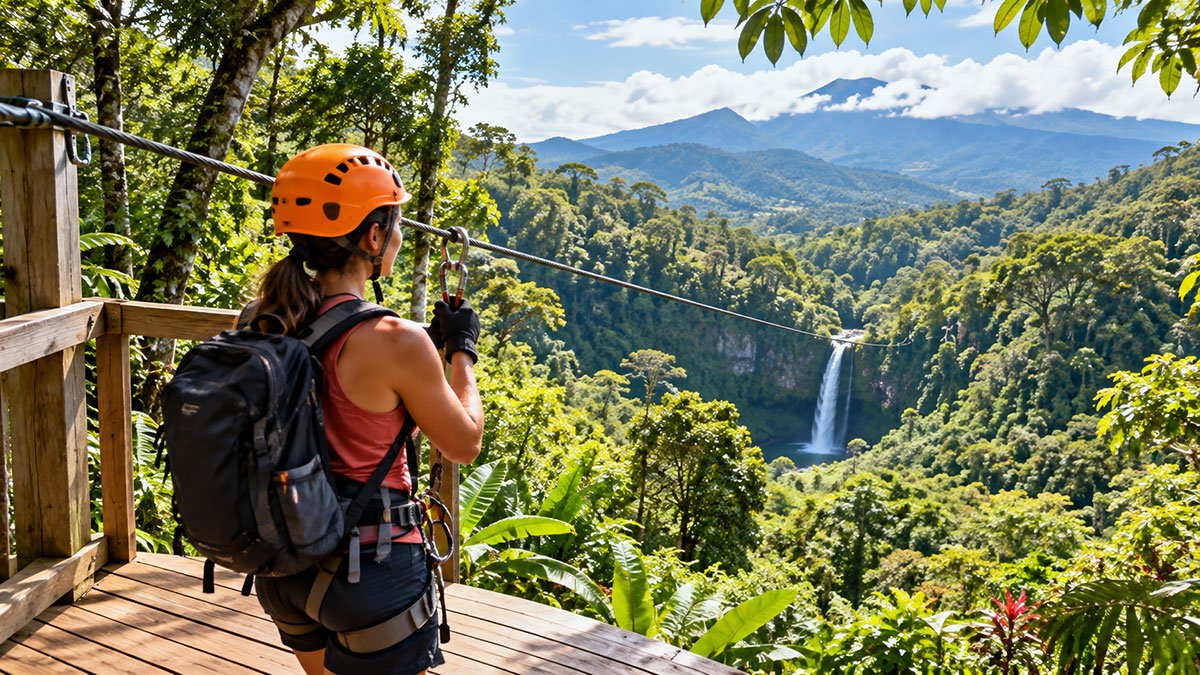
Experience the adventurous side of Costa Rica with rainforest ziplining, spectacular waterfalls and breathtaking tropical landscapes.
Costa Rica Adventure Travel: Surfing, Ziplining, Canyoning and More
Costa Rica adventure travel combines tropical beaches, rainforest canopies, volcanic landscapes and fast-flowing rivers in one destination. Travellers can spend a morning surfing Pacific waves, explore forest trails in the afternoon or plan a separate excursion for waterfall rappelling and white-water rafting.
The country offers adventures for different experience levels, from guided nature walks and canopy bridges to technical surf breaks and demanding river rapids. Choosing the right activity depends on your fitness, experience, travel season and appetite for adventure.
The key is to match your itinerary to the conditions. Surf breaks can be powerful, river difficulty changes with water levels, and access to remote areas may require specialist transport or a guided excursion.
Here are four ways to experience Costa Rica’s adventurous side, plus practical advice to help you plan safely.
1. Surfing: Discover Costa Rica’s Pacific and Caribbean Coasts
Costa Rica attracts surfers with its varied coastline, warm tropical waters and breaks suited to different abilities. The Pacific and Caribbean coasts offer different conditions, so your choice of destination should depend on your surfing experience and the type of waves you want to ride.
Witch’s Rock and Playa Naranjo
Witch’s Rock, known locally as Roca Bruja or Peña Bruja, is a renowned surf location near Playa Naranjo in Guanacaste. It lies within Santa Rosa National Park, part of the Guanacaste Conservation Area.
The setting is remote and undeveloped compared with Costa Rica’s more accessible beach towns. Reaching the Playa Naranjo area involves planning: the official park guidance describes access from the historical site by a rough road that requires a four-wheel-drive vehicle, while the marine sector can be reached by boat. Check current park access arrangements before travelling.
Witch’s Rock is not a beginner break. The park authority describes its waves as suitable for expert surfers. Only attempt the break if your ability matches the conditions, and consider hiring an experienced local surf guide.
Other Surfing Destinations
You do not need to travel to a remote break to enjoy surfing in Costa Rica. Guanacaste offers better-known beach destinations such as Tamarindo and Playa Grande, while the Pacific coast farther south includes places such as Dominical. On the Caribbean side, Puerto Viejo de Talamanca is associated with challenging reef surfing as well as gentler beach options nearby.
Conditions vary considerably between breaks. Before entering the water, check the waves, currents, seabed, local hazards and available rescue services. Beginners should choose a suitable beach and take lessons from a qualified instructor.
When Is the Best Time to Surf?
Surf conditions depend on the coastline, swell direction, winds and the particular break. Costa Rica’s Pacific coast and Caribbean coast do not follow identical seasonal patterns.
Rather than assuming that every surf spot works year-round, research the break you want to visit and ask local surf professionals about current conditions. Leave flexibility in your itinerary in case weather or sea conditions make a planned session unsuitable.
2. Canopy Tours and Ziplining: Explore the Rainforest From Above
Costa Rica’s forests offer an adventurous way to experience the country’s natural environment without following a traditional ground trail. Canopy tours commonly use cables, harnesses and platforms, while hanging bridges let visitors walk through the forest at a slower pace.
Experience the Forest Canopy
Ziplining lets you travel between elevated platforms while secured to a cable system. Depending on the tour, routes may cross forested valleys, pass above streams or offer views across a green mountain landscape.
For a gentler experience, consider a hanging-bridge trail. These walkways provide time to observe the forest, search for birds and other wildlife, and appreciate the vegetation at different heights.
The two activities offer different experiences. Ziplining focuses on movement and speed, while hanging bridges generally allow a more leisurely exploration.
Where to Go
Monteverde is known for its cloud-forest scenery and canopy experiences. Other areas, including the Arenal region, the Central Valley and parts of the Osa Peninsula, also offer ziplining or elevated forest walks.
Choose a location that fits your wider route rather than booking an excursion solely because it sounds exciting. Travel time between regions can take longer than the distance on a map suggests, particularly on mountain roads.
Check Operator Safety Before Booking
Use a reputable operator with trained guides, suitable equipment and clear safety procedures. Before starting a zipline course, make sure the staff explain the braking system, body position and emergency procedures.
Follow all instructions about harnesses, helmets, footwear, clothing, height and weight limits. Requirements differ between courses, so check the specific operator’s conditions before booking.
For anyone who prefers a lower-intensity outing, a guided hanging-bridge walk can provide an enjoyable alternative without the same speed or technical demands.
3. Canyoning: Rappel Down Waterfalls and Explore Gorges
Canyoning combines hiking, climbing, scrambling and, on some routes, descending rock faces or waterfalls with ropes. It offers a close-up look at Costa Rica’s rugged landscapes, including narrow gorges, flowing streams and lush vegetation.
What to Expect on a Canyoning Tour
A guided excursion may involve walking over uneven terrain, crossing streams, negotiating slippery rocks and rappelling down a waterfall. The exact route depends on the location, water conditions and tour operator.
Some tours suit active beginners, while others demand better fitness and greater comfort with heights. Read the activity description closely and ask about the length, elevation changes, swimming requirements and physical difficulty before booking.
Canyoning is not simply a sightseeing walk. You should feel comfortable following technical instructions and using the provided safety equipment.
Where to Go Canyoning in Costa Rica
The Costa Rican Tourism Board identifies areas including La Fortuna, Turrialba, San Ramón, Miramar and Rincón de la Vieja as places where visitors can find canyoning experiences.
La Fortuna is a useful option for travellers exploring the Arenal region, while other locations can suit itineraries focused on different parts of the country.
Use a qualified guide who knows the route and understands how local weather affects waterfalls and streams. Heavy rain can increase water levels and create dangerous conditions, so tours may need to change or cancel.
What to Bring
Follow your operator’s equipment list. Depending on the excursion, useful items may include secure footwear with good grip, quick-drying clothing, sun protection and a change of clothes for after the activity.
Operators should explain which technical equipment they supply, such as helmets, harnesses and ropes. Do not attempt waterfall rappelling independently without appropriate training, equipment and the necessary technical skills.
4. White-Water Rafting: Navigate Costa Rica’s Rivers
White-water rafting combines teamwork, paddling and moving through rapids against a backdrop of tropical forest, mountain scenery and river valleys. Costa Rica offers routes with different levels of difficulty, making the choice of river particularly important.
Pacuare River
The Pacuare River is one of Costa Rica’s best-known rafting destinations. Its rainforest setting and stretches of rapids make it an appealing choice for adventure travellers.
The official tourism board describes sections of the Pacuare as Class III–IV, which involve more demanding currents and manoeuvres than beginner-level water. Conditions and difficulty can vary, so check the section offered by your guide and whether it matches your experience.
Some itineraries also combine rafting with an overnight stay or other activities. Confirm what the excursion includes, how long it lasts and how transport works before booking.
Sarapiquí River
The Sarapiquí region offers rafting options through a forested landscape. Some sections are suitable for less experienced paddlers, while others require more skill.
This can be a practical option for visitors combining river activities with time in Costa Rica’s northern plains or the Arenal area. However, do not assume every trip on the river has the same difficulty or duration.
Corobicí River
The Corobicí River in Guanacaste is associated with gentler river excursions and opportunities to observe wildlife. It may suit travellers who prefer a more relaxed experience than technical white-water rafting.
Check whether a particular trip involves calm-water rafting, floating or another type of river activity. Ask about expected wildlife sightings without assuming that any particular animal will appear.
Understand Rapids Classifications
River classifications provide a general guide to difficulty, but actual conditions can change with water levels and weather.
| Classification | General meaning |
|---|---|
| Class I | Easy, with minimal obstacles |
| Class II | Straightforward rapids with small waves and simple manoeuvres |
| Class III | More challenging rapids requiring manoeuvring and coordination |
| Class IV | Difficult rapids with stronger currents and complex manoeuvres |
| Class V | Very difficult rapids requiring expert skills and precise control |
Classifications may vary by river section and local assessment. Follow the operator’s specific guidance rather than relying on a river’s general reputation.
For a safer experience, choose a licensed or appropriately qualified operator, wear the supplied life jacket and helmet, listen to the guide’s commands and disclose relevant health or swimming concerns before departure. Age and participation restrictions vary by trip, conditions and operator.
When Is the Best Time for Costa Rica Adventure Travel?
Costa Rica has two broad seasonal periods: a dry season generally running from mid-December to late April and a green, or rainy, season that usually runs from May through mid-December. Conditions vary by region, elevation and local climate, so these dates are a guide rather than a guarantee of daily weather.
The Pacific coast generally has a more pronounced dry season, while the Caribbean coast follows a different rainfall pattern. This affects beach plans, trail conditions, river levels and the kinds of activities that may suit a particular month.
Dry Season: Beach Time and Outdoor Exploration
The dry season is often appealing for visitors who want sunny beach days and outdoor excursions, particularly along the Pacific coast.
It can also be a busy period for tourism. Accommodation and popular activities may have limited availability around holidays and peak travel dates, so booking priority excursions ahead of time can help.
Do not assume that every trail or activity will have ideal conditions simply because it is the dry season. Check the local forecast and the operator’s current schedule.
Green Season: Lush Landscapes and River Adventures
The rainy season can bring greener forests and favourable conditions for some river activities. The official tourism board highlights white-water rafting on rivers such as the Pacuare and Sarapiquí during this period.
However, rain can also affect road travel, trail access and river safety. Operators may alter routes or cancel excursions when conditions become unsafe.
If you visit in the green season, build flexibility into your itinerary and avoid placing an important activity immediately before an international flight.
Plan for Regional Differences
Costa Rica’s seasonal patterns are not uniform. The Caribbean can experience different rainfall patterns from the Pacific, while higher elevations and forested regions have their own local conditions.
Choose the season based on the activities you prioritise, then check conditions for the specific area. A flexible itinerary often works better than trying to fit several distant regions into a short trip.
How to Plan an Adventure Trip Around Costa Rica
Costa Rica offers many outdoor experiences, but fitting them all into one short holiday can mean spending too much time travelling between regions.
A more effective plan groups activities by area and allows enough time for transfers, rest and weather changes.
Start With One or Two Main Regions
If surfing is the main priority, focus on a suitable stretch of coastline. For ziplining and canyoning, investigate the areas around Monteverde, La Fortuna or Rincón de la Vieja. If rafting is your main goal, choose a river and build the surrounding itinerary around its location.
You can combine activities in different regions, but check the actual driving or transfer time before booking. Road conditions, terrain and rain may make journeys slower than expected.
Book Important Activities With Suitable Operators
Use official tourism resources to identify guides and tour companies. The Costa Rican Tourism Board maintains directories of local operators and certified guides, which can help you investigate providers.
Before paying, confirm the activity’s difficulty, duration, transport arrangements, equipment, minimum age or other restrictions, cancellation policy and what the quoted price includes.
Ask how the operator responds to poor weather and what happens if it cancels for safety reasons. Do not choose a tour simply because it is the cheapest option.
Pack for Your Activities
A Costa Rica adventure holiday may require different gear for beaches, rainforests and rivers.
Depending on your itinerary, consider:
- Comfortable footwear suited to hiking or wet terrain.
- Lightweight clothing that dries reasonably quickly.
- Sun protection and insect repellent.
- A reusable water bottle.
- A waterproof bag or case for essential items.
- A change of clothing for water activities.
- Any specialised equipment specified by your operator.
For technical activities such as canyoning or rafting, confirm what the operator supplies before buying or carrying specialist gear.
Adventure Safety and Responsible Travel
A good adventure holiday should challenge you without asking you to take unnecessary risks. Costa Rica’s official tourism guidance encourages visitors to use certified guides, pay attention to weather conditions and respect local safety instructions.
Before booking an activity, check the provider’s qualifications, equipment and emergency procedures. Make sure you understand the instructions and ask questions if anything is unclear.
For outdoor excursions, tell someone where you are going when appropriate, carry sufficient water and follow marked routes. Do not enter rivers, canyons or the ocean when conditions are unsafe or beyond your ability.
At beaches, check for rip currents and heed warning signs. Not all beaches have permanent lifeguards. When surfing, respect other surfers and never attempt a break that exceeds your skill level.
Responsible adventure travel also means respecting wildlife and protected areas. Observe animals from an appropriate distance, do not feed them and follow park rules. Use designated trails and avoid disturbing plants, animals or nesting sites.
The goal is not simply to complete the most challenging activity. It is to enjoy Costa Rica’s landscapes while protecting your safety and the natural environment.
Final Thoughts
Costa Rica adventure travel offers options ranging from surfing and rainforest ziplining to waterfall rappelling and white-water rafting. The best experiences depend on matching your interests and ability to the right region, season and operator.
Plan your route around the activities you value most, confirm the current conditions and use qualified local guides for technical excursions. Leave room for changes in weather and river or ocean conditions, and do not underestimate travel times between regions.
With thoughtful preparation, you can experience Costa Rica’s coastlines, rivers and forests in a way that is active, rewarding and respectful of the environment.
