
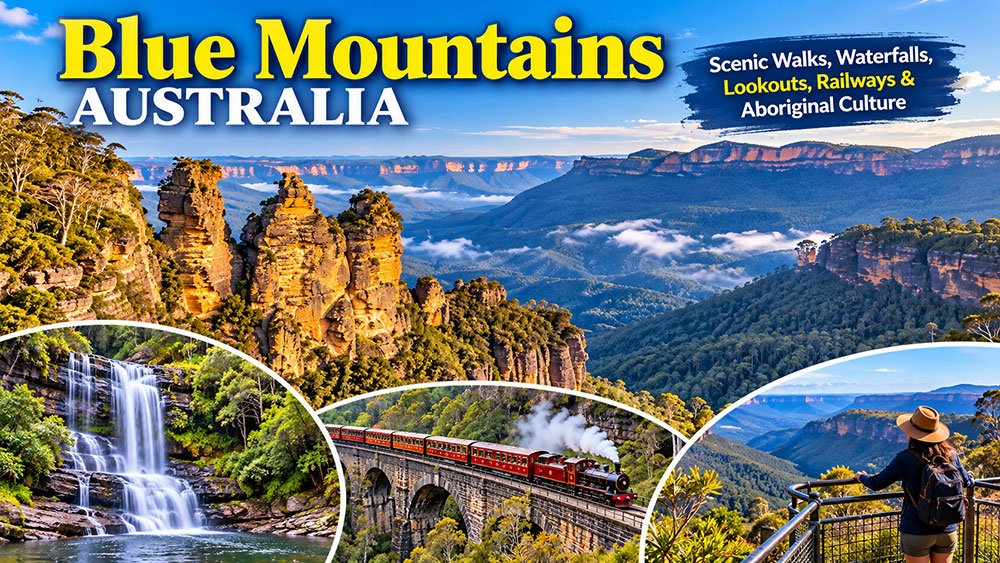
How to Explore the Blue Mountains in Australia
Just west of Sydney, the Blue Mountains offer one of Australia’s most accessible combinations of dramatic scenery, Aboriginal heritage, bushwalking, waterfalls and mountain villages. The Greater Blue Mountains Area covers about 1.03 million hectares across eight protected areas and forms part of Australia’s UNESCO World Heritage estate. Its sandstone plateaus, cliffs, gorges and extensive eucalypt forests create the landscape that makes the region so distinctive.
A visit can be as simple as taking a train from Sydney to a mountain town and walking to a lookout, or as ambitious as spending several days on multi-day walking routes. You can also explore Aboriginal culture with a local guide, visit waterfalls, enjoy scenic drives or take a heritage train through the mountains.
This updated guide explains how to discover the Blue Mountains in Australia, while taking account of current attractions, walking opportunities, transport and access information.
Why Visit the Blue Mountains?
The Blue Mountains are much more than a collection of scenic lookouts.
The region combines spectacular sandstone landscapes with important Aboriginal cultural heritage and an exceptional diversity of eucalypt ecosystems. UNESCO identifies the Greater Blue Mountains Area as an important example of eucalypt evolution and biodiversity, with rare and threatened species also present.
For visitors, that means you can combine nature, walking, wildlife, culture and history in the same trip.
Popular experiences include the Three Sisters at Echo Point, Wentworth Falls, the Grand Cliff Top Walk, Grand Canyon walking routes, Aboriginal cultural experiences and heritage rail travel.
-
Discover Aboriginal Culture With a Local Guide
One of the best ways to understand the Blue Mountains is to learn about its Aboriginal heritage.
The Greater Blue Mountains World Heritage Area includes the traditional homelands of Darug, Gundungurra, Wiradjuri, Wanaruah, Darkinjung and Tharawal peoples. Current Destination NSW information highlights the region’s living Indigenous culture and cultural sites.
Rather than simply viewing a landscape, a guided Aboriginal experience can explain its cultural meaning, traditional knowledge and connection to Country.
NSW National Parks currently lists Aboriginal-led experiences in the Blue Mountains, including tours around the Katoomba area that combine cultural interpretation with the natural environment. One current experience includes a traditional smoking ceremony at Katoomba Falls and interpretation of Aboriginal culture and Country.
Why choose an Aboriginal-led experience?
A knowledgeable local guide can help you understand:
- The cultural significance of particular landforms
- Traditional connections to waterways and plants
- Local stories and knowledge
- Aboriginal relationships with Country
- The continuing importance of the landscape today
Guided experiences can add context that you may miss when visiting a lookout independently.
-
Walk the Blue Mountains
Bushwalking remains one of the best ways to experience the region.
The Blue Mountains National Park contains walking routes ranging from short, accessible outings to challenging multi-day adventures. Current NSW National Parks information recommends checking weather and local alerts before setting out because sections of the park can close because of fire danger, storms, rockfalls, landslides, maintenance and other hazards.
Wentworth Falls Track
The Wentworth Falls Track is a relatively short option for visitors who want a taste of Blue Mountains walking.
NSW National Parks currently lists the main track at 1.4 kilometres return, with an estimated walking time of 45 minutes to one hour. It is a Grade 3 track with short steep sections and many steps.
The route provides views toward Wentworth Falls and the Jamison Valley.
Visitors should stay on the marked track because hidden cliff edges occur in the area.
Wentworth Falls to Leura Walk
More experienced walkers can choose the Wentworth Falls to Leura Walk, which covers approximately 11 kilometres one way and generally takes five to seven hours. NSW National Parks recommends some bushwalking experience for this Grade 3 route.
This is a better choice for travelers who want to spend several hours exploring the landscape rather than making a short lookout visit.
Grand Cliff Top Walk
One of the newer major walking experiences is the Grand Cliff Top Walk.
The route covers approximately 19 kilometres over two days, linking Wentworth Falls and Katoomba through lookouts, waterfalls, bushland and sites of Indigenous heritage. Visitors stay overnight in or around Leura as part of the typical walking experience.
The route provides an excellent way to experience several Blue Mountains highlights in a single journey.
-
See the Three Sisters and Jamison Valley
No first-time visit to the Blue Mountains is complete without seeing the Three Sisters.
Echo Point Lookout at Katoomba provides one of the region’s most famous views. Destination NSW describes the lookout as facing the Three Sisters, with the Jamison Valley and Mount Solitary extending beyond the rock formation.
The Three Sisters also have important cultural significance in local Aboriginal traditions.
A visit to Echo Point works well as a short stop, but it can also serve as a starting point for nearby walking routes.
-
Explore Waterfalls and Rainforest
Waterfalls are among the most recognizable features of the Blue Mountains.
Wentworth Falls is one of the best-known examples. Destination NSW describes the falls as dropping around 100 metres into the Jamison Valley.
The region also contains rainforest gullies, creeks and fern-filled valleys that contrast with the drier eucalypt forests on the plateau.
The Valley of the Waters near Wentworth Falls is one such environment, with walking routes passing waterfalls and descending into a steep canyon landscape.
These areas can look very different after rain, but wet conditions can also make tracks slippery and create additional hazards.
-
Explore the Blue Mountains on a Longer Walk
A longer walk gives you a better sense of the scale of the landscape.
The region offers multi-day routes as well as day hikes, with some trails involving steep descents and climbs through valleys and rainforest.
For example, the Grand Cliff Top Walk links several well-known Blue Mountains attractions over two days. Other routes, such as the Wentworth Pass loop, require considerably more experience.
NSW National Parks currently rates the Wentworth Pass loop as Grade 4, covering five kilometres in around four to five hours. The track includes very steep sections and a rough surface with many obstacles.
Do not choose a route based solely on distance. A short mountain walk can still be physically demanding because of stairs, steep gradients and uneven ground.
-
Enjoy a Scenic Drive
Not every traveler wants to spend an entire day walking.
A road trip provides another way to experience the region. Destination NSW promotes the Greater Blue Mountains Drive, a network of linked scenic drives connecting the World Heritage Area with surrounding towns, attractions, wineries and country markets.
Driving gives you the flexibility to stop at lookouts, villages and attractions along the way.
Popular mountain communities and surrounding areas also provide cafés, restaurants, accommodation and opportunities to explore regional New South Wales.
Allow extra time for the road
A scenic drive works best when you avoid rushing from one attraction to another.
Allow time for viewpoints, meals, short walks and unexpected stops.
Check road conditions before setting out, particularly during severe weather or periods of bushfire risk.
-
Ride the Historic Zig Zag Railway
The Zig Zag Railway provides a completely different way to experience the Blue Mountains.
Located at Clarence near Lithgow, the heritage railway follows part of the historic Great Zig Zag through sandstone cuttings, tunnels, bushland and mountain scenery. Current NSW tourism information says the railway operates daily, with four departures a day and journey options including a 90-minute Signature Journey and a shorter 45-minute Discovery Journey.
The railway has also continued to expand its visitor services.
Its current official website reports four daily rides, seven days a week, and announced in September 2026 that a free NSW TrainLink coach shuttle now stops at the railway.
Check the railway’s official timetable before traveling because maintenance can temporarily affect services. Its September 2026 updates, for example, included a planned track-maintenance period.
-
Visit Jenolan Caves — Check Before You Go
The original article recommended Jenolan Caves as a major Blue Mountains attraction. The caves remain an important part of the wider region, but their current access status has changed.
As of July 2026, the official Jenolan Caves website says the site is closed for major road repairs, with reopening planned for early 2027. The project includes work on the road, cave infrastructure, historic Caves House and a new Blue Lake Boardwalk.
Therefore, Jenolan Caves should not currently appear in a travel itinerary as an attraction that visitors can simply enter.
An important correction to the original article
The old article described Jenolan Caves as the “world’s largest cave system.” That wording is not appropriate for an evergreen travel guide.
Jenolan is a famous limestone cave system with considerable geological and historical significance, but claims about being the world’s largest cave system can be misleading because cave systems can be measured in different ways.
For current travel planning, the most important point is the official access notice: check Jenolan Caves’ official website before making plans.
-
Enjoy the Blue Mountains’ Lookouts
Lookouts are an easy way to appreciate the scale of the landscape without committing to a long hike.
In addition to Echo Point, the region offers viewpoints overlooking deep valleys, sandstone cliffs and waterfalls.
Destination NSW’s current Blue Mountains guide highlights several scenic lookouts, including Echo Point and Wentworth Falls Lookout.
For visitors with limited time, combining two or three major lookouts with a short walk can provide an excellent introduction to the region.
-
Discover Wildlife and Eucalypt Forests
The Blue Mountains are part of a globally significant eucalypt landscape.
UNESCO identifies the Greater Blue Mountains Area as an outstanding example of eucalypt evolution and ecological diversity. The area contains 91 eucalypt taxa, along with rare and threatened species including the Wollemi pine.
Birdwatchers and wildlife enthusiasts may encounter native species while walking through forests and valleys.
However, wildlife sightings are never guaranteed. Treat animals as wild creatures, observe them from a safe distance and avoid feeding them.
-
Spend Time in Mountain Villages
The Blue Mountains experience is not limited to national parks.
Towns such as Katoomba, Leura, Wentworth Falls, Blackheath and Lithgow provide accommodation, restaurants, cafés, galleries and other visitor services.
Staying overnight can make a significant difference to your experience. Instead of rushing through a day trip from Sydney, you can enjoy early-morning views, explore local businesses and undertake longer walks.
Leura is particularly useful for walkers completing the Grand Cliff Top Walk because the two-day route includes an overnight stay in the village.
-
How to Reach the Blue Mountains From Sydney
You do not necessarily need a car to visit.
Destination NSW states that trains on the Blue Mountains Line depart regularly from Sydney-area stations including Central, Strathfield, Parramatta, Blacktown, Penrith and Emu Plains.
For many visitors, traveling by train to towns such as Katoomba or Wentworth Falls provides a straightforward alternative to driving.
A car becomes more useful when you want to explore a wider area or combine the Blue Mountains with surrounding regional attractions.
-
Plan Your Trip Around Current Conditions
One of the most important changes since the original article was published is the amount of current closure and safety information available online.
Blue Mountains National Park currently has active alerts covering issues such as fire bans, closed tracks and infrastructure work. As of September 2026, NSW National Parks lists several temporary restrictions, including repairs affecting the Fern Bower area and closures associated with rockfall, road subsidence and other infrastructure problems.
This does not mean you should avoid the Blue Mountains. It means that you should check the status of your chosen track shortly before departure.
Current example: Wentworth Falls
The main Wentworth Falls Track remains listed by NSW National Parks, but current local alerts apply.
Current example: Jenolan Caves
Jenolan Caves remains closed for major road repairs, with an official reopening target in early 2027.
Current example: Zig Zag Railway
Zig Zag Railway currently operates regular services, but its official website continues to publish maintenance notices and service updates.
This is why an evergreen Blue Mountains article should direct travelers toward current official alerts rather than promise that every attraction will always remain accessible.
-
What to Pack for the Blue Mountains
Your packing list depends on the activities you choose.
For a short sightseeing trip, comfortable shoes, sun protection, water and weather-appropriate clothing may be enough.
For bushwalking, carry:
- Drinking water
- Sturdy walking shoes
- Hat and sunscreen
- Weatherproof clothing
- A fully charged phone
- Navigation information
- First-aid supplies
- Food for longer walks
- A torch for trips that may extend beyond daylight
NSW National Parks specifically recommends checking the weather and preparing properly before long walks. Its bushwalking guidance also encourages visitors to tell others about their plans.

-
Blue Mountains Safety Tips
Mountain scenery can look deceptively easy from a viewpoint. Some tracks involve steep stairs, cliff edges, rough surfaces and rapid changes in weather.
Before starting a walk:
Check alerts
Review NSW National Parks alerts for your chosen area.
Check the weather
Rain, strong winds, heat and fire conditions can change the safety of a route.
Stay on the track
Do not cross barriers or enter closed areas.
Carry enough water
Short walks can still become strenuous when temperatures rise or terrain becomes steep.
Avoid risky photography
Cliffs and loose edges are not safe locations for selfies or photographs.
Tell someone your plans
For longer walks, share your itinerary and expected return time.
The current NSW National Parks information for the Blue Mountains specifically warns that parts of the park may close because of poor weather or fire danger.
-
Choose Experiences That Match Your Time
You can experience the Blue Mountains in a single day, but additional time allows you to explore beyond the major viewpoints.
One-day visit
A practical first visit could combine:
Sydney → Katoomba → Echo Point → Three Sisters → short bushwalk → Wentworth Falls → Sydney
Weekend visit
A longer stay allows time for:
- Aboriginal cultural experiences
- Longer bushwalks
- Leura
- Wentworth Falls
- Scenic lookouts
- Heritage railway experiences
- Local restaurants and cafés
Multi-day adventure
Experienced walkers can build a longer itinerary around multi-day trails such as the Grand Cliff Top Walk and other established routes.
Choose your itinerary based on your fitness, transport and experience rather than trying to see everything.
-
Respect Aboriginal Culture and the Environment
The Blue Mountains are both an environmental and cultural landscape.
The World Heritage area contains important ecosystems, while Aboriginal communities maintain continuing cultural connections with Country.
Visitors can help protect the region by:
- Taking rubbish with them
- Staying on marked trails
- Following fire restrictions
- Respecting cultural sites
- Avoiding damage to plants and rock formations
- Keeping wildlife wild
- Following instructions from park staff and guides
Responsible tourism helps preserve the region for future visitors and local communities.
Best Time to Visit the Blue Mountains
The Blue Mountains offer experiences throughout the year, but conditions vary by season.
Summer
Summer can provide long daylight hours for sightseeing and walking, but visitors should pay close attention to heat, fire danger and weather alerts.
Autumn
Cooler weather and changing foliage can make autumn a pleasant period for walking and sightseeing.
Winter
Winter brings colder mountain conditions and occasional frost or snow in higher areas. Pack warm layers.
Spring
Spring can be a particularly attractive time for walking, with pleasant conditions and flowering plants in some areas.
There is no single “best” season for every traveler. Choose according to the activities you want to undertake and check current conditions before departure.
A Better Way to Discover the Blue Mountains
The original 2013 article focused on escaping Sydney and exploring the mountains by foot or car. Today’s visitor has more options.
You can take public transport from Sydney, join an Aboriginal cultural experience, complete a multi-day walk, explore scenic roads, visit mountain villages or ride a restored heritage railway.
The key is to slow down.
Instead of rushing from one lookout to another, spend time understanding the landscape, learning about its traditional custodians and choosing activities that suit your interests.
Final Thoughts
The Blue Mountains in Australia remain one of the most rewarding destinations for travelers visiting Sydney.
The region combines immense sandstone valleys, waterfalls, eucalypt forests, Aboriginal heritage, mountain villages and an extensive network of walking tracks. UNESCO recognition reflects the area’s global natural significance, while Aboriginal-led experiences offer valuable insight into its continuing cultural importance.
The region has also evolved considerably since this article was first published in 2013. The Grand Cliff Top Walk now provides a major two-day walking experience, the Zig Zag Railway offers regular heritage train journeys, and official digital alert systems make it easier to check track closures and fire conditions before setting out.
At the same time, attractions can change. Jenolan Caves is currently closed for major road repairs, with reopening planned for early 2027, while sections of Blue Mountains National Park may close temporarily for safety, maintenance or environmental reasons.
So, plan ahead, check official information and leave enough time to enjoy the mountains rather than simply passing through them.
The Blue Mountains are close to Sydney, but they feel like a completely different world.
