
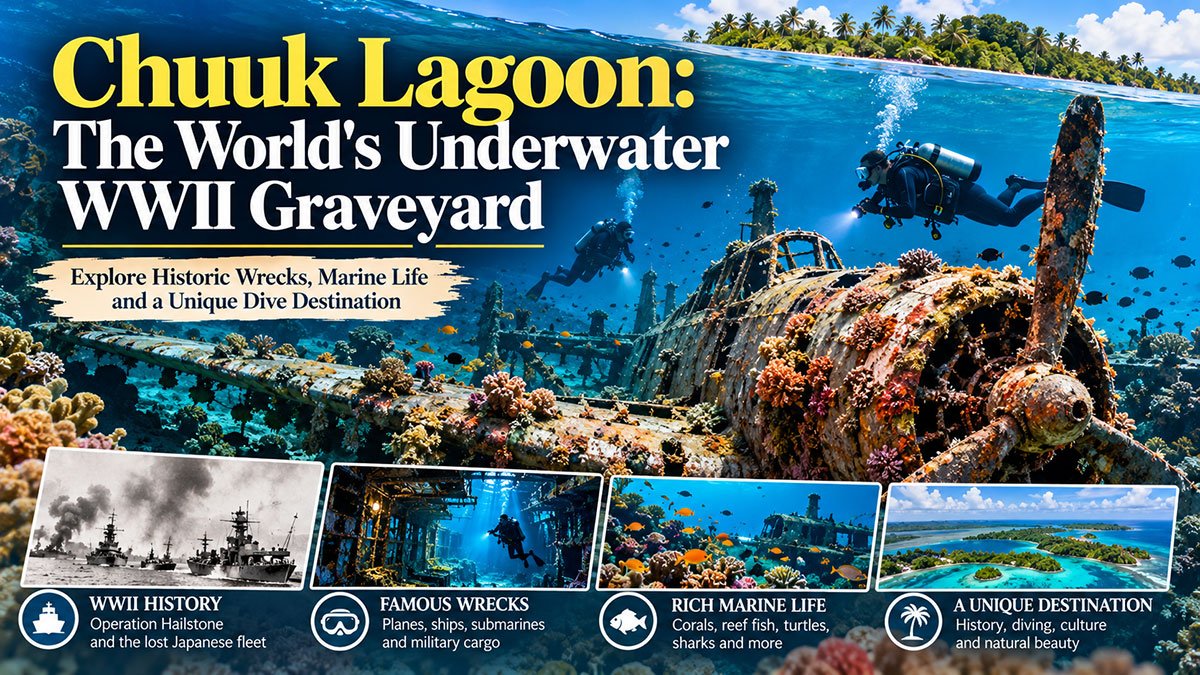
1Chuuk Lagoon: The World’s Underwater WWII Graveyard
Deep in the western Pacific lies Chuuk Lagoon, one of the world’s most famous wreck-diving destinations. The lagoon belongs to Chuuk State in the Federated States of Micronesia. It is also widely known by its former name, Truk Lagoon. (visitchuuk.com)
For divers, Chuuk offers something almost unique. More than 60 Japanese World War II shipwrecks and aircraft are associated with the lagoon’s famous underwater battlefield. Coral, sponges, and tropical fish now cover many of the wrecks. (visitchuuk.com)
The site is more than a spectacular diving destination. It is also an important historical landscape and a place of remembrance. Many wrecks contain wartime remains and unexploded ordnance, so exploration requires respect, training, and careful planning. Chuuk State law protects the wrecks and requires permits and certified guides for people accessing them for examination. (fsmlaw.org)
Where Is Chuuk Lagoon?
Chuuk Lagoon sits in the Caroline Islands of the central Pacific Ocean. It forms part of Chuuk State, one of the four states that make up the Federated States of Micronesia.
The main population center is Weno Island, which also serves as the capital of Chuuk State. The lagoon itself is a large, sheltered body of water surrounded by a protective reef and dotted with islands. (visitchuuk.com)
The name can cause some confusion.
“Truk Lagoon” is still common among divers, historical researchers, and travel publications. Chuuk Lagoon is the current name, while Truk is the former name. Chuuk State legislation formally replaced governmental references to “Truk” with “Chuuk.” (fsmlaw.org)
Why Was Chuuk Important During World War II?
During World War II, the Japanese developed Chuuk Lagoon into a major naval and logistics base.
Its sheltered waters provided a strategic anchorage for Japanese ships operating across the Pacific. The islands also contained airfields, fuel facilities, repair infrastructure, military positions, and supply installations.
Because the lagoon was heavily protected by its reef and surrounding islands, the Japanese considered it a powerful defensive position.
The base developed a reputation as the “Gibraltar of the Pacific.” The U.S. Naval History and Heritage Command notes that the description was somewhat exaggerated, but the base was nevertheless a significant Japanese stronghold. (history.navy.mil)
Operation Hailstone: The Attack That Changed Chuuk
The defining event in Chuuk Lagoon’s history occurred on 17 and 18 February 1944.
The U.S. Navy launched Operation Hailstone, a major carrier raid against the Japanese base at Truk. The operation took place in conjunction with the U.S. campaign in the Marshall Islands. (history.navy.mil)
The scale of the attack was enormous.
The U.S. Navy states that more than 1,200 strike sorties were flown during the operation. Between 250 and 275 Japanese aircraft were shot down or destroyed on the ground, while more than 4,500 Japanese personnel were killed. Japanese ship losses included cruisers, destroyers, auxiliary vessels, transports, and freighters. (history.navy.mil)
The attack severely damaged the Japanese position.
Many vessels were sunk inside the lagoon. Others were attacked while attempting to escape. The result transformed Chuuk into one of the Pacific War’s most significant concentrations of military wreckage. (history.navy.mil)
Chuuk Lagoon Became an Underwater Museum
Over the decades, the wrecks became covered with marine growth.
Today, divers can see ship hulls, propellers, guns, cargo, aircraft parts, machinery, bottles, and other wartime objects. Some wrecks remain remarkably recognizable despite more than eight decades underwater. (visitchuuk.com)
That is why divers often describe Chuuk as an underwater museum.
The phrase is useful, but it should not suggest that the wrecks are ordinary museum exhibits. They remain actual wartime sites on the seabed.
Some contain human remains. Others contain fuel, ammunition, shells, and other hazardous materials.
The emotional impact can therefore be much stronger than that of a conventional museum visit.
Famous Chuuk Lagoon Wrecks
There are many wrecks to explore, and each offers a different experience.
Fujikawa Maru
The Fujikawa Maru is among Chuuk’s best-known wrecks.
The vessel carried aircraft and other military cargo. Marine life has now transformed much of the ship into a spectacular artificial reef.
Divers can explore the superstructure and selected sections of the wreck, depending on certification, conditions, and local guidance.
Shinkoku Maru
The Shinkoku Maru is another popular dive site.
The tanker is famous for its marine growth and relatively accessible sections. Divers can see coral, sponges, and tropical fish among the remains of the ship.
Heian Maru
The Heian Maru was a submarine tender and is one of the lagoon’s largest and most impressive wrecks.
Its enormous size makes it particularly memorable. Divers can see sections of its superstructure and distinctive wartime equipment while exploring the site under appropriate supervision. (visitchuuk.com)
San Francisco Maru
The San Francisco Maru is famous among experienced wreck divers.
It lies at greater depth than many of the lagoon’s more accessible sites. Tanks, mines, trucks, and other wartime cargo remain associated with the wreck.
Its depth and cargo make it a serious technical-diving environment. Suitable training and equipment are essential.
Diving in Chuuk Lagoon
Chuuk Lagoon diving attracts recreational divers, experienced wreck divers, photographers, and technical divers from around the world.
Several wrecks have sections that can be explored by recreational divers. Deeper sites require more advanced training, specialized equipment, and careful gas planning.
The local tourism authority currently describes Chuuk’s wreck diving as suitable for both recreational and technical divers. (visitchuuk.com)
That does not mean every wreck is suitable for every diver.
A diver’s certification, experience, depth limits, buoyancy control, and ability to handle overhead environments all matter.
Why Wreck Penetration Requires Extra Training
Some Chuuk wrecks contain enclosed spaces such as engine rooms, holds, passageways, and other interior areas.
Entering these spaces creates additional risks.
There can be limited visibility, entanglement hazards, unstable structures, sharp metal, silt, and restricted exits. A diver without appropriate wreck or technical training should not enter an overhead environment simply because another diver does.
Stay within your training and the limits set by your guide.
Experienced operators can recommend wrecks that match your certification and experience.
Marine Life Around the Wrecks
The history is only one part of the Chuuk experience.
The wrecks have become artificial reefs supporting a wide variety of marine life. Divers can encounter reef fish, groupers, sharks, rays, turtles, colorful corals, sponges, and smaller marine species. (visitchuuk.com)
This creates an unusual combination.
You can photograph a wartime ship’s bridge while reef fish move through the structure. A corroded propeller may be surrounded by coral. Old steel surfaces can provide habitat for organisms that have colonized the wreck over many decades.
The result is a living ecosystem built around historical remains.
Chuuk Lagoon Is a Place of Remembrance
The term “ship graveyard” is appropriate, but it can also obscure the human stories behind the wrecks.
Many people died during the 1944 attacks.
Some wrecks are therefore considered war graves. Human remains may still exist within or around the vessels.
Divers should never treat bones, personal objects, ammunition, or other wartime material as souvenirs.
The experience is best approached as historical and memorial tourism rather than treasure hunting.
The Wrecks Are Legally Protected
One of the most important facts for modern visitors is the legal protection surrounding the wrecks.
Chuuk State’s law establishes protections for the sunken ships, vessels, and aircraft. The law also requires people accessing them for examination to obtain a permit and use a certified diving guide through a duly licensed diving shop. (fsmlaw.org)
This makes the original advice about respecting the wrecks even more important today.
- Do not remove artifacts.
- Do not relocate objects.
- Do not collect souvenirs.
- Do not disturb human remains.
Even seemingly insignificant objects can be historically important.
Unexploded Ordnance Remains a Serious Concern
The wrecks are not simply old metal structures.
Some sites still contain ammunition, mines, shells, torpedoes, and other military ordnance. The Australian government’s current travel guidance warns that remnants of war remain in Micronesia and states that it is dangerous and illegal to remove objects from sunken World War II wrecks. (smartraveller.gov.au)
Divers should therefore never touch suspicious objects.
- Do not attempt to move ammunition.
- Do not handle weapons.
- Do not enter a compartment simply to investigate an unknown object.
A qualified local guide can identify hazards and help determine which areas are appropriate to visit.
A Major Environmental Concern: Oil From the Wrecks
There is another issue that has become increasingly important since the original article was written.
Some Chuuk Lagoon wrecks still contain oil.
As steel hulls corrode, the potential for leaks increases. Modern research identifies potentially polluting World War II wrecks as a significant environmental concern across the Pacific, with Chuuk Lagoon among the sites requiring attention. (pubmed.ncbi.nlm.nih.gov)
This is no longer just a theoretical concern.
In September 2025, Chuuk authorities declared an emergency following an oil leak from a sunken World War II vessel. The incident affected the lagoon and prompted response efforts. The FSM’s environmental data portal records the emergency declaration and subsequent situation reports. (fsm-data.sprep.org)
Japan has also continued working with Chuuk authorities to remove oil from deteriorating wrecks.
In March 2026, Japan’s Embassy in the Federated States of Micronesia announced continued support for the Oil Leak Countermeasures Project for Sunken Warships in Chuuk State. The project aims to assess deteriorating vessels, safely recover oil, and reduce environmental risks. (micronesia.emb-japan.go.jp)
Japan also provided a 2026 grant to Chuuk’s Environmental Protection Agency for oil-response equipment and storage facilities. (micronesia.emb-japan.go.jp)
This conservation work is essential for protecting the lagoon’s marine environment and the communities that depend on it.
Is Chuuk Lagoon Safe to Visit?
Chuuk is an established international dive destination, but visitors should understand its limitations.
The U.S. Department of State currently rates the Federated States of Micronesia at Level 1: Exercise Normal Precautions. However, its guidance specifically advises travelers to be more vigilant in Chuuk because crime rates are higher there than in some other parts of the country. (travel.state.gov)
Diving safety also deserves careful consideration.
Australia’s Smartraveller guidance notes that medical facilities in FSM are limited and that serious injuries may require medical evacuation. It also warns that diving operators may not always maintain equipment or follow appropriate safety standards. (smartraveller.gov.au)
Divers should therefore choose reputable operators and confirm that their insurance covers:
- Planned diving depths
- Decompression treatment
- Hyperbaric chamber treatment
- Medical evacuation
- Wreck or technical diving, if applicable
These checks are particularly important for remote destinations.
How to Reach Chuuk Lagoon
Most international visitors reach Chuuk through Weno’s Chuuk International Airport.
Current visitor information lists regional connections through Guam, Hawaii, and other Micronesian states. Flight schedules are limited, so advance planning is important. (visitchuuk.com)
Visitors should verify current airline schedules before making non-refundable hotel or dive bookings.
The remote location is part of Chuuk’s appeal, but it also affects logistics.
There are fewer flights, fewer medical resources, and fewer options for replacing lost or specialized diving equipment.
Good preparation can therefore make a major difference.
When Is the Best Time for Chuuk Lagoon Diving?
Chuuk offers warm tropical conditions throughout much of the year.
The official Chuuk tourism website promotes diving, snorkeling, island tours, and cultural experiences throughout the destination. (visitchuuk.com)
For divers, however, weather and sea conditions still matter.
Check the forecast and local conditions before every dive. Your dive operator will have the best information about visibility, currents, boat conditions, and which wrecks are suitable on a particular day.
Do not assume that a previously successful dive remains safe under different conditions.
Respect Chuukese Culture and Communities
Chuuk is not simply a collection of dive sites.
People live around the lagoon, and the islands have their own history, traditions, languages, and cultural practices.
Visitors should ask permission before photographing people or entering private property. Respect local customs and follow guidance from local operators.
The U.S. State Department specifically advises visitors not to enter private property without permission and to take additional precautions in Chuuk. (travel.state.gov)
Responsible tourism helps protect both the local community and the destination.
Tips for a Responsible Chuuk Lagoon Dive
A few simple habits can protect the wrecks for future generations.
Do not touch coral unless necessary for safety. Avoid kicking up sediment inside wrecks. Maintain good buoyancy around fragile structures.
Never remove artifacts.
Never disturb ammunition or unexploded ordnance.
Do not enter areas beyond your training.
Follow the instructions of your local guide.
Most importantly, remember that these are historical sites and, in some cases, graves.
Is Chuuk Lagoon Worth Visiting?
For experienced divers and World War II history enthusiasts, Chuuk Lagoon offers an experience that few destinations can match.
The sheer concentration of wrecks creates an extraordinary underwater archive. Ships that once carried fuel, aircraft, weapons, vehicles, and supplies now lie among coral reefs and tropical marine life.
Yet the destination is much more than a collection of dive photographs.
The wrecks tell the story of a major Pacific War campaign. They preserve evidence of military technology and daily life aboard wartime vessels. They also remind visitors of the human cost of conflict.
The environmental challenges now facing some of these wrecks add another layer to their story.
Final Thoughts on Chuuk Lagoon
Chuuk Lagoon, formerly known as Truk Lagoon, remains one of the world’s most remarkable wreck-diving destinations.
Operation Hailstone in February 1944 transformed the Japanese naval base into a vast underwater historical landscape. Today, more than 60 Japanese World War II shipwrecks and aircraft form the foundation of Chuuk’s international diving reputation. (visitchuuk.com)
The destination has also changed since this article was first published in 2013.
Modern visitors must consider legal protection, responsible diving, unexploded ordnance, limited medical resources, and environmental risks from oil inside deteriorating wrecks. Chuuk authorities and international partners are actively working to address those environmental threats. (micronesia.emb-japan.go.jp)
For divers, the opportunity remains extraordinary.
You can explore the Fujikawa Maru, Shinkoku Maru, Heian Maru, San Francisco Maru, and many other historic sites while surrounded by tropical marine life. (visitchuuk.com)
Approach the lagoon with respect, proper training, and a qualified local guide. That is the best way to experience Chuuk’s remarkable underwater history while helping preserve it for future generations.
