
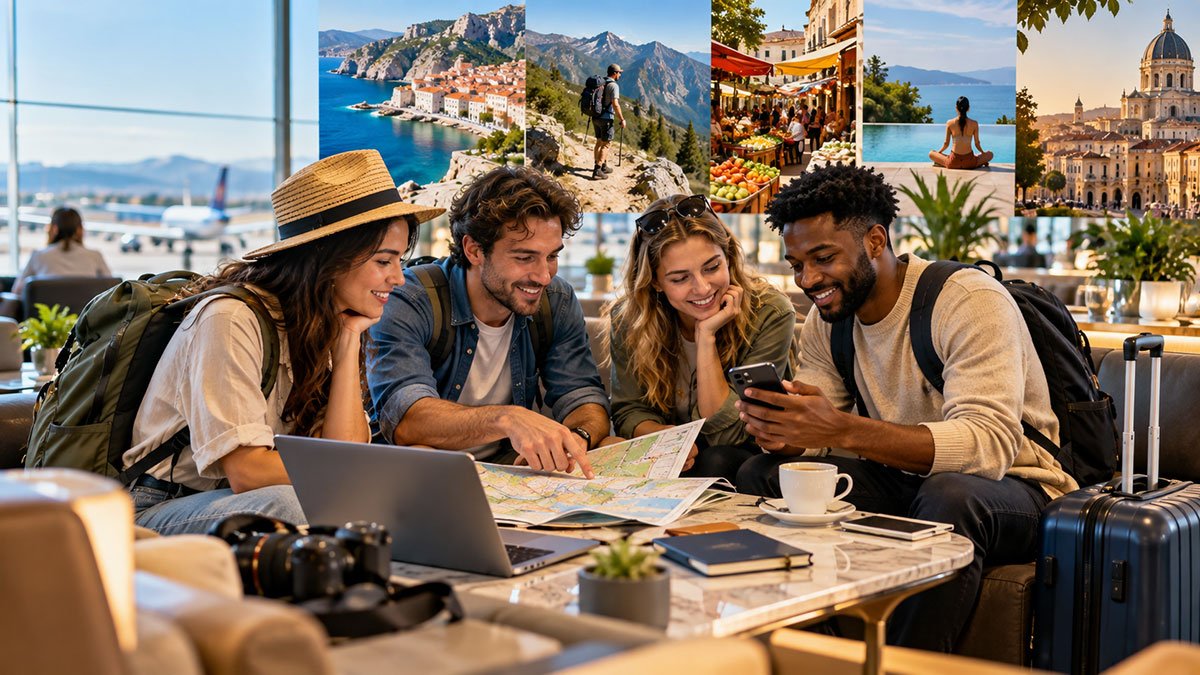
Modern travelers are combining technology, flexibility and personal interests to create more individual travel experiences.
Latest Travel Trends: What Is Shaping Travel Today
Travel continues to evolve as travelers respond to changing prices, technology, climate conditions, global events and new ways of discovering the world.
The latest travel trends are not simply about where people go. They also reveal how people choose destinations, how they plan trips and what they expect from the experience.
Current tourism data shows that travel demand remains resilient, although travelers are becoming more selective about where and how they spend. The sector is still expanding globally, while safety, value, flexibility and connectivity are becoming increasingly important parts of the decision-making process.
At the same time, traditional sightseeing is no longer the only reason people travel. Food, wellness, nature, sports, entertainment, books, films, hobbies and personal interests are increasingly shaping itineraries.
Technology is changing the process too. Travelers can now use smartphones, AI tools, digital wallets and real-time search to plan much of a journey before they even leave home.
Here are the major tren
ds shaping travel today.
1. Travelers Are Still Traveling, But Value Matters More
The idea that economic uncertainty automatically stops people from travelling does not reflect the current picture.
Travel demand remains strong, but many people are becoming more careful about how they spend their holiday budget.
Recent European Travel Commission research shows that travelers are placing greater importance on affordability and safety, while shorter trips and more moderate budgets are becoming more common.
That does not necessarily mean travelers are giving up on holidays.
Instead, they may change the way they travel.
A traveler might:
- Choose a shorter holiday.
- Compare more accommodation options.
- Travel during a shoulder season.
- Select a nearby destination.
- Combine free activities with paid experiences.
- Spend more selectively on food or experiences.
This means the modern traveler is often looking for better value rather than simply the lowest price.
2. Shorter and More Flexible Trips Are Becoming More Important
Long, complicated holidays are not disappearing, but flexibility is becoming more valuable.
Travelers increasingly want itineraries that can adapt to changing schedules, budgets and circumstances.
A shorter trip can also make it easier to take several holidays during the year rather than one large annual trip.
This is particularly visible in Europe, where current travel research points to strong interest in intra-European trips and a greater willingness to take shorter breaks.
Flexibility can mean choosing:
- Flexible travel dates
- Refundable accommodation
- Destinations with several transport options
- Shorter itineraries
- Fewer hotel changes
- Activities that can be booked closer to departure
For travelers, flexibility is becoming a practical part of trip planning rather than a luxury.
3. Travelers Are Looking Beyond the Traditional Tourist Hotspots
The world’s famous cities and landmarks remain popular.
However, travelers are also becoming more interested in alternative destinations, smaller towns and places that offer a different experience.
This shift can have several motivations.
Travelers may want:
- Better value
- Fewer crowds
- More authentic experiences
- Easier access to nature
- A slower pace
- A stronger connection with local communities
Current European travel research shows growing interest in destinations beyond the traditional major hotspots, including parts of Central and Eastern Europe.
For travelers, this creates an opportunity to explore places that may offer a more relaxed experience.
For destinations, it also creates the challenge of managing growth responsibly.
4. Experience-Led Travel Is Replacing One-Size-Fits-All Holidays
The old model of choosing a destination first and deciding what to do later is changing.
Many people now start with an interest.
They might want to:
- Learn to cook local food
- Attend a major sporting event
- Follow a favourite television series
- Explore a literary destination
- Go hiking
- Take a wellness retreat
- Visit vineyards
- Learn a craft
- Photograph wildlife
- Attend a music festival
The destination becomes part of the experience rather than the entire reason for the trip.
Current travel research from Booking.com and Expedia reflects this move toward more personal and interest-driven travel.
The result is a more diverse tourism market, where specialist experiences can attract travelers who might not otherwise consider a particular destination.
5. Passion-Led and Niche Travel Is Growing
Special-interest travel is becoming one of the most interesting parts of the tourism market.
Travelers are increasingly building holidays around personal passions.
This can include:
Food Travel
People travel specifically to experience local cuisine, markets, restaurants, cooking classes and regional food traditions.
Wellness Travel
Yoga, meditation, thermal experiences, fitness retreats and other wellness activities are becoming more important parts of travel planning.
Nature Travel
National parks, wildlife destinations, mountains, forests and remote landscapes remain powerful attractions.
Literary Travel
Book-related travel and reading retreats are gaining attention, with travelers visiting places connected with authors, stories and literary themes.
Sports Travel
Major sporting competitions can influence where people travel and when they book.
Screen Tourism
Television series and films can turn filming locations into major travel attractions.
This trend is significant because it makes travel more personal.
People are not simply asking, “Where should I go?”
They are increasingly asking, “What do I want to experience?”
6. AI Is Becoming Part of Travel Planning
One of the biggest changes in travel planning is the growing use of artificial intelligence.
Travelers can increasingly use AI tools to:
- Generate itinerary ideas
- Compare destinations
- Find activities
- Build day-by-day plans
- Organize travel information
- Suggest restaurants
- Compare hotels
- Identify flight options
- Create packing lists
- Reorganize an itinerary
Google has introduced increasingly sophisticated AI travel features that can combine information from flights, hotels, maps and other sources to help travelers build personalized itineraries.
In 2026, Google also expanded AI-powered travel functions such as flight-price tracking and hotel booking within AI-enabled search experiences in supported markets.
This means the role of search is changing.
Instead of entering many separate searches, travelers can increasingly describe the trip they want in natural language.
For example:
“Plan a five-day trip for two people with good food, easy hiking and a moderate budget.”
That kind of conversational planning is becoming more normal.
7. Mobile Travel Is Becoming the Default
Smartphones already influence almost every part of the travel experience.
Travelers use them for:
- Searching destinations
- Booking flights
- Booking hotels
- Digital payments
- Check-in
- Boarding passes
- Maps
- Translation
- Weather
- Transport
- Travel alerts
- Loyalty programmes
The International Air Transport Association’s latest passenger research found that mobile use is becoming increasingly central to air travel.
Its 2025 Global Passenger Survey found that 78% of passengers wanted a smartphone that could combine a digital wallet, digital passport and loyalty cards for travel-related tasks.
Digital wallets are also becoming more common, while biometric processing is expanding at airports.
Travelers should still keep important information available offline because connectivity is not guaranteed everywhere.
8. Digital Identity and Contactless Travel Are Expanding
The mobile revolution is moving beyond booking.
Airlines, airports and governments are testing ways to use digital identity and biometrics to reduce repeated document checks.
IATA’s 2026 work on contactless travel demonstrated that biometric-enabled international travel is technically possible across different carriers and digital identity systems.
This could eventually make airport journeys faster and more seamless.
However, the transition is still developing.
Privacy, regulation, interoperability and acceptance by individual governments remain important considerations.
Travelers should continue carrying the physical documents required for their journey unless an official authority specifically confirms that a digital credential is accepted.
9. Travelers Are Paying More Attention to Nature and Wellness
Travel is increasingly being used as a way to improve quality of life.
That includes conventional relaxation, but it also extends to experiences designed around health, nature and mental well-being.
Recent European Travel Commission research identifies increasing interest in nature, wellness and experience-led travel among long-haul visitors.
This can take many forms:
- Yoga retreats
- Walking holidays
- Forest stays
- National park trips
- Spa breaks
- Cycling holidays
- Meditation retreats
- Outdoor adventure
- Digital-detox trips
The appeal is partly about escape.
Travelers want to return home feeling that the trip added something to their lives rather than simply filling a few days on the calendar.
10. Sustainable Travel Is Becoming More Practical
Sustainability is no longer limited to a small group of eco-conscious travelers.
Destination management, community impact, biodiversity and resource use are increasingly part of the wider tourism conversation.
The shift is also moving beyond individual choices such as avoiding plastic bottles.
Travel companies and destinations are increasingly expected to consider:
- Water use
- Energy efficiency
- Waste
- Biodiversity
- Local employment
- Community involvement
- Infrastructure
- Visitor pressure
- Long-term destination planning
The World Travel & Tourism Council’s current destination-stewardship work emphasizes planning tourism growth alongside the needs of residents, businesses and visitors.
That matters to travelers because the quality of a destination can decline when visitor numbers grow faster than local infrastructure can handle.
Responsible tourism therefore becomes part of protecting the experience itself.
11. Shoulder-Season Travel Is Becoming More Attractive
Summer is still the traditional high season for many destinations.
But rising costs, crowds and climate concerns are encouraging travelers to consider different times of year.
Spring and autumn can offer:
- Lower or more moderate demand
- Cooler weather
- Smaller crowds
- Different cultural events
- Seasonal food
- Better opportunities for slower exploration
Travelers should not automatically assume that shoulder-season travel will always be cheaper.
Instead, compare prices and conditions for your exact destination and dates.
The bigger advantage may be a better overall experience.
12. Climate Is Influencing Destination Choices
Weather has always affected travel.
Its role is becoming more prominent as travelers pay greater attention to heat, storms, wildfires, flooding and other climate-related risks.
Recent European travel research identifies climate considerations as one of the factors shaping destination decisions.
This does not mean travelers are abandoning warm destinations.
It can mean changing when they visit them.
A traveler who once chose the hottest part of summer may now prefer:
- Spring
- Autumn
- Early summer
- Higher-altitude destinations
- Cooler coastal regions
- Northern destinations
Climate awareness is therefore becoming part of itinerary planning.
13. Events Are Driving Travel Decisions
Travel is increasingly built around something happening at a particular place and time.
Major sporting events are one example.
Music festivals, concerts, exhibitions, food festivals and cultural celebrations can have a similar effect.
This creates a different type of travel planning.
Instead of asking:
“Where should I go?”
the traveler asks:
“Where should I go for this event?”
Recent travel data has also shown strong interest in event-related travel around major sporting competitions.
For travelers, this can produce memorable experiences but also higher accommodation demand.
Book carefully when travelling around major events.
14. Movies and Television Are Influencing Where People Travel
Screen-inspired travel has become much more established.
Travelers increasingly visit locations they discovered through films, television series and streaming platforms.
Expedia’s 2026 research found particularly strong interest among younger travelers in screen-inspired travel.
The attraction is easy to understand.
A destination that exists in a fictional story suddenly feels familiar.
People want to walk through the same streets, visit the same landscapes or experience the atmosphere they saw on screen.
This trend can benefit lesser-known locations as well as established destinations.
15. Local Experiences Matter More Than Checklist Tourism
Travelers increasingly want to do more than photograph famous attractions.
They want to understand a destination.
That might mean:
- Eating where local residents eat
- Shopping at a neighbourhood market
- Taking a local cooking class
- Visiting smaller museums
- Learning about traditional crafts
- Exploring rural communities
- Using local transportation
- Joining a small-group activity
This does not mean tourists should avoid famous attractions.
It means a strong itinerary can combine major sights with experiences that provide greater local context.
16. Slow Travel Is Gaining Ground
Slow travel is not about travelling slowly for its own sake.
It is about reducing unnecessary movement and spending more meaningful time in fewer places.
Instead of visiting six cities in one week, a traveler may choose two.
That can mean:
- Fewer hotel changes
- More time in local neighbourhoods
- Longer stays
- Scenic rail journeys
- Walking and cycling
- Local food experiences
- More unplanned time
Current travel research increasingly points toward shorter, more flexible and experience-focused travel rather than rigid itineraries packed with activities.
Slow travel fits naturally into that shift.
17. Rail Travel Is Regaining Attention
Rail is also benefiting from changing traveler preferences.
Recent European travel research found growing interest in rail travel among long-haul visitors to Europe, including both rail passes and point-to-point train journeys.
Rail can offer several practical advantages:
- City-centre connections
- Scenic journeys
- Reduced airport transfers
- The ability to combine multiple destinations
- A slower travel experience
It is not always the fastest or cheapest option.
But for some itineraries, the journey itself becomes part of the holiday.
18. Travelers Are Combining More Than One Interest
Modern travel categories increasingly overlap.
A single trip might include:
- Food and culture
- Wellness and nature
- Adventure and relaxation
- Sport and nightlife
- History and gastronomy
- Beaches and hiking
This is one reason traditional travel categories are becoming less useful.
A traveler does not necessarily identify as a “beach tourist” or an “adventure tourist.”
The same person may want a beach in the morning, a food tour in the afternoon and a concert in the evening.
Flexible destinations can benefit from this behaviour because they appeal to several interests at once.
19. Travelers Are Using Search in New Ways
Travel discovery is becoming more visual, conversational and interactive.
Google reports that visual search has grown substantially, while AI tools are helping travelers ask more complex questions.
Instead of searching only for:
“Hotels in Paris”
a traveler may search for:
“Quiet boutique hotels in Paris near major museums with good public transport.”
This changes how travelers discover destinations and how travel publishers need to present information.
Clear, useful and specific content becomes more valuable.
Travelers want answers to practical questions, not simply inspirational descriptions.
20. Personalization Is Becoming the Standard
The idea of a single “perfect holiday” is fading.
Two travelers visiting the same destination may want completely different things.
One may prioritize:
- Luxury
- Fine dining
- Shopping
- Nightlife
Another may prefer:
- Hiking
- Local food
- Small villages
- Nature
Current travel predictions from Booking.com emphasize this growing desire for highly personalized experiences built around individual interests.
Travel businesses that understand these differences can create better experiences.
Travelers can benefit too by planning around their actual priorities rather than copying someone else’s itinerary.
What These Trends Mean for Travelers
The latest travel trends point toward one broad change.
Travel is becoming more personal.
Technology makes planning easier. AI makes search more conversational. Mobile tools simplify the journey. Travelers are more aware of value, safety and climate. At the same time, people are looking for experiences that match their interests rather than following standard tourist itineraries.
That changes how a good holiday should be planned.
Start with what you want from the trip.
Then choose the destination.
How to Use Current Travel Trends When Planning Your Trip
Start With Your Main Interest
Ask yourself what you actually want to experience.
It might be food, nature, wellness, adventure, culture or simply rest.
Compare the Full Cost
Do not look only at airfare.
Consider accommodation, transport, activities, meals and local costs.
Be Flexible With Dates
Changing your travel dates by even a small amount can sometimes change availability and pricing considerably.
Consider Shoulder Seasons
Look at spring and autumn as well as peak summer.
Research Alternative Destinations
A less-famous destination may offer better value and a more relaxed experience.
Use AI as a Planning Tool
AI can help organize information, but verify important details through official sources before booking.
Keep Human Judgment in the Process
An AI itinerary may look perfect on a screen.
That does not mean it is practical.
Check travel times, opening hours, distances, local transport and realistic energy levels.
Support Local Businesses
Choose local guides, restaurants, independent businesses and community-based experiences where practical.
Leave Room for Discovery
A completely scheduled holiday leaves little room for spontaneous experiences.
What Travel Companies Need to Understand
These trends matter to more than travelers.
Hotels, tour operators, restaurants, attractions and tourism boards also need to adapt.
The modern traveler increasingly expects:
- Fast digital access
- Clear information
- Flexible booking options
- Personalized recommendations
- Strong mobile experiences
- Authentic experiences
- Responsible tourism practices
- Good value
The old model of selling a generic package to everyone is becoming less effective.
Travel businesses have more opportunities when they understand the specific motivations behind a booking.
A food traveler should not receive the same recommendations as a family looking for activities with children.
Personalization is becoming a competitive advantage.
How Travel Publishers Can Respond to These Trends
Travel content is changing too.
Readers increasingly want practical information that helps them make decisions.
A strong travel guide should answer questions such as:
- How do I get there?
- When should I visit?
- What does the experience cost?
- What should I book in advance?
- Is public transportation practical?
- What are the less crowded alternatives?
- What should I know about local rules?
- What happens if plans change?
This is more useful than simply listing attractions.
Travel publishers should also make information easy to scan on mobile devices and keep time-sensitive details separate from evergreen advice.
The Future of Travel
The travel industry is entering a period where technology and human experience are becoming increasingly connected.
AI can help plan the itinerary.
Mobile tools can manage the journey.
Digital identity can simplify airport processes.
Real-time information can help travelers adapt to changing conditions.
But technology is only one part of the story.
People still travel to eat something unfamiliar, see a beautiful landscape, meet other people, celebrate an event, learn something new or simply escape their everyday routine.
The strongest travel experiences combine convenience with discovery.
Final Thoughts
The latest travel trends show that tourism is moving away from a one-size-fits-all model.
Travelers are becoming more selective about value, more flexible with timing and more interested in experiences that reflect their personal interests.
AI and mobile technology are changing how trips are discovered and booked. Wellness, nature, food, sports and popular culture are creating new reasons to travel. Rail and slow travel are gaining attention in some markets, while responsible tourism and destination management are becoming increasingly important.
For travelers, the message is simple.
You do not have to follow the traditional idea of what a holiday should be.
<p>Choose the destination that fits your interests. Build an itinerary that matches your pace. Use technology when it helps. Consider alternative seasons and destinations. Leave space for unexpected experiences.
The future of travel is not just about going farther.
It is about making each journey more relevant to the person taking it.
