
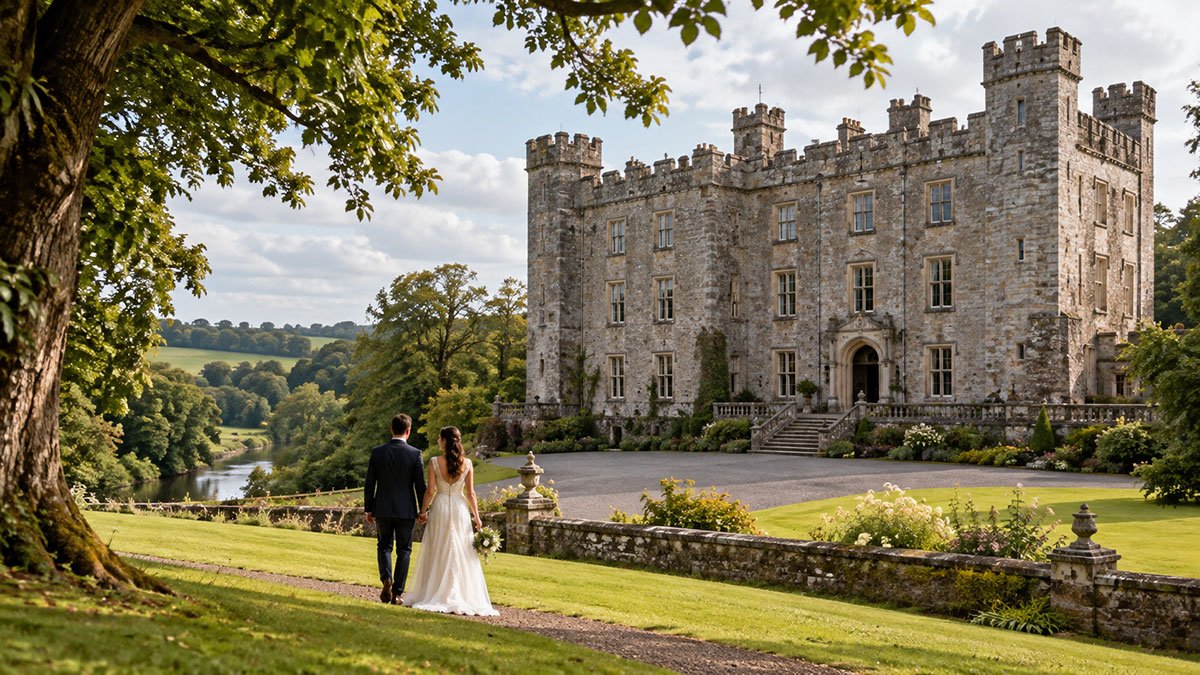
A romantic castle setting captures the charm of planning a destination wedding in Ireland.
Ireland Wedding Destination Guide: Castles, Heritage and Planning Tips
Ireland is an appealing wedding destination for couples who want historic architecture, green countryside and a celebration that becomes a memorable trip for family and friends. The island offers a variety of settings, including castle hotels, country estates, elegant manor houses, gardens and coastal venues.
County Meath, in the east of the Republic of Ireland, is particularly interesting for couples drawn to Irish history. Its historic landscapes include the Hill of Tara, Trim Castle and the prehistoric monuments of Brú na Bóinne. Slane Castle, meanwhile, is known for hosting weddings and events.
The key to planning a successful Irish wedding is choosing a venue that suits your celebration, understanding the legal requirements and preparing for Ireland’s changeable weather. With the right arrangements, couples can combine their wedding with a rewarding holiday filled with history, local culture and time together.
Why choose Ireland for a destination wedding?
Ireland offers more than an attractive backdrop for wedding photographs. Its historic buildings, rural landscapes and established hospitality venues make it possible to plan celebrations in several different styles.
Castle weddings and historic estates
Couples who dream of a castle wedding can explore venues that combine traditional architecture with contemporary event facilities. Depending on the property, these may include ceremony rooms, landscaped gardens, dining spaces and accommodation for guests.
Country houses and estate venues provide another option. They can offer a historic atmosphere without the formal feel of a traditional castle, making them suitable for both intimate gatherings and larger celebrations.
However, not every castle or historic landmark can be booked for a wedding. Some are private properties, while others are protected heritage attractions that operate primarily as visitor sites. Always confirm that the venue can accommodate your preferred ceremony and reception before making arrangements.
A wedding that becomes a holiday
A destination wedding gives guests a reason to spend more time exploring the country. Rather than limiting the trip to the ceremony and reception, couples can organise a welcome dinner, a heritage excursion or a relaxed gathering the following day.
Ireland’s historic towns and countryside are particularly suited to this approach. In County Meath, for example, guests can experience medieval fortifications, prehistoric monuments and traditional town centres as part of the wedding itinerary.
Different styles of celebration
An Irish wedding does not have to revolve around a medieval theme. Couples can choose a grand castle celebration, a garden ceremony, an intimate country-house gathering or a more contemporary event.
The best choice depends on the guest list, budget, preferred atmosphere and practical requirements. A visually impressive venue is only one consideration; accessibility, accommodation, catering arrangements and transport can have just as much influence on the overall experience.
Choosing the right wedding venue in Ireland
Before selecting a location, establish what you need from the venue. This will help you compare properties accurately and avoid committing to a place that cannot accommodate your plans.
Check the ceremony and reception arrangements
Ask whether the venue offers a legally recognised marriage ceremony, a religious ceremony, a symbolic celebration or reception facilities only. These arrangements are not interchangeable.
A property that hosts wedding receptions may not automatically be approved for a legally binding civil ceremony. Confirm the relevant requirements with the venue and, where necessary, the local civil registration service.
Consider accommodation and guest capacity
Ask how many guests can be accommodated for the ceremony and reception, and whether rooms are available at the property or nearby.
For guests travelling internationally, convenient accommodation can make a considerable difference. Consider the distance between the venue, hotels, airports and nearby towns before finalising the location.
Also ask whether guests can stay on site, whether accommodation must be booked separately and what arrangements apply to children or guests with accessibility requirements.
Make a weather contingency plan
Ireland’s weather can change throughout the year. Even when the forecast looks promising, an outdoor ceremony or reception needs a realistic alternative.
Before booking, establish whether the venue has an indoor ceremony space, a covered reception area or another suitable arrangement should rain or strong winds affect your plans.
This is especially important when outdoor gardens, estate grounds or scenic settings are central to your wedding.
Confirm what the venue package includes
Compare the details of each proposal rather than relying on the headline price. Ask about catering, drinks, furniture, decoration, photography access, accommodation, staffing, supplier restrictions and any additional charges.
Also clarify cancellation conditions, payment schedules, event timings and arrangements for music or entertainment.
A clear agreement helps you understand what is included and which services need to be arranged separately.
Castle wedding venues to consider in Ireland
A useful starting point is to compare a small number of venues with different settings and styles.
Slane Castle, County Meath
Slane Castle stands on an extensive estate in the Boyne Valley. Its historic architecture and grounds make it a natural option for couples considering a wedding in County Meath.
The castle is known for hosting weddings and events, alongside other visitor experiences. Couples should contact the venue directly to discuss available wedding arrangements, dates, ceremony options and event requirements.
Its location also makes it possible to explore several of Meath’s historic attractions during the surrounding trip.
Ashford Castle, County Mayo
Ashford Castle is another option for couples seeking a traditional castle setting. The property promotes dedicated wedding experiences, including intimate celebrations and larger occasions.
Its setting in County Mayo offers a different landscape from eastern Ireland, so it may suit couples who want to make the wedding part of a longer visit to the west of the country.
Compare the venue’s current wedding arrangements, guest accommodation and travel logistics with those of properties closer to Dublin.
Country houses and estate venues
A castle is not the only way to experience an Irish wedding. Historic manor houses and country estates may offer gardens, traditional interiors and private event spaces.
These properties can be particularly attractive for couples who want an elegant setting without necessarily choosing a fortress-style building.
Tourism Ireland’s official wedding guide is a useful starting point for exploring venue styles and wedding inspiration across the island.
County Meath: A historic setting for a wedding trip
Located in Ireland’s Ancient East, County Meath combines rich history, scenic countryside and easy access to Dublin, making it an appealing destination for weddings and cultural getaways.
County Meath is worth considering for couples who want to combine a wedding with visits to some of Ireland’s best-known historic places. Its ancient monuments and medieval architecture provide a meaningful itinerary for guests interested in Irish history.
The region is associated with Ireland’s Ancient East, a broad tourism area known for archaeological sites, historic settlements and cultural attractions.
Slane Castle
Slane Castle is the most direct starting point for a castle-wedding shortlist in Meath because it is known for hosting weddings and events.
Beyond the wedding itself, the wider estate offers a setting for exploring the Boyne Valley. Visitor experiences and event arrangements vary, so check what is available during your planned dates.
Do not assume that public tours, private events and wedding bookings operate under the same arrangements.
Hill of Tara
The Hill of Tara is one of Ireland’s most significant historic landscapes. It is closely associated with the high kings of Ireland and has a long history extending back to prehistoric times.
The site contains ancient earthworks and monuments, including the Lia Fáil, or Stone of Destiny. Although the original halls and palaces at Tara no longer stand, archaeologists and historians piece together the site’s history through archaeological evidence, historical accounts and tradition.
For wedding guests, the Hill of Tara offers a chance to experience the open Irish countryside while learning about the country’s past.
Practical advice: The hill is an outdoor site with uneven terrain, so wear suitable footwear and weatherproof clothing. Heritage Ireland lists the site as accessible throughout the year, but guided services can vary. Its current information states that guide presence has ceased for the 2026 season, so confirm the available visitor services before travelling.
Trim Castle
Trim Castle is one of the most striking medieval landmarks in County Meath. It is the largest Anglo-Norman fortification in Ireland and was developed over several decades by Hugh de Lacy and his successors.
The castle’s substantial keep, defensive walls and position beside the River Boyne create a strong impression of medieval military architecture. The town of Trim also has a number of historic buildings that reward a slower visit.
Treat Trim Castle as a heritage excursion rather than assuming it is a bookable wedding venue. Opening arrangements vary by season, and the keep’s steep, narrow stairs may prevent visitors with mobility impairments from accessing it.
Important travel consideration: Heritage Ireland currently lists Trim Castle as closed for works from 1 November 2026 to 1 April 2027. Anyone travelling during this period should check the official visitor information before including the castle in their itinerary, as access arrangements can change.
Brú na Bóinne: Newgrange and Knowth
For couples and guests interested in ancient history, Brú na Bóinne is one of the region’s most rewarding attractions.
The archaeological landscape includes the prehistoric passage-tomb sites of Newgrange, Knowth and Dowth. Newgrange and Knowth are particularly well known for their monumental structures and prehistoric artwork.
Visits to Newgrange and Knowth begin at the Brú na Bóinne Visitor Centre. Transport to the monuments is arranged as part of the official visit, and access is through guided tours. Travellers should not go directly to the monuments expecting to enter from there.
Book in advance. Ticket availability is limited, and pre-booking is essential for monument visits. Purchase tickets through the official Heritage Ireland booking system rather than relying on resellers.
The visitor experience includes outdoor walking, and some areas have restricted accessibility. Check the official guidance if anyone in your group has mobility requirements or would find narrow passageways uncomfortable.
Kells and its monastic heritage
With its early Christian roots and historic landmarks, Kells offers visitors a glimpse into County Meath’s rich religious and cultural heritage. Kells’ monastic heritage and historic round tower highlight the important role early Christian communities played in Ireland.
<p>However, Heritage Ireland currently lists the Kells Round Tower site as closed because of ongoing conservation works. Verify the status before planning a visit specifically to see the tower.
Including a mix of ancient monuments, medieval architecture and local towns can help guests experience the area beyond the wedding venue itself.
When is the best time to plan an Irish wedding?
The best time depends on the atmosphere you want, your budget, the venue’s availability and how much of the celebration will take place outdoors.
Spring and summer
Late spring and summer offer longer daylight hours, which can be useful for outdoor ceremonies, garden receptions and wedding photography.
Popular dates may be in demand, so check venue availability early and secure accommodation before inviting guests to make firm travel arrangements.
Ireland’s long-term rainfall records show that April and May are among the drier months on average. However, this is not a guarantee of dry weather on your wedding day.
Autumn and winter
Autumn can provide rich natural colours and a different atmosphere for photographs. Winter may appeal to couples who prefer historic interiors, intimate gatherings and a celebration centred on indoor spaces.
These seasons also require careful planning around shorter daylight hours, colder conditions and possible disruptions to outdoor activities. Build enough flexibility into travel and photography schedules.
Plan around the actual forecast
Whatever season you choose, check local weather forecasts as the date approaches. Met Éireann, Ireland’s national meteorological service, provides official weather information and climate records.
Rather than choosing a date solely on the assumption of good weather, select a venue with appropriate alternatives and ensure guests know what clothing and footwear will be practical.
Legal requirements for getting married in Ireland
Couples planning a legally binding wedding in the Republic of Ireland should investigate the formal requirements before confirming their arrangements.
The legal process is separate from selecting a venue, booking a reception or arranging travel.
Give the required notice
Under the Republic of Ireland’s standard marriage-notification process, couples must give at least three months’ notice to a civil registration service. The government states that this requirement applies to civil, religious and secular marriages.
Both partners must normally attend the marriage-notification appointment. Couples who live outside Ireland should contact the relevant registration service well in advance to confirm the procedure that applies to them, including arrangements for postal notification where available.
The government currently lists a non-refundable marriage-notification fee of €200. Confirm the applicable requirements and charges before making arrangements.
Prepare the necessary documents
The official requirements include identification and supporting civil documents. Depending on your circumstances, you may need documents such as:
- A valid passport or another accepted form of photo identification.
- Original birth certificates.
- Proof of address.
- Translations or other supporting documentation where required.
The registrar may request additional information depending on your nationality and personal circumstances. If either partner is a foreign national, an interview may be required.
Always obtain the current document checklist directly from the Irish civil registration service rather than relying exclusively on a venue, planner or third-party website.
Confirm the venue’s legal status
For a civil ceremony outside a registration office, the registrar must confirm that the venue meets the relevant legal requirements and approve it for the ceremony.
A castle that offers receptions or wedding packages is not automatically suitable for every type of legally binding ceremony. Confirm this point before signing a contract or paying a non-refundable deposit.
The ceremony must also be performed by an authorised solemniser. The government’s official marriage guidance explains the requirements for different ceremony types.
Understand the difference between the Republic of Ireland and Northern Ireland
The Republic of Ireland and Northern Ireland have separate legal and administrative arrangements.
The three-month marriage-notification guidance above relates to the Republic. If you choose a venue in Northern Ireland, consult the relevant Northern Ireland authorities for its marriage-notice and immigration requirements.
Travel documents are a separate consideration. Check passport and visa requirements for your nationality through the official Irish immigration service. If your trip also includes Northern Ireland or another part of the United Kingdom, check the entry requirements for that part of your itinerary separately.
Getting around Ireland and organising guest transport
Transport planning is particularly important when your wedding venue is in the countryside.
For a celebration in County Meath, Dublin is a practical arrival point to consider. Regional bus services connect Dublin with places such as Navan, although the final journey to a rural estate may require additional transport.
Use Transport for Ireland’s journey planner to check current public transport routes and timetables. Do not assume that a bus or train will take guests directly to a wedding venue.
Arrange transfers before the wedding
Depending on the venue’s location, useful options may include:
- A scheduled shuttle between the venue and nearby hotels.
- A minibus for groups arriving at the same airport or station.
- Pre-arranged taxis for guests staying in different towns.
- Car hire for guests planning a longer independent road trip.
If the reception finishes late, confirm how guests will return to their accommodation. Rural transport options can differ from those available in larger towns and cities.
Share confirmed travel instructions with guests before departure. Include the venue address, accommodation details, transfer times and a contact number for practical questions on the day.
Keep the itinerary manageable
Guests may want to explore Ireland beyond the wedding location, but an overloaded schedule can make a destination wedding unnecessarily tiring.
For a wedding in Meath, consider a simple plan:
Arrival day: Allow time for checking in, recovering from travel and meeting other guests over an informal meal.
Wedding day: Keep transport and preparation schedules realistic, with enough time for photographs and unexpected delays.
Following day: Arrange one main excursion, such as an appropriately booked visit to Brú na Bóinne or another attraction confirmed to be open. Leave time for a relaxed meal or independent exploration.
The most effective itinerary balances shared activities with time for guests to enjoy the destination at their own pace.
Frequently asked questions
Is Ireland a good destination for a castle wedding?
Ireland offers castle venues, historic estates and country houses across the island. Slane Castle in County Meath and Ashford Castle in County Mayo are two starting points for couples interested in castle settings. Confirm each property’s current wedding arrangements and legal ceremony options directly with the venue.
How far in advance should you plan an Ireland wedding?
Begin by checking venue availability and the arrangements for your preferred ceremony. Popular dates can be in demand, so booking early is sensible, especially when guests also need international flights and accommodation.
For a legally binding marriage in the Republic of Ireland, remember that the government requires at least three months’ notice under the standard process. Venue bookings do not replace this requirement.
Can you get married at any historic castle in Ireland?
No. Some historic buildings operate as wedding venues, while others are private properties or protected heritage attractions. Check whether the property hosts weddings and whether it can accommodate your preferred ceremony before making any commitments.
Can wedding guests visit Newgrange during a trip to Meath?
Yes, subject to ticket availability and the site’s current arrangements. Start your visit to Newgrange and Knowth at the Brú na Bóinne Visitor Centre, then join a guided tour to the monuments. Pre-booking is essential for these visits.
Do visitors need a visa to attend a wedding in Ireland?
Visa requirements depend on nationality and individual circumstances. Guests should consult the official Irish immigration service and check any additional entry requirements if their itinerary includes Northern Ireland or another country.
Making an Irish wedding a memorable trip
Ireland offers couples a combination of historic settings, distinctive landscapes and opportunities for guests to explore beyond the ceremony. County Meath is especially appealing for those who want a wedding near ancient monuments and medieval architecture, while other parts of Ireland provide different castle, estate and countryside experiences.
Start with a venue that suits the celebration and its practical requirements. Then confirm the marriage formalities, organise accommodation and transport, and build a realistic itinerary around attractions that will be accessible during your visit.
With those details in place, an Ireland wedding can become more than a single day’s celebration: it can be an opportunity for family and friends to experience the country’s heritage and landscapes together.
