
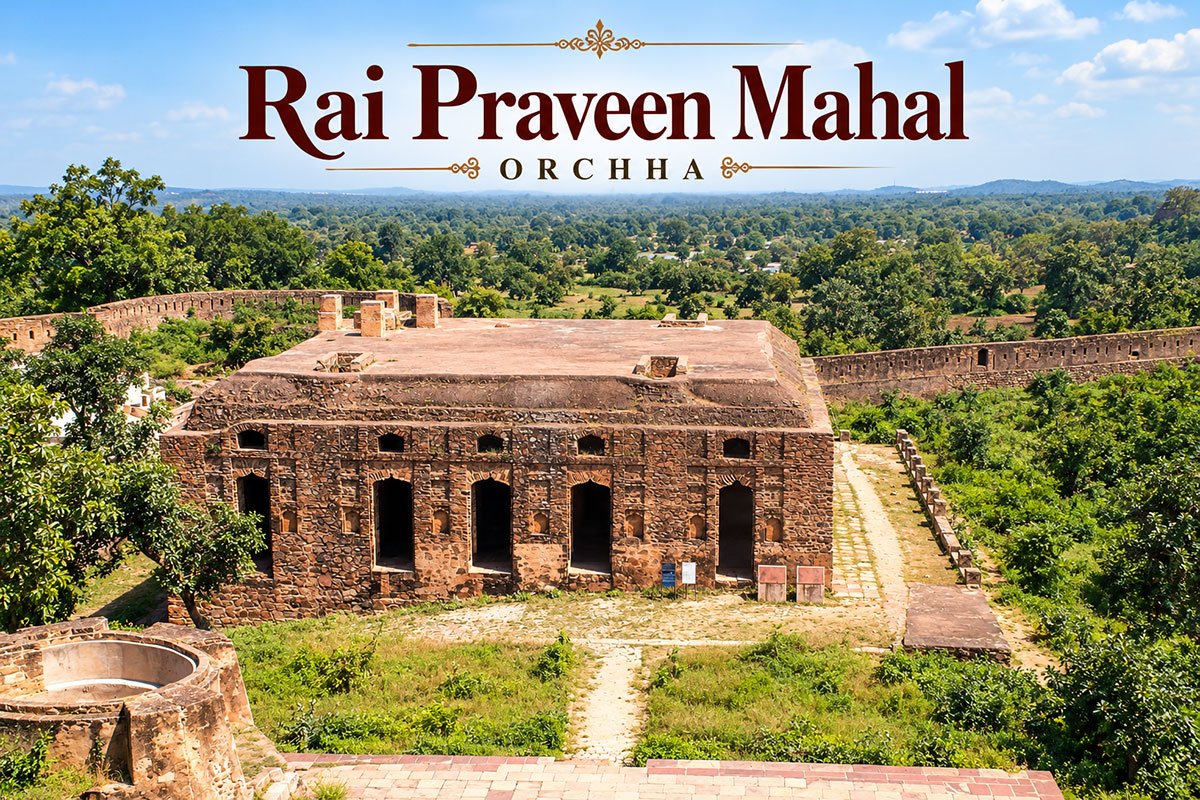
Rai Praveen Mahal in Orchha: History, Architecture and the Story of Rai Praveen
Rai Praveen Mahal is one of the most intriguing historic monuments in Orchha, Madhya Pradesh. Set in the historic palace landscape of this former Bundela capital, the elegant brick structure reflects the legacy of Rai Praveen, a celebrated poet, singer, dancer, and court performer.
Unlike the imposing Jahangir Mahal and Raja Mahal, Rai Praveen Mahal is relatively modest in scale. Its graceful proportions, garden setting and association with one of Orchha’s most famous literary figures give it a distinctive character.
Today, the palace forms part of the wider historic ensemble that makes Orchha an important heritage destination in Bundelkhand. The Historic Ensemble of Orchha has been on India’s UNESCO World Heritage Tentative List since 2019.
The History of Rai Praveen Mahal
Rai Praveen Mahal belongs to Orchha’s Bundela-era architectural landscape. Madhya Pradesh Tourism identifies it as a two-storey brick building associated with Raja Indramani and Rai Praveen. The palace is located near Orchha’s principal palace complex and is surrounded by the gardens traditionally associated with Anand Mahal.
The exact chronology of the building is less straightforward than older travel accounts suggest. Some architectural scholarship places the pavilion in the period associated with Indramani’s rule from 1672 to 1675, while other sources discuss earlier construction or later development. For this reason, it is preferable to describe the palace as a 17th-century Bundela monument associated with Rai Praveen and Indramani, rather than attach an unsupported modern-era construction date.
The original claim that it was constructed in the “mid-60s” is therefore misleading and has been removed.
Who Was Rai Praveen?
Rai Praveen remains an important figure in Orchha’s cultural history, celebrated for her accomplishments in music, dance and poetry. She was also associated with the renowned Hindi poet Keshav Das, whose literary works contributed to the rich cultural and literary tradition of the Bundela court in Orchha.
Madhya Pradesh Tourism describes Rai Praveen as a skilled dancer, singer, musician and poetess. Her reputation became an important part of Orchha’s cultural heritage and contributed to the romantic stories surrounding the palace.
Her story is not simply about beauty. Rai Praveen’s reputation as a talented artist and poet helped establish her place in the cultural memory of Orchha.
The Legend of Rai Praveen and the Mughal Court
One of the most famous stories connected with Rai Praveen Mahal concerns her relationship with Raja Indramani and the Mughal court.
According to traditional accounts, Rai Praveen’s beauty, talent and reputation reached the Mughal court. She was eventually taken to the imperial court, where her artistic abilities and devotion to Indramani became central to the story.
Different versions of the legend attribute the Mughal emperor involved to different rulers. However, the chronology of Indramani’s rule places his period during the reign of Aurangzeb, rather than Akbar. Contemporary travel and heritage accounts therefore commonly associate the story with Aurangzeb.
The most enduring part of the legend is Rai Praveen’s loyalty to Indramani. According to the traditional narrative, her poetic response impressed the emperor, who allowed her to return to Orchha.
Because surviving accounts blend historical records with oral tradition, historians best regard the story as a celebrated Orchha legend rather than a fully documented historical episode.
Architecture of Rai Praveen Mahal
The architecture of Rai Praveen Mahal reflects the distinctive character of Orchha’s historic buildings.
The palace is a relatively low, two-storey brick structure designed within a landscaped setting. It contains a principal hall, smaller chambers and terraces overlooking the surrounding gardens. Madhya Pradesh Tourism describes the building as being filled with light and air, with its design incorporating terraces and smaller rooms.
Its relatively restrained scale contrasts with the monumental Jahangir Mahal nearby.
The building also demonstrates the broader architectural character of Orchha, where Bundela traditions interacted with influences from Rajput and Mughal architecture. UNESCO describes the historic ensemble as an important example of architectural and garden design that developed through the interaction of these traditions.
The Gardens Around the Palace
The setting of Rai Praveen Mahal is an important part of its appeal.
The palace overlooks the historic garden landscape associated with Anand Mahal. Traditional descriptions mention formal landscaping, octagonal flower beds and an elaborate water system.
Orchha’s gardens form part of a wider tradition of combining architecture, water management and landscape design. UNESCO notes that the town’s historic gardens incorporated influences from Mughal garden traditions, Rajput fort gardens and sacred groves, creating a distinctive landscape system.
This relationship between buildings and gardens helps explain why Rai Praveen Mahal feels different from a conventional fortified palace.
Rai Praveen Mahal and the Heritage of Orchha
Orchha was founded in the 16th century by Bundela ruler Rudra Pratap Singh and later grew into an important centre of Bundela political power and cultural heritage. Its monuments include palaces, temples, gardens, cenotaphs and other historic structures.
The town’s historic ensemble is significant because it demonstrates the development of a distinctive Bundeli architectural tradition.
Visitors exploring Rai Praveen Mahal can also see other important Orchha landmarks, including:
- Jahangir Mahal
- Raja Mahal
- Ram Raja Temple
- Chaturbhuj Temple
- Laxmi Narayan Temple
- Phool Bagh
- Orchha’s riverside cenotaphs
- The Betwa River landscape
Madhya Pradesh Tourism continues to feature Rai Praveen Mahal among the major places to visit in Orchha.
Is Orchha a UNESCO World Heritage Site?
This point is important for travellers.
Orchha is not currently a UNESCO World Heritage Site. The Historic Ensemble of Orchha is included on UNESCO’s Tentative List, following India’s submission in 2019. A Tentative List is an inventory of properties that a country intends to consider for future World Heritage nomination.
The status should therefore not be described as UNESCO World Heritage status.
Why Visit Rai Praveen Mahal?
Rai Praveen Mahal offers something different from Orchha’s larger monuments.
Its appeal comes from the combination of:
- Bundela-era architecture
- Brick palace construction
- Historic gardens
- Literary and musical heritage
- The story of Rai Praveen
- Connections with Orchha’s royal history
- The wider palace complex and Betwa River landscape
For travellers interested in history, architecture, literature and cultural traditions, the palace provides a quieter perspective on Orchha’s royal past.
Final Thoughts
Rai Praveen Mahal is one of the most evocative monuments in Orchha. Its relatively modest architecture complements a remarkable cultural story involving Rai Praveen, Raja Indramani and the Mughal court.
The palace also demonstrates why Orchha is more than a collection of individual monuments. Its palaces, gardens, temples, riverfront and historic townscape form a connected cultural landscape that reflects centuries of Bundela history. UNESCO recognises this broader historic ensemble as having potential Outstanding Universal Value and keeps it on India’s Tentative List.
For anyone exploring Madhya Pradesh’s heritage, Rai Praveen Mahal in Orchha offers a fascinating combination of architecture, poetry, music, gardens and royal legend.
