
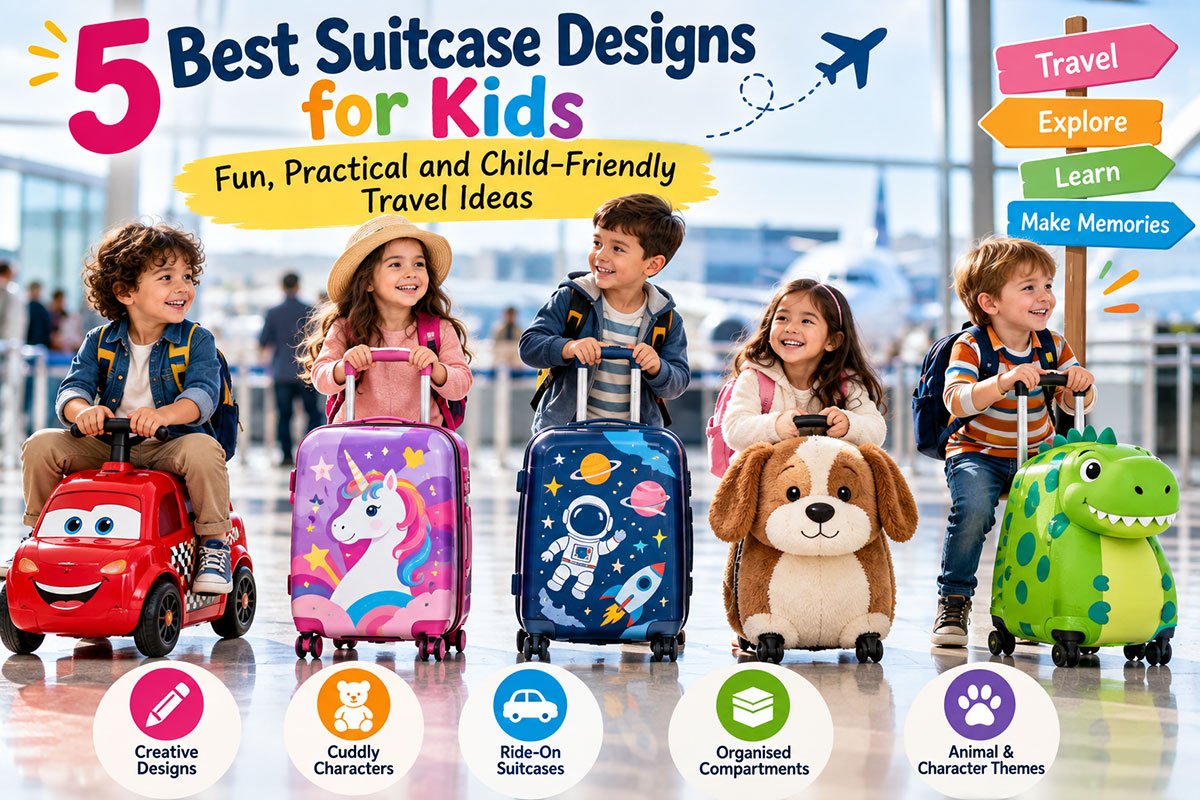
5 Best Suitcase Designs for Kids: A Parent’s Guide
Travelling with children can be exciting, but packing and managing luggage can also be challenging. Giving your child their own suitcase can make the journey more enjoyable while teaching them to take responsibility for their belongings.
The best suitcase designs for kids combine fun looks with practical features. Children can choose a design they love, while parents can focus on durability, weight, storage and safety.
From animal-themed cases to creative activity suitcases, there are many options available today. However, parents should look beyond appearance before buying. Size, weight, wheel quality, handle design and airline baggage rules can all affect how useful a children’s suitcase will be.
What to Look For in a Kids’ Suitcase
Before choosing one, consider your child’s age, size and travel habits.
A good children’s suitcase should ideally have:
- A lightweight construction
- Strong and smooth-rolling wheels
- A comfortable telescopic handle
- Secure zips or closures
- Sufficient internal storage
- Easy-to-clean materials
- A suitable size for your child’s needs
- Clear age or weight recommendations where applicable
If you plan to use the suitcase as cabin baggage, check the airline’s current requirements before buying. IATA notes that carry-on allowances vary by airline, cabin class and aircraft type. Dimensions can also include wheels and handles.
With that in mind, here are five fun suitcase designs for kids.
1. Creative Activity Suitcase
Long journeys can become boring for children. A suitcase that doubles as a creative activity surface can help keep them occupied.
Some designs feature wipe-clean surfaces that allow children to draw or play while waiting at an airport or during a journey. This can be particularly useful when there is limited space and you do not want to carry a separate activity kit.
Look for a case with a durable exterior and a surface that is genuinely easy to clean. Avoid designs that require permanent markers or other materials that could create a mess.
You can also pack a small activity kit inside the case, including:
- Colouring books
- Pencils or washable crayons
- Stickers
- Small books
- Travel games
- Headphones
This type of suitcase can make children more interested in carrying their own luggage.
2. Plush or Cuddly Character Suitcase
For younger children, a suitcase featuring a soft toy or familiar character can be a great choice.
A cuddly suitcase combines luggage with something that feels familiar to the child. This can make travelling less intimidating, particularly during a first flight or long family holiday.
Some designs have a soft character attached to the front, while others combine a small suitcase with a plush companion.
When choosing this style, pay attention to practicality. A soft exterior may be harder to clean than a hard-shell case. Check the stitching, wheels, handles and zips before buying.
It is also worth choosing a design that your child genuinely likes. A suitcase featuring a favourite animal or character can encourage them to take responsibility for it.
3. Ride-On Suitcase
Ride-on suitcases have become a popular option for families looking for luggage that can also provide entertainment.
These cases allow children to sit on or ride the suitcase in situations where the product is designed for that purpose. They can be especially useful during long airport waits.
However, parents should treat a ride-on suitcase as a child-oriented mobility product, not simply as ordinary luggage.
Check the manufacturer’s recommended age, weight limit and instructions before use. The product should be stable and appropriate for the child’s physical abilities. CPSC guidance for ride-on products emphasises stability, age suitability and appropriate safety considerations.
Parents should also supervise children closely. Busy airport terminals, escalators, ramps and crowded boarding areas are not suitable places for unrestricted riding.
Most importantly, check the airline’s baggage policy before travelling. A ride-on design may have dimensions or features that affect whether it can be taken into the cabin.
4. Organised Compartment Suitcase
A suitcase with multiple compartments can make packing much easier for children.
Instead of placing everything into one large compartment, children can separate clothing, toiletries, toys and accessories. This helps them understand how to organise their belongings.
For older children, a suitcase with internal pockets and compression straps can also encourage better packing habits.
Look for features such as:
- Separate zipped compartments
- Internal packing straps
- Mesh pockets
- Easy-access front compartments
- Durable lining
- Secure zippers
A well-organised suitcase can save parents time when unpacking at the destination.
It can also help children learn an important travel skill: keeping track of their own belongings.
5. Animal or Character-Themed Suitcase
Children often respond strongly to colourful designs and familiar characters. An animal-themed suitcase can therefore turn an ordinary piece of luggage into something they are excited to own.
Popular designs can include:
- Dogs and cats
- Dinosaurs
- Butterflies
- Bears
- Sharks
- Space themes
- Cartoon characters
- Fantasy animals
A distinctive design can also make the suitcase easier to identify at an airport.
However, avoid choosing a case based solely on appearance. A colourful suitcase is only useful if it is comfortable for your child to carry or pull.
Check the handle height and wheel movement before buying. Your child should be able to manoeuvre the case without excessive effort.
Choose the Right Size and Weight
One of the most important considerations when buying suitcases for kids is weight.
A suitcase that is too heavy when empty can become difficult for a child to pull once it has been packed.
For air travel, check the airline’s current baggage allowance before your trip. The UK Civil Aviation Authority advises passengers to check their airline’s baggage allowance because limits can vary by airline and destination. Children’s allowances can also differ from adult allowances.
If the suitcase is intended as cabin baggage, check the maximum dimensions and weight. IATA also notes that carry-on baggage must be suitable for storage under the seat or in an overhead compartment.
Remember that wheels, handles and external pockets may count towards the permitted dimensions.
Safety Matters When Choosing Children’s Luggage
A fun suitcase should never compromise safety.
Parents should inspect the suitcase before every major trip. Check that wheels turn properly, the handle locks securely and there are no loose or broken components.
For ride-on models, follow the manufacturer’s age, height and weight recommendations. Supervise children whenever they use the riding function.
If you choose a smart suitcase with electronic features, pay particular attention to battery requirements. IATA states that smart bags containing lithium batteries may have restrictions, particularly when the battery cannot be removed.
The UK Civil Aviation Authority also advises passengers to follow airline rules concerning batteries and other potentially restricted items.
Make Packing Fun for Children
Giving your child their own suitcase is an opportunity to make packing part of the holiday experience.
Instead of packing everything yourself, give your child a simple checklist.
For example:
- Choose several outfits.
- Select comfortable shoes.
- Pack favourite toys.
- Add books or activities.
- Pack essential toiletries.
- Check the suitcase together.
- Keep important items with the adults.
You can also allow children to decorate their suitcase with removable stickers or luggage tags.
This can make them feel involved while helping them learn basic travel organisation.
Which Kids’ Suitcase Design Is Best?
The best suitcase depends on your child’s age, personality and travel needs.
A creative activity suitcase can be useful for children who enjoy drawing and games. A plush suitcase may suit younger travellers who like familiar characters. A ride-on suitcase can provide additional entertainment, provided it is age-appropriate and used safely.
An organised compartment suitcase is ideal for older children learning to pack independently. Meanwhile, an animal or character-themed suitcase can make ordinary luggage more exciting.
There is no single best suitcase for every child.
The most important thing is to find a case that your child can manage comfortably while meeting the practical requirements of your journey.
Final Thoughts
Choosing one of the best suitcase designs for kids can make family travel more enjoyable. A colourful or creative case can encourage children to take responsibility for their belongings, while practical features can make packing and travelling easier for parents.
Today’s children’s luggage offers far more choice than the basic cases available when family travel guides were first written years ago. However, appearance should not be the only consideration.
Always check the suitcase’s size, weight, construction, age suitability and safety features. If you are flying, confirm the latest baggage rules directly with your airline before travelling.
With the right suitcase, children can become more involved in the journey from the moment they start packing until they arrive at their destination.
