

Wheelchair Travel: Accessible Adventures Around the World
Wheelchair travel has changed considerably since this article was first published in 2013. More destinations, transport networks, airlines and tourism businesses now provide accessibility information and assistance. At the same time, travellers with mobility needs can still encounter challenges that require careful planning.
An accessible holiday is about more than finding a hotel with an accessible room. Travellers may need to consider airport assistance, wheelchair storage, accessible transportation, step-free attractions, suitable bathrooms, road surfaces and the distance between different parts of a destination.
The good news is that accessibility is increasingly recognised as an important part of tourism. UN Tourism describes universally accessible tourism as an important part of responsible and sustainable tourism, covering areas such as transport, information, facilities and the wider tourism environment.
For wheelchair users who want to explore the world, preparation can make the journey considerably easier.
Wheelchair Travel Is Becoming More Accessible
The original article focused on individuals who travelled despite facing mobility challenges. Their experiences remain interesting, but accessibility has moved forward since 2013.
Today, travellers can find more detailed accessibility information before booking flights, accommodation and attractions. Some transport operators also provide dedicated journey-planning tools that allow passengers to identify step-free routes.
However, accessibility is not identical everywhere. A destination described as “accessible” may still contain individual attractions, streets or transport connections that present difficulties.
That is why wheelchair travellers should look beyond a general accessibility label and check the specific facilities they will need.
Planning a Wheelchair-Friendly Trip
Good preparation is one of the most important parts of wheelchair travel.
Before booking a trip, consider:
- Whether the accommodation has step-free access
- Door widths and bathroom accessibility
- Lift dimensions and weight limits
- Accessible parking or transport
- The availability of wheelchair-accessible taxis
- Step-free access at tourist attractions
- Accessible toilets
- The condition of pavements and roads
- The distance between accommodation and attractions
- How the airline or transport operator handles mobility equipment
It is also worth contacting hotels and transport providers directly if an accessibility detail is particularly important.
Do not rely only on a generic statement such as “accessible hotel”. Ask specific questions about entrances, bathrooms, beds, lifts and other facilities.
Photos or videos can also be useful when written descriptions are unclear.

Flying With a Wheelchair
Air travel can seem complicated, but passengers with disabilities or reduced mobility have specific protections in many jurisdictions.
In the UK, passengers with disabilities or reduced mobility are legally entitled to assistance free of charge when flying from a UK airport, regardless of the airline. Similar protections apply when flying to a UK airport on a UK or EU airline.
Airport assistance can include help from designated airport points through check-in, security and the departure gate, as well as assistance with boarding and navigating the airport.
The UK Civil Aviation Authority recommends telling the airline or travel agent about assistance requirements when booking or at least 48 hours before departure.
Travellers should also tell the airline if they are bringing an electric wheelchair or mobility scooter. Battery type and other equipment specifications can affect how the mobility aid is transported. The CAA recommends providing details such as the make, model, dimensions, weight and battery information in advance.
A useful pre-flight checklist
Before flying, confirm:
- How to request airport assistance.
- Where the assistance meeting point is located.
- Whether you can use your own wheelchair to the departure gate.
- How your wheelchair will be stored.
- Whether an onboard wheelchair is available.
- What type of aircraft boarding equipment will be used.
- Whether the aircraft has an accessible toilet.
- What documentation is required for an electric wheelchair or mobility aid.
The exact arrangements vary between airlines and airports, so checking directly with the operator is essential.
Accessible Transport at Your Destination
Arriving at an accessible airport does not automatically mean the rest of the journey will be accessible.
Airport transfers, trains, buses, taxis and local attractions can have different accessibility standards.
For example, London’s public transport network has introduced a range of accessibility improvements. TfL provides step-free journey planning through its TfL Go app and Journey Planner, allowing users to select options such as full step-free access, step-free access to platforms and reduced walking.
TfL also provides information about lifts, accessible toilets, boarding ramps and station accessibility through its journey-planning tools.
In September 2026, TfL announced that Surrey Quays and Northolt had gained additional step-free facilities. It also reported that more than a third of London Underground stations were then step-free, while all Elizabeth line stations, DLR stations and tram stops offered step-free access.
This demonstrates why checking current transport information before travelling matters. Accessibility infrastructure can change significantly over time.
Wheelchair Travel in Europe
European travellers also benefit from passenger-rights legislation covering different forms of transport.
The European Union states that passengers with disabilities or reduced mobility have rights to assistance when travelling by air, rail, bus, coach and boat in applicable circumstances. Information about accessibility should also be provided to travellers.
For air travel within the relevant European framework, passengers should generally request assistance at least 48 hours before departure to help ensure that suitable support is available.
Rail travel also has accessibility protections. EU rules provide for assistance to passengers with reduced mobility, although the procedures and advance-notice requirements can vary depending on the journey and country.
Therefore, wheelchair travellers should check the rules applying to their specific route rather than assuming that every European country operates in exactly the same way.

Choosing Accessible Accommodation
Accommodation can make or break a wheelchair-accessible holiday.
A hotel may advertise itself as accessible while offering facilities that do not meet an individual traveller’s requirements. Accessibility needs can also differ from one wheelchair user to another.
Before booking, consider asking about:
- Step-free access from the entrance
- Accessible parking
- Lift access
- Door widths
- Bedroom layout
- Bed height
- Bathroom layout
- Roll-in or level-access showers
- Grab rails
- Accessible toilets
- Pool or leisure-facility access
- Emergency procedures
If possible, communicate your specific requirements rather than simply asking whether the hotel is “wheelchair accessible”.
This gives the accommodation provider a clearer understanding of what you need.
Accessible Attractions Require Research
Tourist attractions can present another challenge.
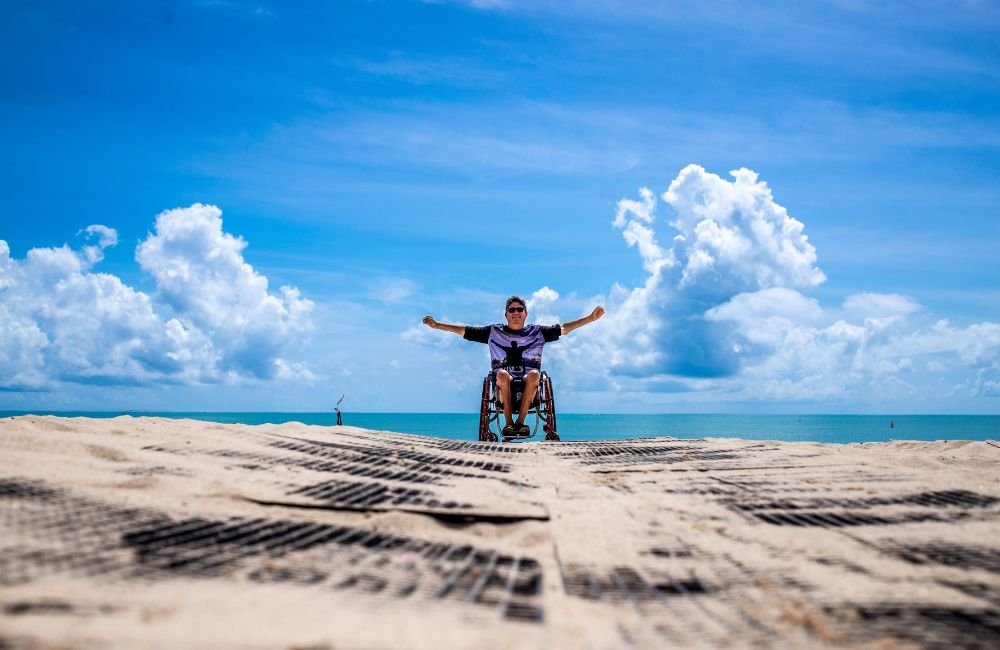
A historic building might have an accessible entrance but limited access to certain rooms. A museum may provide lifts but have narrow routes in some galleries. A beach destination may offer an accessible path but no suitable transport from the hotel.
Before visiting an attraction, check:
- Entrance arrangements
- Step-free routes
- Accessible toilets
- Lift availability
- Wheelchair restrictions
- Seating areas
- Accessible parking
- Booking requirements
- Assistance available from staff
Some attractions also provide downloadable accessibility guides, which can be more useful than a simple accessibility symbol.
UN Tourism’s work on accessible tourism highlights the importance of accessibility across the entire tourism chain, including transport, accommodation, attractions, information and communication.
Inspiring Wheelchair Travellers From the Original Story
The original 2013 article featured several wheelchair travellers whose experiences reflected the possibilities of accessible adventure.
Trevor Herdman and Lanzarote
Trevor Herdman’s trip to Lanzarote illustrated some of the practical difficulties wheelchair users could encounter when travelling abroad. His experience involved dealing with flights, local transport and accommodation.
The original article also connected his experience with Abletogo, a website intended to help disabled travellers find suitable accommodation.
Because these details date from the early 2010s and the original website information is no longer independently verifiable as current, they are best viewed as part of the history of accessible travel rather than as current accommodation advice.
Andy Campbell’s Global Adventure
Andy Campbell was featured in the original article for his ambitious attempt to travel around the world using a combination of transport and adaptive equipment.
Contemporary accounts described his planned 30,000-mile expedition using equipment including a hand cycle, kayak, wheelchair and paramotor. The project was supported through the Royal Geographical Society’s partnership with Land Rover’s Go Beyond Bursary.
His story remains an example of how adaptive equipment can expand the possibilities for adventure travel.
Noel and Doreen Webster
Noel and Doreen Webster also appeared in the original article.
Contemporary coverage described how Noel, who became a wheelchair user after suffering a stroke, continued travelling with his wife. Doreen later documented their experiences in Round the World in a Wheelchair.
Their story is particularly relevant because accessible travel is not limited to a particular age group.
Harvey Thulborn-McCorkell
Harvey Thulborn was another traveller featured in the original article because of his involvement in adaptive surfing and skating activities.
Later reporting provides a more nuanced picture of his experience. In Australia, Harvey Thulborn-McCorkell encountered significant problems with inaccessible and unreliable regional rail services. ABC News reported that transport limitations affected his education and ability to travel independently.
At the same time, historical material from the Australian National Surfing Museum documents his family’s accessible-adventure experiences in California and Costa Rica.
His story highlights an important point: accessible travel is not simply about individual determination. Infrastructure and transport systems also play a major role.
The Importance of Accessible Information
One of the biggest changes since the original article was published is the amount of accessibility information available online.
Travellers can now investigate transport networks, airports and attractions before leaving home.
For example, TfL provides accessibility maps, step-free journey planning and live information about disruptions.
Air passengers can also find detailed information about assistance, mobility equipment and accessibility rights through the UK Civil Aviation Authority.
This does not eliminate every problem, but it allows travellers to make more informed decisions before booking.
Accessibility Is About More Than Wheelchairs
Accessible tourism is broader than wheelchair access.
Travellers can have physical, sensory, cognitive or other accessibility requirements. A genuinely inclusive destination therefore needs to consider accessible information, communication, transport, accommodation and attractions.
UN Tourism currently describes accessible tourism as part of its wider commitment to universally accessible tourism. Its guidance also recognises features such as step-free access, accessible toilets, information in accessible formats and staff awareness.
This broader approach helps make travel more comfortable for people with different requirements.
Tips for a Smoother Wheelchair Travel Experience
A few simple steps can make an accessible trip easier to manage.
Research before booking
Check every major part of the journey rather than assuming the destination is accessible.
Contact providers directly
If you have specific requirements, ask the hotel, airline or transport provider detailed questions.
Request assistance early
Airlines and transport operators often require advance notice to arrange appropriate assistance.
Have a backup plan
Lift failures, inaccessible vehicles, construction and temporary closures can affect even well-planned journeys.
Keep important information accessible
Save booking confirmations, assistance details and contact numbers on your phone and keep a backup copy where practical.
Check accessibility shortly before travelling
Transport infrastructure and attraction facilities can change. Current information is more reliable than an old travel guide.
The Future of Accessible Travel
The idea of accessible tourism has developed significantly since this article first appeared in 2013.
Accessibility is increasingly treated as part of destination planning rather than as an optional extra. UN Tourism has promoted universal accessibility across the tourism value chain, while transport authorities and airlines continue to develop assistance and accessible journey-planning services.
There is still work to do. A destination may have accessible hotels and attractions but still lack reliable connections between them. Likewise, accessible infrastructure can exist but remain difficult to use if information is incomplete or outdated.
The most useful approach is therefore to combine good accessibility infrastructure with accurate information and careful personal planning.
Wheelchair Travel Can Open the World
The stories behind wheelchair travel are not simply stories about overcoming obstacles. They also demonstrate why accessible tourism matters.
Travellers should be able to explore new destinations, experience different cultures and enjoy adventures without accessibility becoming an unnecessary barrier.
From international flights and accessible rail networks to adapted sporting activities and step-free attractions, opportunities continue to expand. At the same time, careful research remains essential because accessibility varies between destinations and individual travellers have different needs.
The experiences featured in the original 2013 article remain part of the history of accessible travel. Today, the conversation has moved further toward inclusive tourism, reliable accessibility information and equal opportunities to travel.
For anyone planning a wheelchair-accessible adventure, the best starting point is simple: research the complete journey, ask specific questions, arrange assistance early and check the latest information before departure.
That preparation can turn a complicated journey into an achievable adventure.
