
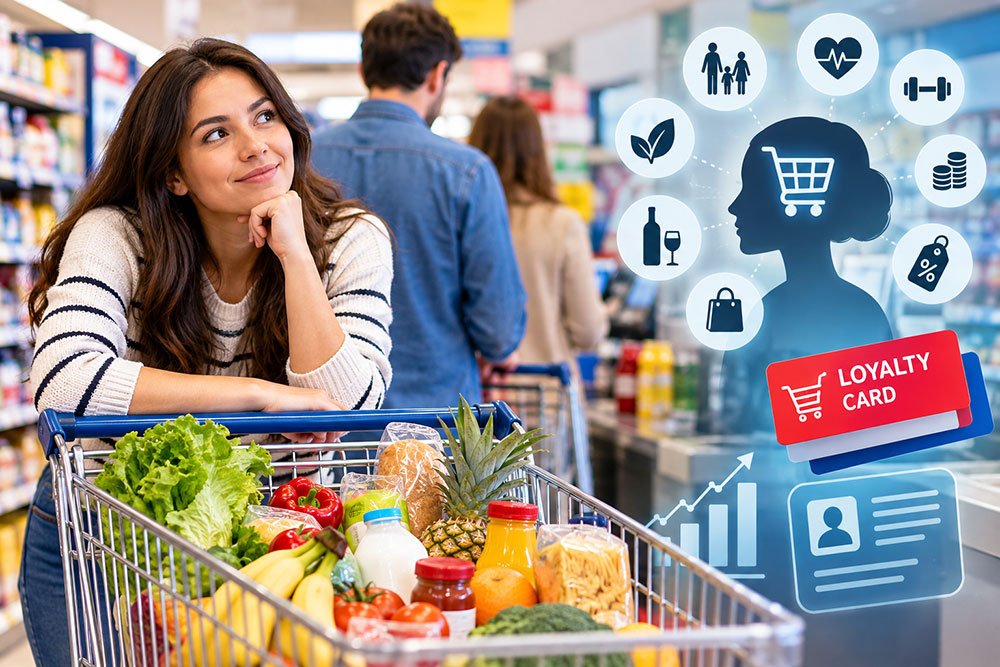
What Your Shopping Trolley Says About You
Have you ever glanced at another shopper’s trolley while waiting in a supermarket checkout queue?
Most of us have. A trolley filled with particular foods, household products or drinks can quickly make us wonder about the person buying them. We may try to guess their lifestyle, family situation, budget or preferences based on a handful of purchases.
But while we might make these assumptions casually, supermarkets can use much more detailed information to understand shopping behaviour.
From traditional loyalty cards to personalised discounts and digital shopping accounts, today’s retailers can analyse purchasing patterns in ways that were difficult to imagine when loyalty programmes first became popular.
We Often Judge People by Their Shopping Choices
Imagine seeing a shopper buying several loaves of bread, large bottles of milk and a selection of children’s snacks. You might assume they have a large family.
Another shopper may have sausages, frozen food and chocolate biscuits in their trolley. You could imagine that they live alone or prefer convenient meals.
Of course, these assumptions may be completely wrong.
A person buying several bottles of wine could be preparing for a party. Someone purchasing frozen meals may simply be short of time. A trolley containing premium organic products may reflect a particular preference rather than a person’s overall lifestyle.
Our brains naturally try to create stories from limited information. However, a shopping trolley only provides a small snapshot of someone’s life.
Your Shopping Trolley Can Reveal Your Shopping Habits
Although individual purchases do not tell the whole story, repeated shopping patterns can reveal useful information.
For example, regular purchases may indicate preferences such as:
- Interest in fresh or prepared food
- Preference for premium or budget products
- Frequent use of special offers
- Interest in organic or health-focused products
- Preference for particular brands
- Regular purchases of household products
- Convenience-focused shopping
- Seasonal purchasing habits
The important difference is that a single trolley provides very limited information, while repeated transactions can create a much more detailed picture.
This is where supermarket loyalty programmes become particularly important.
How Supermarket Loyalty Cards Changed Shopping
Loyalty cards were originally designed to encourage customers to keep shopping with the same retailer. In return for using a loyalty card or account, customers could receive points, discounts, vouchers or other benefits.
At the same time, retailers gained information about purchasing behaviour.
A loyalty programme can connect purchases with an individual customer account. This means a supermarket can potentially analyse information such as what products are purchased, how frequently they are bought and which promotions attract a response.
The UK’s Information Commissioner’s Office explains that loyalty schemes can provide retailers with information about where customers shop, how much they spend and what they buy.
This creates value for both sides of the relationship: customers can receive rewards or relevant offers, while retailers can better understand demand.
From Shopping Baskets to Customer Profiles
Modern retail analytics goes considerably further than simply counting how many units of a product were sold.
Retailers can analyse purchasing histories and other customer information to identify patterns and create customer segments. This process is commonly known as customer profiling.
For example, a retailer might identify customers who frequently respond to discounts, regularly purchase particular product categories or shop at specific times.
The ICO describes profiling as analysing information to classify people into groups or sectors, including through algorithms and machine learning. When profiling is used for direct marketing, organisations have responsibilities concerning transparency, fairness and lawful processing.
This means the modern version of the supermarket trolley is not simply the physical basket you carry around the store. Your longer-term shopping history can also form part of a digital customer profile.
Why Do Supermarkets Personalise Offers?
One of the most visible results of customer data analysis is personalised marketing.
Instead of giving every customer exactly the same promotion, a supermarket can use previous shopping behaviour to determine which products or offers may be more relevant to an individual.
For example, someone who regularly buys a particular brand may receive an offer connected to that product. Another shopper may receive a promotion for products from a category they frequently purchase.
Tesco currently explains that its Clubcard Prices can be personalised using shopping habits and that customers can see personalised discounts through its digital services.
So, if a supermarket offer seems remarkably relevant to your usual shopping, there may be a straightforward explanation: your previous purchases have helped the retailer understand what you are likely to buy.
Loyalty Pricing Has Become More Important
Supermarket loyalty schemes have also evolved beyond traditional points and vouchers.
Some retailers now offer lower prices to customers who belong to their loyalty programmes. This is commonly called loyalty pricing, member pricing or dual pricing.
The UK Competition and Markets Authority investigated loyalty pricing in the grocery sector and published its findings in November 2024. The review examined around 50,000 grocery products and found very little evidence that supermarkets were artificially increasing usual prices to make loyalty discounts appear larger than they really were.
The CMA also noted that loyalty prices were not necessarily the cheapest prices available across all supermarkets, meaning that comparing prices can still be useful.
This illustrates how supermarket loyalty schemes have changed from simple reward programmes into an important part of modern grocery pricing.
What Happens to Your Shopping Data?
When you join a loyalty scheme, you are generally providing information that can be connected with your account and purchasing activity.
Depending on the retailer and the particular programme, this can include information about purchases, preferences and interactions with the loyalty service.
Retailers need to explain how personal information is collected and used. The ICO says organisations using profiling for marketing should be transparent about the activity and have an appropriate lawful basis for processing personal data.
Consumers also have important data protection rights. For example, the ICO states that individuals can object to the processing of their personal data for direct marketing, including profiling connected with direct marketing.
Are Personalised Offers a Good Thing?
Personalised shopping offers can be useful because they may make discounts more relevant to individual customers.
For example, a shopper who regularly buys certain household products may find a targeted promotion more useful than a discount on something they never purchase.
However, personalisation also raises questions about privacy and how much information consumers are comfortable sharing.
The CMA’s research found that 61% of surveyed shoppers were comfortable with supermarkets using information collected through loyalty schemes to send personalised offers. At the same time, comfort was lower when considering data being shared with other companies.
The balance between convenience, discounts and privacy is therefore an important part of the modern loyalty-card relationship.
Your Shopping Trolley Does Not Tell the Whole Story
It is worth remembering that shopping data, just like a physical trolley, only provides part of the picture.
Buying inexpensive food does not necessarily mean someone has a low income. Purchasing premium products does not necessarily mean someone is wealthy. Buying convenience food does not prove that someone is unhealthy or lazy.
Likewise, buying products for children, elderly relatives, guests or a special occasion can make a person’s shopping basket look very different from their everyday lifestyle.
The same caution applies to digital customer profiles. Data analysis can identify patterns, but patterns should not automatically be treated as complete descriptions of individuals.
Think Before You Share Your Loyalty Data
Loyalty programmes can provide genuine benefits, but it is worth understanding what you are signing up for.
Before joining a supermarket loyalty scheme, consider:
- What information does the retailer collect?
- How is your purchase history used?
- Are offers personalised?
- What marketing communications will you receive?
- Can you change your marketing preferences?
- What privacy rights do you have?
- How does the retailer protect your account?
The ICO recommends that organisations provide clear information about profiling and explain how customer information will be used.
It is also sensible to be cautious with third-party loyalty-card apps. Tesco warns that unofficial loyalty-card applications may collect information such as account details and shopping habits, and recommends checking their terms and privacy practices carefully.
The Shopping Trolley Has Become Digital
The next time you look at someone’s trolley in a supermarket queue, remember that you are doing something surprisingly similar to what retailers have been doing with shopping data for years: looking for patterns.
The difference is that a person in a checkout queue sees only a few products.
A supermarket’s customer database can contain a much longer history of purchases and interactions. Modern analytics can use that information to identify preferences, personalise promotions and understand shopping behaviour at a much more detailed level.
So, what your shopping trolley says about you may be interesting, but your complete shopping history can tell a much more detailed story.
The modern supermarket trolley is no longer just a basket for carrying groceries. It can also be part of a much larger picture of consumer behaviour, personalised marketing and retail data analytics.
